
Education dominates at legislative town hall
CAROLINE LOBSINGER | Hagadone News Network | UPDATED 4 hours, 52 minutes AGO
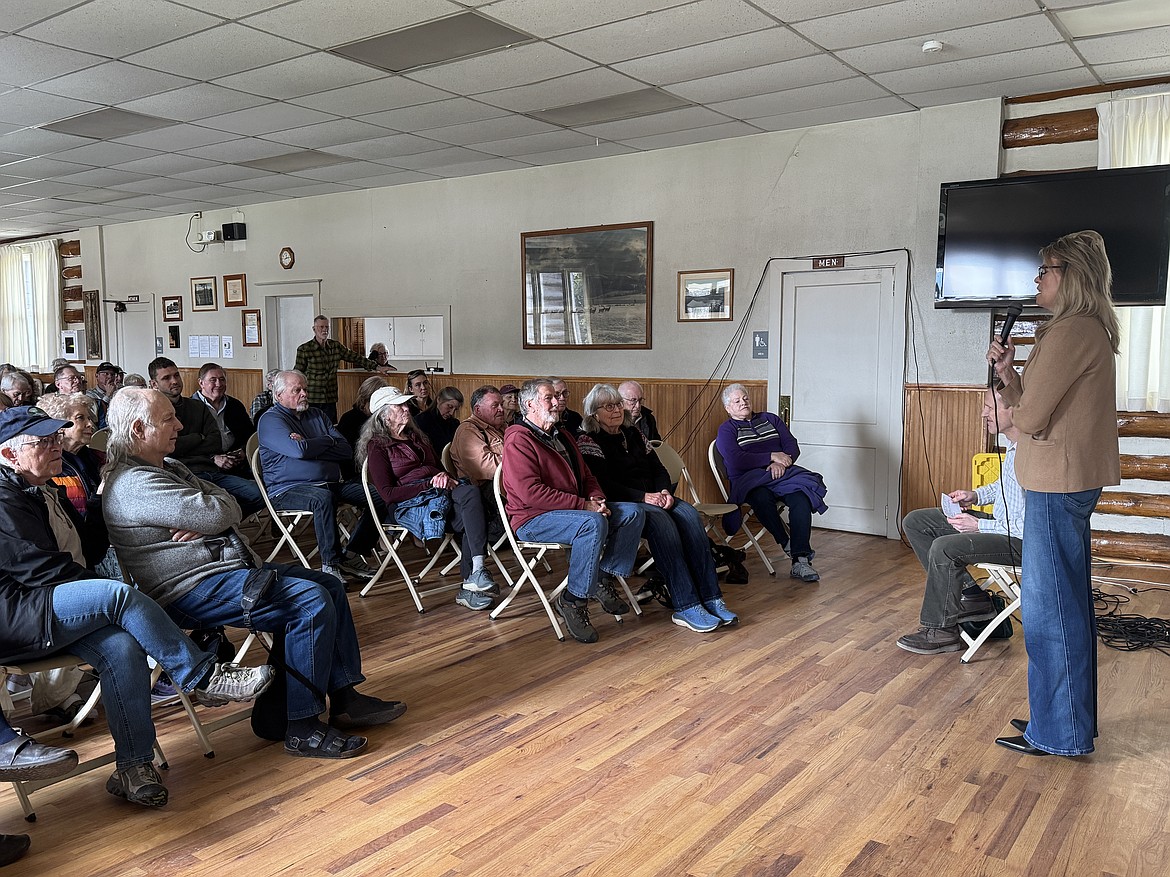
Debbie Critchfield, Idaho Superintendent of Public Instruction, answers a question during Saturday's legislative town hall with District 1 Sen. Jim Woodward, R-Sagle. Education dominated at the event, which attracted more than 130 people.
Photo by CAROLINE LOBSINGER
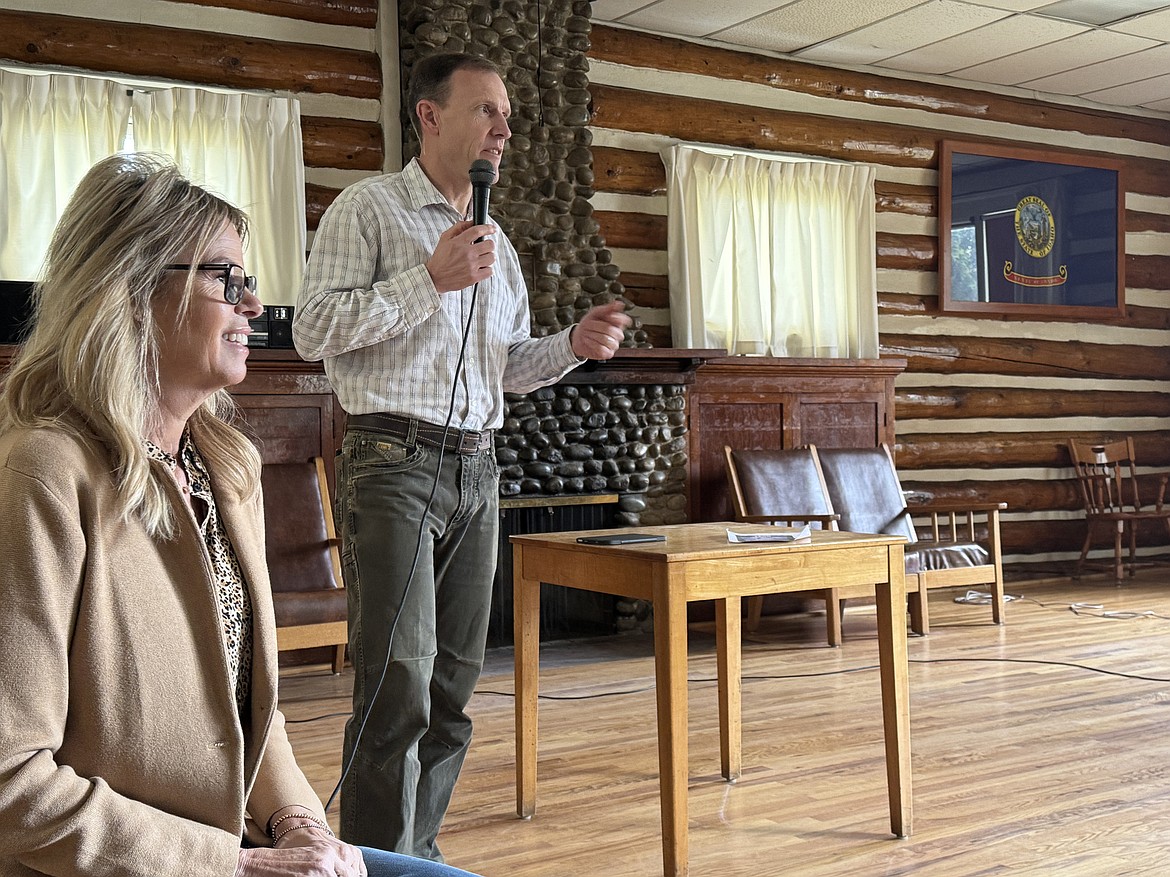
Debbie Critchfield, Idaho Superintendent of Public Instruction, listens as Idaho Sen. Jim Woodward, R-Sagle, quizzes the crowd to find out who knew the state's seven constitutional posts.
I grew up in the Tri-Cities, Wash., and have always loved to write. I attended the University of Washington, where I earned a double major in journalism and political science, with an area of emphasis in history. I am the fifth out of six kids — don't believe any of the stories that my siblings tell. To be able to tell others stories and take photos for a living is a dream come true — and I considered myself blessed to be a community journalist. When I am not working, I enjoy spending time with family and friends, hiking and spending time outdoors, genealogy, reading, and watching the UW Huskies and the Seattle Seahawks. I am a servant to my cat, Frankie, who yes, will eat anything and everything in sight … even wedding cookies. | March 29, 2026 1:00 AM
SANDPOINT — Much of the discussion surrounding Saturday's legislative town hall in Sandpoint centered around education.
Which, given the presence of special guest Debbie Critchfield, Idaho superintendent of public instruction, was no surprise as more than 130 people attended the monthly legislative event held by District 1 legislators.
Critchfield, who is running for reelection, talked about everything from the role of phonics to the funding of Idaho's schools. Since a return to phonics, the superintendent of public instruction said a stronger emphasis on phonics and cursive is already paying off.
The latest tests show an average increase in reading proficiency of 11%, with the state's kindergartners increasing by 13%. The numbers are the highest they've been since 2007, Critchfield said.
"My focus really can be kind of rolled up into saying we're getting back to basics," she told the crowd of more than 130 people.
There is also an emphasis on career-technical programs, from diesel mechanics to culinary arts. In the last three years, Critchfield said, the state has expanded or created more than 170 CTE programs around the state.
"We want our kids to know things, but we also want them to do things with what they know, and that's going to look different for our students," she added. "So we have more pathways to those goals of individual students than we've ever had."
With budgetary concerns top of mind, Critchfield said her top role was to advocate for the state's public schools and their budget.
"This was a particularly challenging year, and when we look at what the budget was going to be like, my goal was to put as much of a barbed-wire electrical fence around the public schools budget as we could, recognizing that everyone was going to take some cuts," she said.
While the outcome won't be known until the session ends, Critchfield said the department's budget should mirror last year's.
"That's a win for us this year," she added. "I know it doesn't sound like a win, but when you look at every other place that's been cut, for us to be able to say at least we can maintain, that's a win."
Changes to the U.S. Department of Education have not impacted the state, Critchfield said in response to a question, noting she supported the move and said it hasn't impacted Idaho. Instead, she said it has streamlined the bureaucracy and the process, allowing a better focus on schools and education.
Others asked if, in the midst of budget cuts throughout state government, any cuts had been made to the $50 million earmarked for private and homeschool programs.
"The answer is no," Idaho Sen. Jim Woodward, R-Sagle, said. "There was an effort, but we still have the same legislative makeup that we had a year ago when that was first put into law."
Critchfield said efforts were made this year to streamline virtual and online education to ensure the money is going to the students.
"Is it responsible for us to be sending money out the door for our virtual schools to hire a bus driver and buy a bus? No, particularly when our brick-and-mortar schools are having to do more with less," Critchfield said.
Others questioned the superintendent on the use of artificial intelligence in the classrooms and what safeguards were in place regarding the data collected.
"How is the state going to accurately do due diligence on privacy issues and the effect that speaking to an AI has on children who are doing testing?" one man asked, adding that some protection is needed for the overall use of such technology.
Critchfield said she understood the man's concerns but said that while the state was establishing guideposts, Idaho Department of Education staff didn't want to hamstring the ability of local districts to adapt.
"Without question, our teachers and our parents are looking for some leadership in this area," Critchfield said. "We're among the first five in the country to have legislation that will require our department to set forth what those guideposts look like, and I think that's very critical."
Others sought state help on funding for the district's alternative high school, expressing concern over Lake Pend Oreille High School's move from a separate campus to the former driver's education building and portable classrooms adjacent to the Sandpoint High School campus.
"We need to keep that school open," one woman said.
Noting the town hall was not the place for the discussion, Lake Pend Oreille School District board vice chair Dave DeMers said the program has the district's support, but limited state funding has caused the program to run at a loss.
"The state has never funded public education and special ed the way they should, even though the Idaho Supreme Court said 20 years ago that you need to do that," DeMers said. "The other side doesn't want to do that for some reason, and we're in a situation right now where we are in the hole on operating LPOHS, which cost the district $350,000. We can't do that again, so there were some hard decisions that have to be made."
One resident said attendance was a "stupid" way to fund schools and hurts both districts and students who fall outside the norm, whether they attend an alternative high school or are academically gifted and need programs beyond their communities' ability to fund them.
While education dominated the 90-minute town hall, a number of other issues were discussed, including the successful amendment of House Bill 561, which limits what flags can be flown by cities and counties in the state.
Woodward said the exemption would allow Bonners Ferry to fly the Canadian flag to celebrate the community's unique relationship with Canada, including cross-border commerce, highways and waterways, and collaboration regarding the Libby Dam.
The city, which has flown the Canadian flag in addition to the Idaho and U.S. flags to celebrate its "neighbor" for decades, was caught in a political struggle over ideology about a flag being flown in Boise, Woodward said.
However, an amendment on the House floor allowed an exemption to be carved out, which will allow the city to keep flying the flag.
Also discussed was a failed bill that would have brought regulation of private, for-profit sewer utilities under Idaho Public Utilities Commission oversight. While receiving support in committee and in the Idaho Senate, Woodward said, the bill garnered a negative rating from the Idaho Freedom Foundation, which led to its defeat on the House floor.
A bill that "got hung up on politics" was one that would have boosted Idaho State Police trooper pay to help the law enforcement agency compete with nearby states. While the bill to add $5 to vehicle registration fees likely isn't going anywhere, Woodward said he remains hopeful that something will happen.
A bill to return consequences to driver infractions has failed to make headway. Championed by Rep. Mark Sauter, R-Sandpoint, the bill would have reinstated loss of driving privileges if fines aren't paid. When the loss was pulled seven to eight years ago, Idaho had $1 million in unpaid fines; that number has ballooned to $23 million in outstanding fines.
"I think it's good public policy that if you're speeding and you get a ticket, you actually have to pay that ticket," Woodward said.
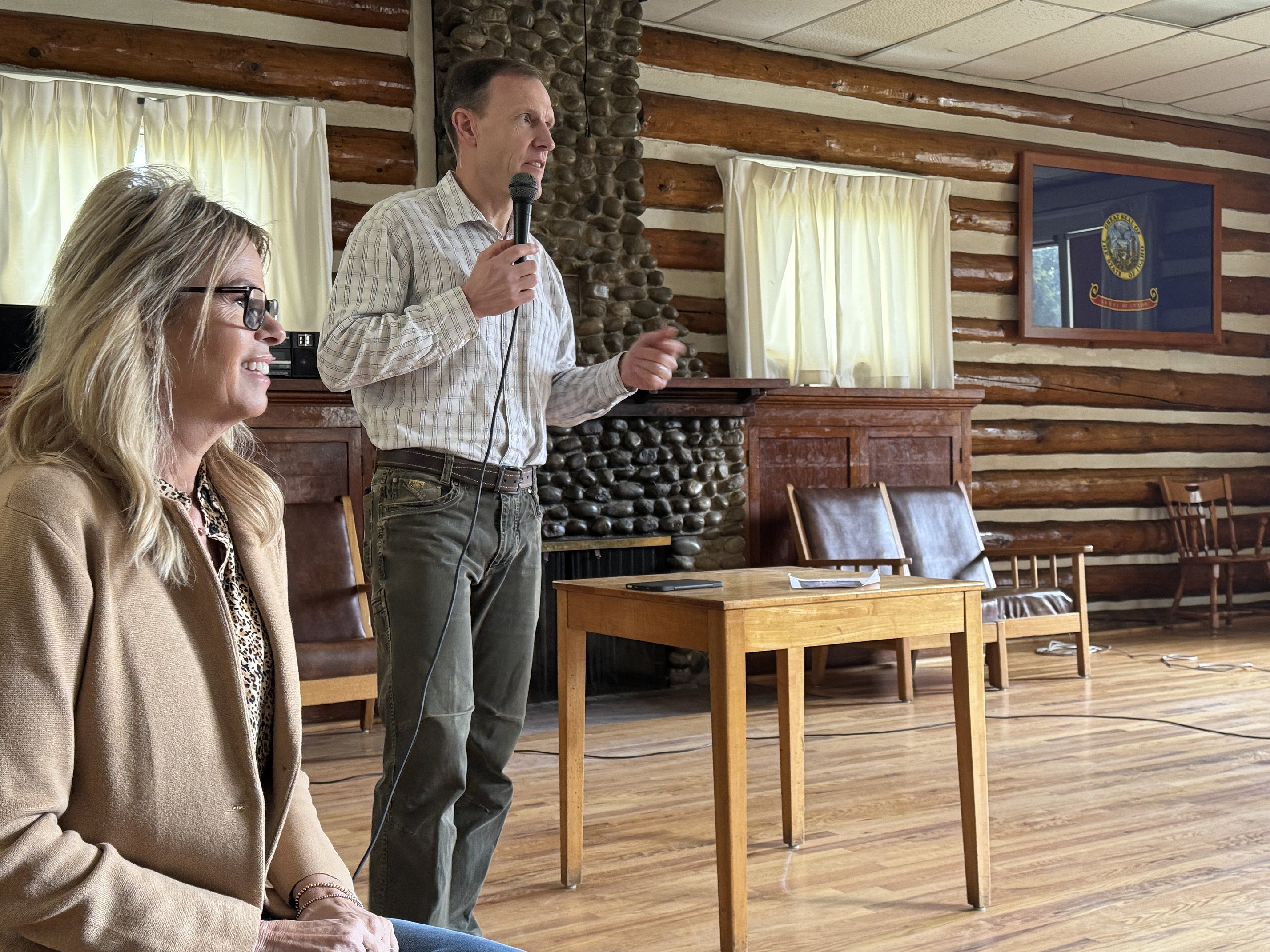 Debbie Critchfield, Idaho Superintendent of Public Instruction, listens as Idaho Sen. Jim Woodward, R-Sagle, quizzes the crowd to find out who knew the state's seven constitutional posts.
ARTICLES BY CAROLINE LOBSINGER

Education dominates at legislative town hall
Education led the discussion at Sandpoint’s legislative town hall as leaders reviewed reading gains, expanding CTE programs, school budget concerns, virtual learning oversight, and AI guidance.
Westside Fire seeking override levy
