
Winging it through winter: Rare Anna's hummingbird finds shelter in Bigfork backyard
HAILEY SMALLEY | Hagadone News Network | UPDATED 6 months, 3 weeks AGO
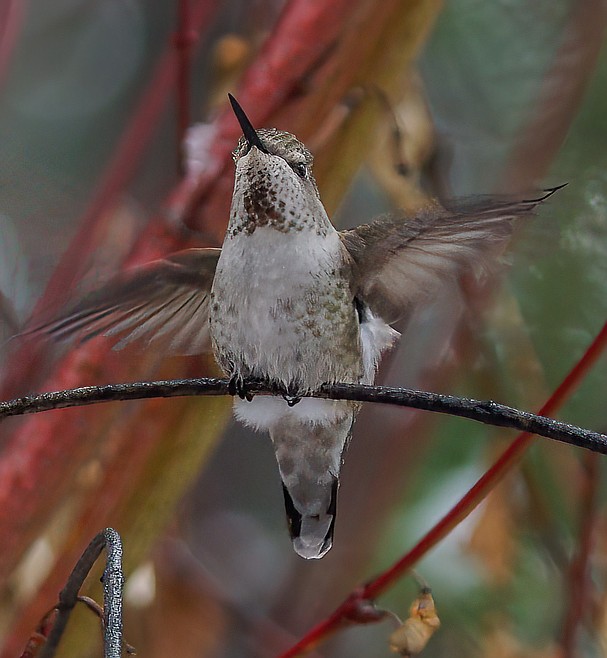
Female Anna's hummingbirds are green, with a small pinkish red marking called a gorget on their throat. (Courtesy of Michell De Leon Tyler)

Michell De Leon Tyler poses near a hummingbird feeder and heat lamp she set up on her back patio. (Hailey Smalley/Daily Inter Lake)
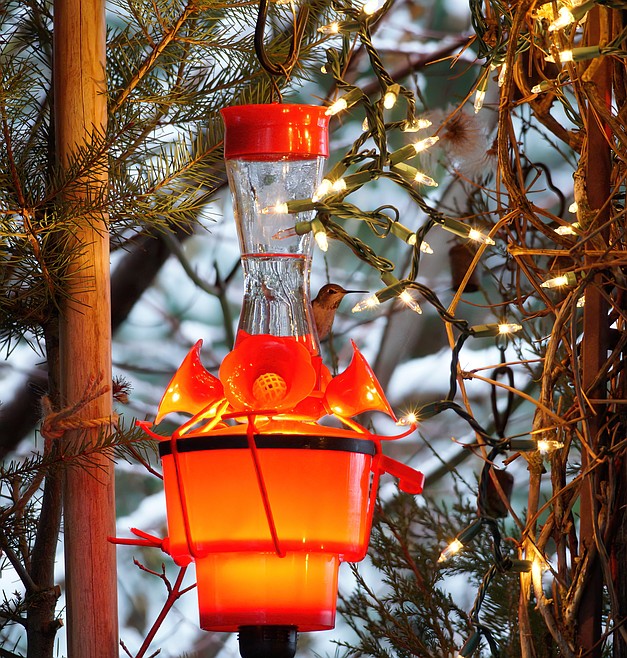
Anna perches on a heating feeder in Michell De Leon Tyler's backyard. (Courtesy of Michell De Leon Tyler)
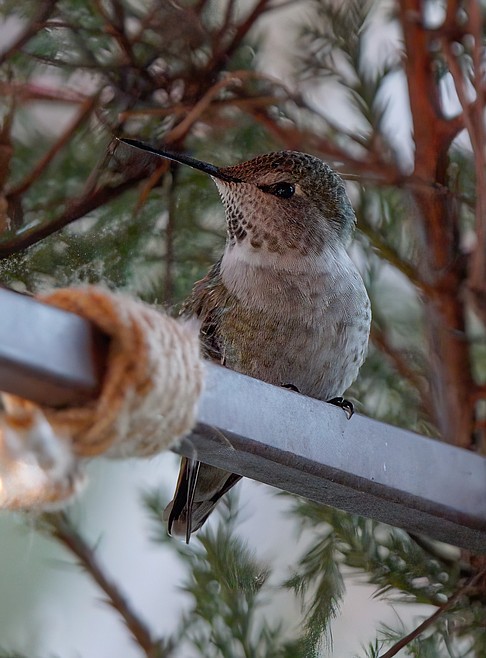
Anna perches in Michell De Leon Tyler's backyard. (Courtesy of Michell De Leon Tyler)
She appeared as a flash of green in the corner of the garden.
Michell De Leon Tyler registered the rapid burr of wings and the flash of sunlight off iridescent feathers, but the hummingbird was gone before she could turn to examine it closer.
Probably a Calliope hummingbird, she shrugged. During the summer, she often found the dusky green birds squabbling for a perch on the hummingbird feeders hung along the back patio. It was now September, and frost was already starting to crust over the flowerbeds, but De Leon Tyler figured the hummingbird was just a late migrator. She would probably be gone by morning, bound for warmer overwintering grounds in Mexico.
De Leon Tyler was wrong on all counts.
The bird turned out to be an Anna’s hummingbird — a rare find in western Montana. The Montana Natural Heritage Program’s bird distribution database has logged only 158 sightings of Anna’s hummingbirds in the state, including 21 sightings in Flathead County.
Rarer still is the Anna’s hummingbird that chooses to overwinter in Montana, but that is exactly what De Leon Tyler's backyard visitor did. Anna, as De Leon Tyler came to call the hummingbird, remained in the garden for six months, braving rain and snow and freezing temperatures.
“She was tough,” said De Leon Tyler. “She was a tough little bird, really just resilient.”
Unlike other North American hummingbirds, Anna’s hummingbirds don’t migrate south for the winter. The species evolved in the chaparral of southern California and northern Baja California, where mild winter temperatures ensure a year-round supply of nectar.
Increasing use of hummingbird feeders and perennial garden plants over the past century has spurred an expansion of the hummingbird’s historic range into Oregon, Washington and southeastern Alaska, but De Leon Tyler worried about Anna’s ability to withstand the cold that would soon clamp down on Northwest Montana.
“This little hummingbird definitely needed someone to help her along during the winter,” she said.
De Leon Tyler knew the most important factor to Anna’s survival would be a consistent source of nectar. While insects and spiders make up the bulk of hummingbirds’ diets, frequent sips of nectar — or a sugar water alternative — provide the quickfire energy necessary to fuel one of the fastest metabolisms in the animal kingdom.
At rest, a hummingbird’s heart beats 420 and 460 times per minute. When flying or stressed, their heart rate can exceed 1,200 beats per minute. A human would have to consume a bare minimum of 155,000 calories a day to keep up with a hummingbird’s baseline body functions. Due to their petite size, a hummingbird can make do with three to seven calories of nectar each day, which they lap up in 10- to 15-minute increments.
Each morning, De Leon Tyler filled two hummingbird feeders with a sugar water mixture. One had a built-in heater to keep the sugar water from freezing. De Leon Tyler brought the other feeder in each night and rehung it in the morning. Some days, she sprinkled crushed dried mealworms into the feeders to make up for the lack of insects during the winter months.
Through research, De Leon Tyler learned that Anna was already remarkably adept at managing cold winter temperatures. Hummingbirds go into a hibernation-like state called torpor to conserve energy at night. Their heart rate drops to about 50 beats per minute and their body temperature plummets from about 107 degrees Fahrenheit to as low as 40 degrees Fahrenheit. Their breathing slows, sometimes suspending for minutes at a time.
De Leon Tyler dragged an old patio umbrella out of storage so Anna would have shelter from impending snowfall, even when she wasn’t in torpor. She positioned a heat lamp so it bathed Anna’s favorite daytime perch in artificial sunshine and filled out the now-derelict flowerbeds with juniper branches so Anna would have cover from would-be predators.
Anna supervised every addition. The hummingbird had developed a habit of following De Leon Tyler around the garden and peering into the house windows, as though she was keeping an eye on her benefactor. When De Leon Tyler refilled the feeders in the morning, Anna greeted her with a series of chirrups.
“I think she knew all these things I was doing for her and helping her,” said De Leon Tyler. “We had an amazing relationship, but I wanted to keep her wild.”
When storms crashed through the area, De Leon Tyler wrung her hands and worried about the winds battering the little bird, but she never brought Anna inside. She never extended her finger as a perch, the way princesses in animated movies do, and she never considered that Anna would stay past the winter.
Anna’s hummingbirds breed in early spring, and De Leon Tyler suspected that Anna would need to travel farther inland to find a mate. The longer the hummingbird lingered, the more adventurous she became. By mid-February, Anna was visiting De Leon Tyler’s front yard. A week later, De Leon Tyler saw her flitting along the perimeter of the property.
“I just kept thinking, yeah, you’re thinking about it. You’re thinking about going,” said De Leon Tyler.
On March 1, De Leon Tyler hung the hummingbird feeders as normal. She called Anna’s name and made the same kiss sounds she used to beckon her dogs.
For the first time in six months, the hummingbird did not appear. There were no twittering chirps. No beat of wings against De Leon Tyler’s eardrums.
“Off she goes,” said De Leon Tyler with a wry smile. “She didn’t even leave me a thank-you note.”
De Leon Tyler scoured the woods behind her home, but she found no signs of a struggle. She is certain Anna is weaving a nest somewhere on the Pacific Coast to prepare for her impending clutch.
“It’s kind of bittersweet,” said De Leon Tyler. “It’s sad, but I’m also grateful she was able to make it and move on and be what she was meant to be.”
Researchers with Boise State University's Intermountain Bird Observatory have documented at least six instances in which Anna’s hummingbirds return to the same overwintering sites in Idaho after spending the summer elsewhere. The same research team also reported the first Anna’s hummingbird nest in Idaho in 2020, suggesting that the birds’ breeding range is expanding toward western Montana.
But De Leon Tyler said only Anna knows what her future plans are. She keeps the hummingbird feeder filled, just in case.
Reporter Hailey Smalley can be reached at 406-758-4433 or [email protected]. If you value local journalism, pledge your support at dailyinterlake.com/support.
 Michell De Leon Tyler poses near a hummingbird feeder and heat lamp she set up on her back patio. (Hailey Smalley/Daily Inter Lake)
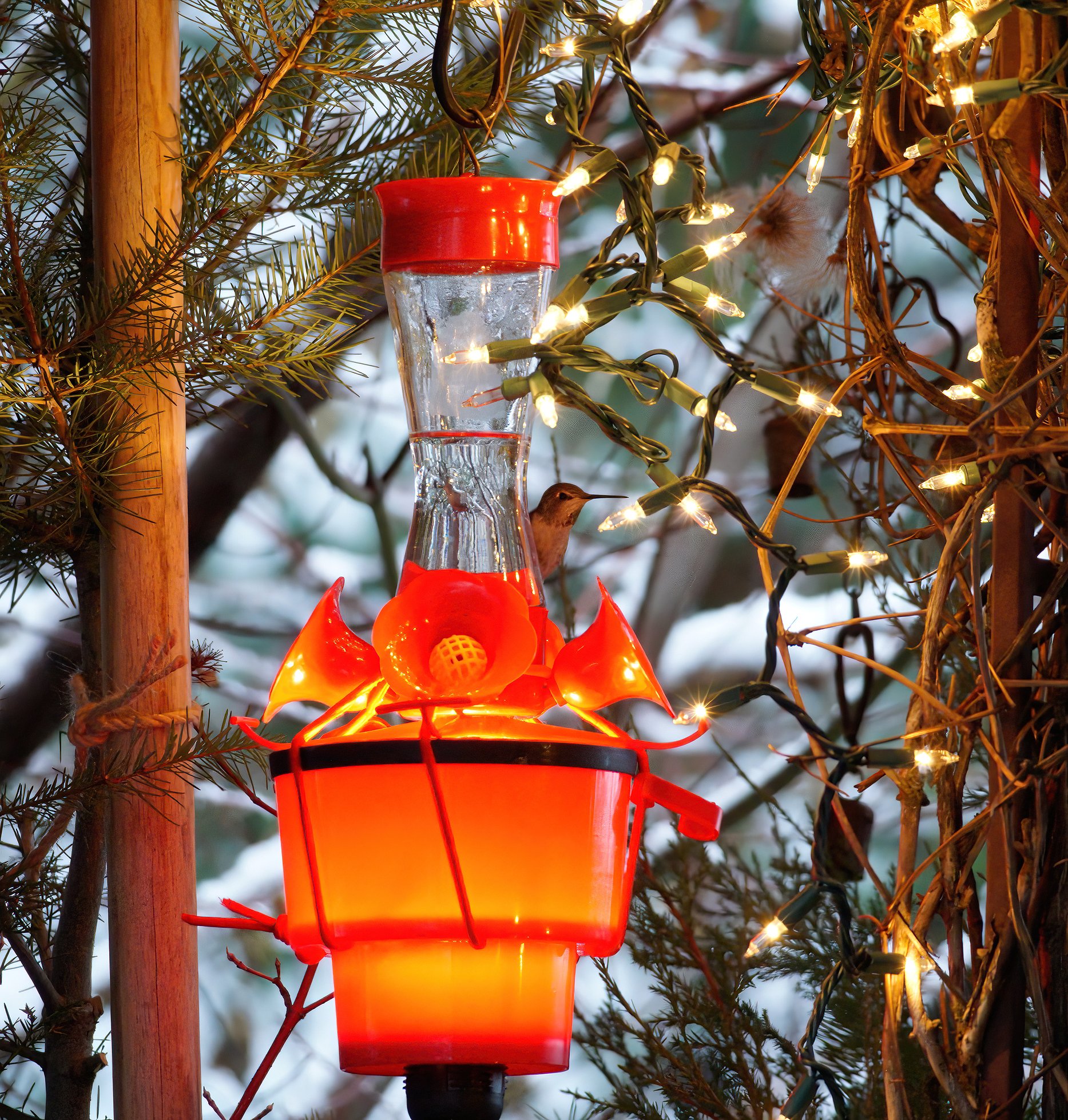 Anna perches on a heating feeder in Michell De Leon Tyler's backyard. (Courtesy of Michell De Leon Tyler)
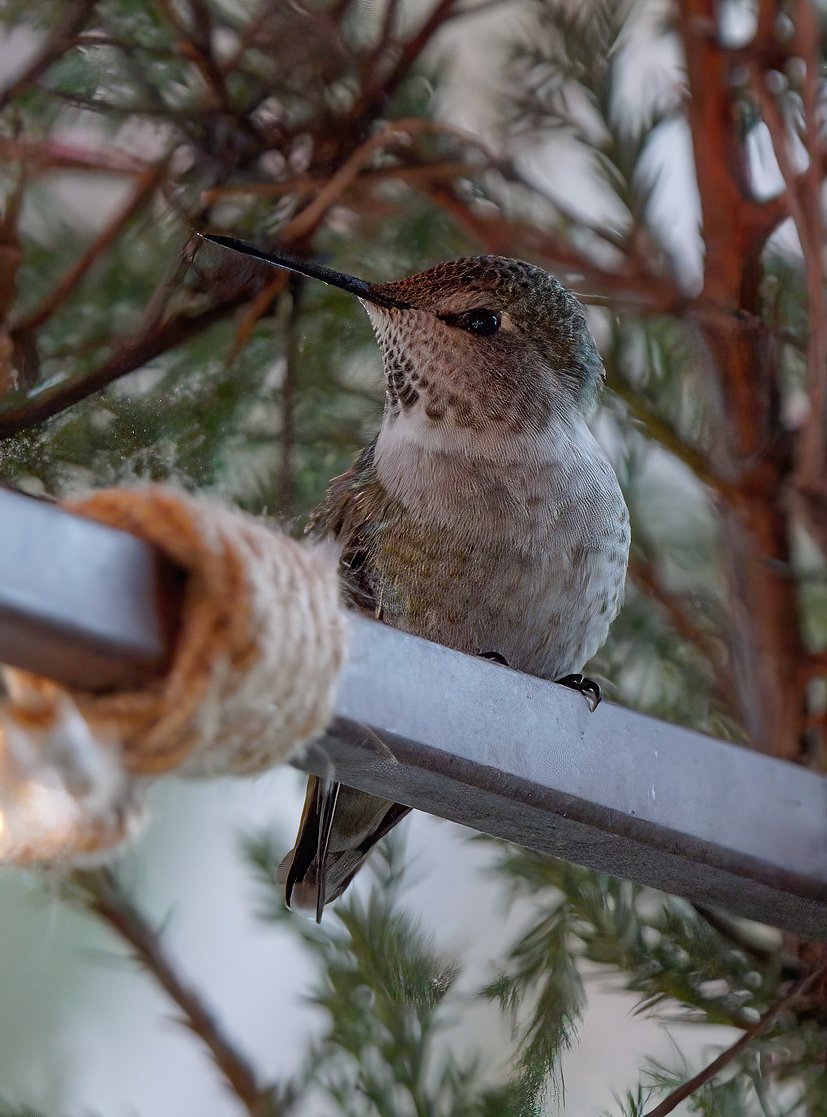 Anna perches in Michell De Leon Tyler's backyard. (Courtesy of Michell De Leon Tyler)
ARTICLES BY HAILEY SMALLEY

Trump stumps for Flint in Kalispell as Election Day nears
President Donald Trump, wearing a dark suit, red tie and red USA cap, ambled into the Majestic Valley Arena to the raucous roar of a crowd.

Flathead National Forest greenlights Swan Valley timber project
A 2,307-acre timber project is now under way in the Swan Valley.
Flathead National Forest greenlights Swan Valley timber project
A 2,307-acre timber project is now under way in the Swan Valley.