
Dr. Alexander Brzezny guards the community’s health
JOEL MARTIN | Hagadone News Network | UPDATED 6 months, 2 weeks AGO
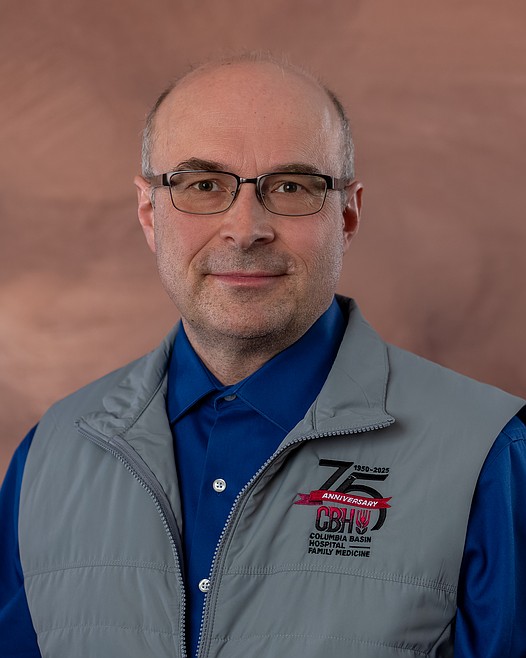
Dr. Alexander Brzezny has been the public health officer for Grant County for 25 years, and for Adams County for 10.
COURTESY PHOTO/COLUMBIA BASIN HOSPITAL
Joel Martin has been with the Columbia Basin Herald for more than 25 years in a variety of roles and is the most-tenured employee in the building. Martin is a married father of eight and enjoys spending time with his children and his wife, Christina. He is passionate about the paper’s mission of informing the people of the Columbia Basin because he knows it is important to record the history of the communities the publication serves. | March 30, 2026 3:20 AM
EPHRATA — Dr. Alexander Brzezny had a good reason for going into public medicine.
“I grew up in an area which is well known for coal mining and production of steel,” Brzezny said. “The air was very unhealthy and there was a lot of pollution. It was what we call the black heart of the country … I could see firsthand the difficulties of people who were working, and I could see how poor air and bad health habits affected them.”
Brzezny, who grew up in what is now the Czech Republic, was sickly a lot as a child himself, and even confined to a wheelchair for a while, he said. Many of his family worked in the coal and steel industries, but his mother and several other female relatives were nurses, and his uncle was a highly-regarded urologist who had served both in Europe and in Africa. Brzezny himself attended medical school at Masaryk University in the Czech city of Brno, the same city where Gregor Mendel had done groundbreaking experiments in genetics more than 100 years earlier and about 75 miles from the birthplace of Sigmund Freud. It’s the second-largest medical school in the country, Brzezny said.
“As you can imagine, genetics was one of the most (important) subjects at the medical school because of Gregor Mendel,” Brzezny said. “And not surprisingly, psychiatry was the other.”
Brzezny graduated from Masaryk University in 1996, according to his biography on WebMD. After that, he said, he went to the University of Kansas in Wichita and studied with some scientists from the National Cancer Institute. He came away with a master’s degree from the public health program at the University of Kansas, he said.
“(Public health) was always my parallel interest, but my main interest was internal medicine,” he said. “I took a lot of surgery classes when I was in medical school, thinking that one day I might be a cardiothoracic surgeon, but when the opportunity came to work on cancer research and observe how that’s done in the United States, I used that opportunity.”
Brzezny has been the health officer for the Grant County Health District for 25 years, he said, and for Adams County for 10 years. He’s board-certified in family medicine and spends more than half of his time in clinical work at Columbia Basin Hospital in Ephrata. But his public health work came to the forefront during the COVID-19 pandemic.
“It was a challenging time for public health in general,” Brzezny said. “I would not single myself out as having particularly a more difficult time. (I was) prepared for that in the years prior, particularly around 2005, 2006 when we were concerned about an avian influenza pandemic in the United States. And subsequently, we had a little pandemic globally in 2009, H1N1, which didn’t become as well remembered or as deadly. But in public health, we always prepare for the next emergency.”
There were 33 cases of H1N1, also called swine flu, in Grant County in 2009 and 2010, according to the Washington Department of Health, one of them fatal. Statewide, there were 1,667 cases and 98 fatalities. Washington was better off than some states; the Centers for Disease Control estimates that swine flu was responsible for more than 12,000 American deaths.
Grant County fared better than some places during the COVID-19 pandemic as well. Data from the GCHD and the Washington Department of Health indicate that only 0.9% of COVID-related deaths in Washington were in Grant County, which held about 1.9% of the state’s total population. Similar data was not available for Adams County.
Brzezny credited the staff at GCHD for their response to the pandemic.
“Public health employs a lot of people,” he said. “Thankfully, we have very important and dedicated staff. I may be (involved) in a lot of work of being prepared, but it is not often me who does that work. It is the people who are behind the scenes and (are) often underrecognized and underreported. Medicine is not a solo endeavor; it is a team sport.”
In both public health and clinical work, Brzezny said, it’s the chance of improving lives that makes him go to work every day.
“Sometimes it is the smallest of things that make the biggest difference,” he said. “I get up every morning with the hope that I can affect the life of one person in a way that’s going to be meaningful to their loved ones. If I can do that in a way … that achieves even half of that, then it’s worth getting up in the morning.”
ARTICLES BY JOEL MARTIN

Endless battle
Noxious Weed Control Board works to keep invasive plants under control
MOSES LAKE — Some of the nastiest plants in Grant County were the topic of a class led by Jay Johnson, a consultant with the Grant County Noxious Weed Control Board, Tuesday. The Noxious Weed Control Board, as its name would suggest, is tasked with keeping weeds under control in Grant County. That’s not a small job; the board’s website lists 129 species of noxious weeds that are found around Grant County. A noxious weed is defined as an invasive, non-native plant that threatens agricultural crops, local ecosystems or fish and wildlife habitat, according to the Noxious Weed Control Board. Washington state law requires that these weeds be identified and their spread kept to a minimum, if not completely eradicated. “We’re one of those agencies a lot of people don’t really understand,” Johnson said. “We’re a county office and … our funding is tax-based assessment. When you get your tax bill and you look down at all the expenses that you pay for, there we are.”

BASIN EVENTS: Oct. 16-24
COLUMBIA BASIN — Whether you feel like shopping, crafting, learning or seeing a show, there’s something happening for you this week in the Basin. Oct. 16 ‘My Family (Mi Familia)’ screening Spanning three generations, “My Family (Mi Familia)” is a heartfelt drama that follows the Sánchez family as they build their lives in East Los Angeles. Through love, hardship, triumph, and sacrifice, the film explores the immigrant experience, the strength of family bonds, and the traditions that connect one generation to the next. Lowrider show and taco truck before the screening. Sponsored by Columbia Basin Allied Arts, EDUBS C/S and the Moses Lake Creative District. $12 per person. Doors open at 6 p.m., film begins at 7 p.m. at the Moses Lake Civic Center Auditorium, 401 S. Balsam St. Tickets and info: www.cba-arts.org.

Moses Lake author encourages women to look beyond church culture norms
MOSES LAKE — A Moses Lake author’s book, “A Christian Woman Striving to Live Her Faith in a Man-Controlled World,” takes aim at the role to which many churches relegate the female half of their congregations. “It’s to encourage women in the faith,” Linda Curran said. “A lot of churches say, ‘Teach Sunday school, do this, do that, but don’t (evangelize.)’" In her book, Curran recounts a time when she moved to a new community and joined a church there. She was surprised to learn that, as a new female member, she had been automatically assigned church cleaning duties. When she questioned it, she wrote, she was met with condescension and her objections were brushed aside. In other churches, she said, women who were capable of teaching were relegated to “women’s ministry.”