
Most pilots avoid thunderstorms, Wayne Sand welcomed them
JACK UNDERHILL | Hagadone News Network | UPDATED 6 months, 3 weeks AGO
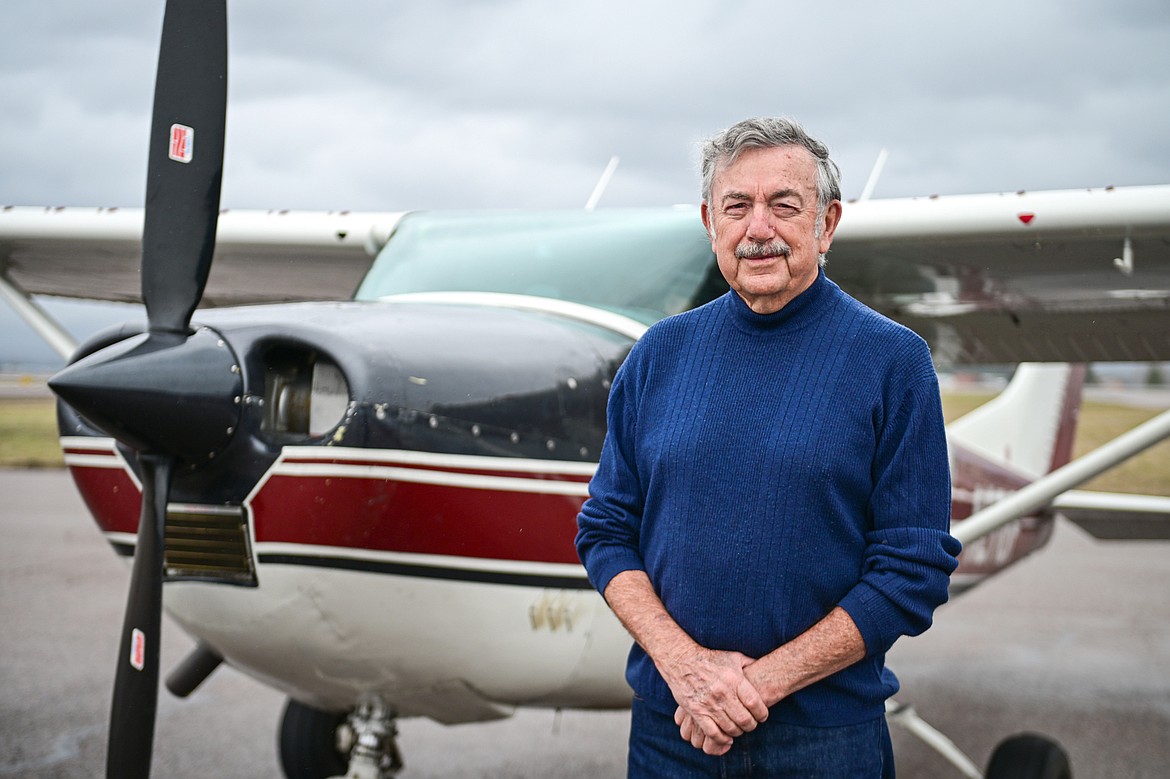
Wayne Sand with a Cessna 182 on Tuesday, March 24. (Casey Kreider/Daily Inter Lake)
Casey Kreider
KALISPELL GOVERNMENT, HOUSING AND TRANSPORTATION REPORTER Jack Underhill covers Kalispell city government, housing and transportation for the Daily Inter Lake. His reporting focuses on how local policy decisions affect residents and the rapidly growing Flathead Valley. Underhill has reported on housing challenges, infrastructure issues and regional service providers across Montana. His work also includes accountability reporting on complex community issues and public institutions. Originally from Massachusetts, Underhill graduated from the University of Massachusetts, Amherst with a degree in Journalism before joining the Inter Lake. In his free time, Underhill enjoys mountain biking around the valley, skiing up on Big Mountain or exploring Glacier National Park. IMPACT: Jack’s work helps residents understand how growth, housing and infrastructure decisions affect the future of their community. | March 30, 2026 12:00 AM
Whether facing gunfire, lightning, hail or freezing rain, Wayne Sand willingly flew into conditions most pilots would go through great lengths to avoid.
Now 85, the Vietnam veteran, pilot, aviation weather expert and author has spent most of his life in the sky. Although he saw combat, he devoted his career to studying severe weather effects on aircraft and teaching pilots how to navigate it.
Sand was first introduced to aviation in the tiny farming community of Valier, Montana, where his family struggled financially, and he picked up any job he could find. But it was the Piper Super Cub airplane that flew in and out of the small grass airstrip in town that caught his eye. The plane would cruise as low as 3 feet from the ground, spraying crops with chemicals to fight insects and weeds.
“I started hanging out at the airport, basically made a pest out of myself,” Sand said.
After graduating high school, the crop-duster's pilot, Ora Lohse, finally took teenage Sand under his wing.
By 2:30 each morning, Sand was out in the fields doing chores while the crop-duster soared overhead. During the off-season, Lohse taught him how to fly. Sand went from never having set foot in an aircraft to learning how to pilot one.
“It was a lot of work, but the reward, if you will, he basically taught me how to fly,” Sand said. “Which was a heck of a deal, because there’s no way I could have ever afforded to do that.”
In many ways, he became Lohse’s apprentice, following him into other projects as well. Sand earned his commercial pilot’s license and flight instructor credentials while working for Lohse.
“This guy was really my mentor in life. I honor him in every way because he totally changed the direction of my life,” Sand said.
After spending time as a flight instructor at Montana State University and graduating with a degree in math, physics in chemistry, Lohse invited Sand to Colorado State University to help him build and test cloud seeding devices for the U.S. Forest Service.
Cloud seeding, as Sand described, is humans’ way of tricking Mother Nature. Planes can alter the amount or type of precipitation by dispersing certain chemicals into clouds.
Lohse had invented a cloud-seeding device designed to reduce hail, and in the summer of 1964, Sand flew a North American T-6 through thunderstorms over eastern Colorado to test it.
The 23-year-old spent two summers seeding clouds before the military draft caught up to him.
“Within two weeks, I’m in Pensacola wondering what in the world I’ve done to myself,” he said.
Sand attended flight school in the Navy and ultimately got to fly the aircraft he wanted most: a Grumman A-6 intruder, an all-weather attack bomber.
Most of his missions were flown over Laos, where he hunted trucks rumbling through the jungle in the dead of night.
The bullets streaking past his aircraft were distracting, but what frightened him most was being launched off the nose of an aircraft carrier in total darkness and harsh weather.
“When you’re shot off the ship, you have no control at all,” Sand said. “You were right on the edge of a stall with a fully loaded airplane just 75 feet off the water.”
After five years flying for the military in Vietnam and the Mediterranean, Sand reconnected with his former Colorado State professor, who had started a new weather-research project at the South Dakota School of Mines and Technology.
There, Sand tested the limits of an armor-plated T-28 Trojan in intense thunderstorms and hail. He willingly flew through three-quarter-inch-sized hail, “not necessarily without little damage, but without being destroyed,” Sand said.
The violent rattling of the aircraft left him bruised on his shoulders and across his lap as the harness slammed against him.
Sand left Rapid City in 1976 with a degree in meteorology and took an invite from a mutual friend to bring his research to the University of Wyoming and enroll in the school’s doctoral program.
He recalled one flight in particularly nasty weather over Lake Tahoe that led to a significant scientific discovery. Even with the plane at full throttle, it began to buffet as if it were stalling — an unusual reaction for a 1,700-horsepower engine.
The plane’s many instruments documented for the first time supercooled large droplets.
“It’s a condition that has changed the whole thought process when it comes to icing,” Sand said.
Although the conditions are dangerous for an aircraft, Sand kept flying into them. That harrowing experience launched years of research and instruction on aircraft icing. He recently published a book drawing from his firsthand knowledge, titled “Aviate, Navigate, Communicate.”
He knows how unusual it sounds to eagerly fly into the very conditions every pilot tries to avoid, but he emphasizes that he does so only with thorough preparation and top-tier equipment.
“If you just compare this to the last job of flying off an aircraft carrier in the middle of the night with an airplane fully loaded with bombs, getting shot at, and then coming back and landing on a wet deck in the middle of the night. This is a piece of cake,” Sand said.
After staying at the University of Wyoming for 12 years, Sand launched his own consulting business in 1992, investigating aviation accidents caused or affected by weather.
Today, he has settled down in the Flathead Valley but continues teaching aviation and weather courses to aerospace engineering students at the University of Kansas, and he has taught icing courses around the world.
Sand recently received an accolade recognizing over 50 years of flight without an accident or violation. The Federal Aviation Administration presented Sand with the prestigious Wright Brothers Master Pilot award in Billings in February.
Although Sand hasn’t been in a cockpit for a couple of years, he was more than satisfied with his time in the air and the career it gave him. And he never forgets to thank the small-town crop sprayer who first believed in him.
“It just totally changed the course of my life. Just lots of opportunities along the way that came along at just the right time, and I was smart enough, or lucky enough, or God blessed me enough to be able to take advantage of it and learn a lot and keep growing, and it’s been just fabulous,” he said.
Reporter Jack Underhill can be reached at 406-758-4407 or [email protected]. If you value local journalism, pledge your support at dailyinterlake.com/support.
ARTICLES BY JACK UNDERHILL

Kalispell clears way for tiny homes by adopting building standards
Councilors on Monday added tiny homes to Kalispell's city code in a bid to make it easier to build the simpler, low-cost housing alternatives.

Glacier Park International Airport earns spot among nation’s resort airports
Glacier Park International Airport was named one of the nation’s top resort airports in USA Today’s 10BEST Readers’ Choice Awards.

Kalispell City Council to consider tiny home regulations
Kalispell City Council on Monday will vote on whether to add tiny homes to city code, allowing the municipality to inspect them and enforce building standards.