
Flathead Basin fish free of forever chemicals
HAILEY SMALLEY | Hagadone News Network | UPDATED 5 months, 3 weeks AGO
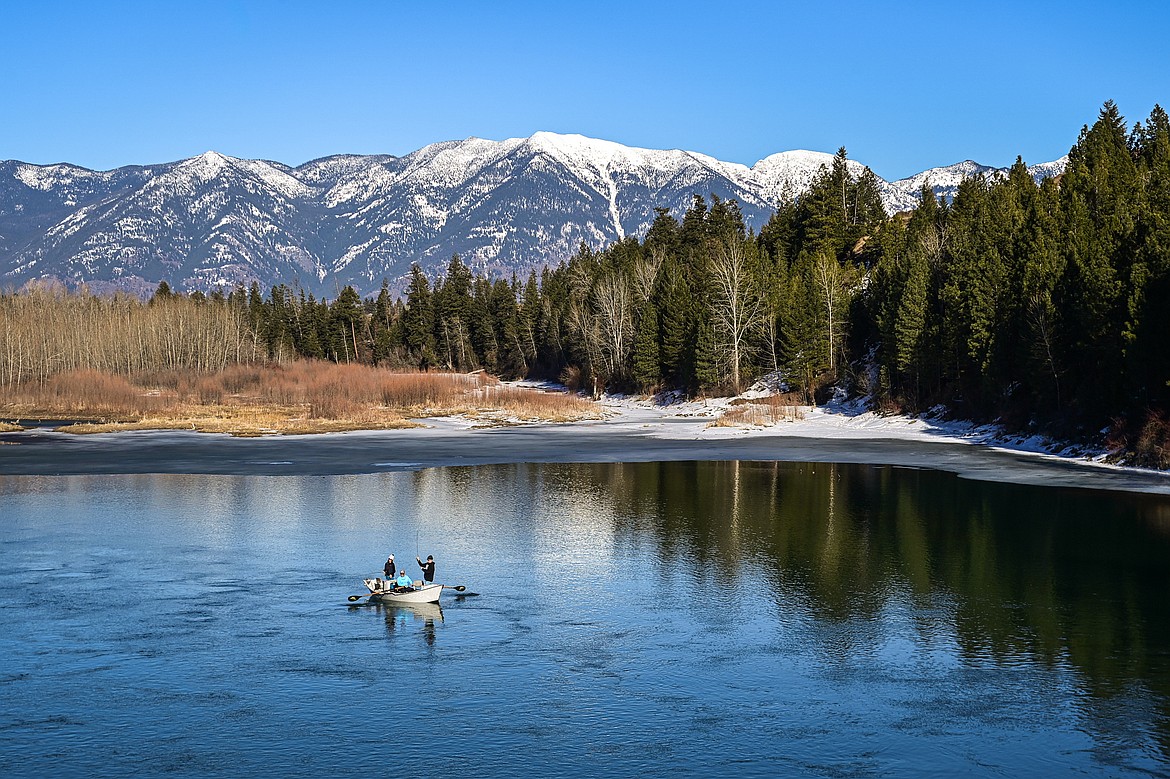
Three anglers fish from a boat on the Flathead River on Saturday, March 1. (Casey Kreider/Daily Inter Lake)
Casey Kreider
Testing by state wildlife officials in 2023 found no evidence of so-called forever chemicals in the Flathead River and Flathead Lake.
Out of 14 sites tested, the Northwest Montana waterbodies were the only ones that showed no signs of per- and polyfluoroalkyl substances, better known as PFAS.
Widely used in manufacturing since the 1940s, the long-lasting chemicals have built up in water, soil and animal tissues across the country. Recent studies have linked exposure to high levels of PFAS to increased risk of reproductive defects, development delays and some cancers in humans.
In spring 2023, state officials tested tissue samples taken from fish in 14 waterbodies to better ascertain the statewide risk of PFAS exposure. Biologists caught 10 whitefish and nine rainbow trout near the Old Steel Bridge as well as four lake trout and 10 whitefish in Flathead Lake near Somers. All 33 fish tested negative for 40 different PFAS compounds.
A variety of popular sportfish caught in the other 12 locations tested positive for PFAS, with the highest concentrations found in samples taken from the East Gallatin, Missouri and Yellowstone rivers and Fort Peck Reservoir. Fish in the Clark Fork River, Lake Helena, Nelson Reservoir and Prickly Pear Creek also tested positive for PFAS.
An investigation by Montana PBS found that Gov. Greg Gianforte’s office suppressed the results of the testing and delayed producing a report with updated fish advisory consumptions until late April 2026. The final consumption advisories related to PFAS were much looser than the limits originally recommended by the Montana Department of Environmental Quality in an unpublished 2024 draft of the report.
While fish in local waterbodies tested negative for PFAS, fish consumption advisories remain in effect for other potentially dangerous chemicals.
Lake trout and lake whitefish in Flathead Lake may contain mercury and polychlorinated biphenyls, a man-made chemical banned in 1977 that has since been linked to cancer in humans. The state recommends eating no more than 1-12 lake trout and no more than 1-7 whitefish per month. Exact amounts depend on age, sex and medical background as well as the size of the fish.
The state has also recommended limiting consumption of fish caught in the Kootenai and Clark Fork rivers, the Fifth Street and Stimpson Fire ponds in Libby, Cabinet Gorge, Thompson Falls and Noxon Rapids reservoirs and Ninepipe National Wildlife Refuge.
Lakes in Northwest Montana with fish consumption advisories include: Lake Koocanusa, Lake Mary Ronan, McGregor Lake, Whitefish Lake, Seeley and Swan lakes in the Swan Valley, Bowman, Harrison, St. Mary, Upper Two Medicine, Waterton and McDonald lakes in Glacier National Park, Cliff Lake in the Jewel Basin, Leigh Lake in the Cabinet Mountains and Upper Cold Lake in the Mission Mountains.
Advisories vary based on the size of the fish and the age and sex of the person consuming the fish. Visit fwp.mt.gov/fish for more information and to view a full list of consumption advisories.
Reporter Hailey Smalley can be reached at 406-758-4433 or [email protected]. If you value local journalism, pledge your support at dailyinterlake.com/support.
ARTICLES BY HAILEY SMALLEY

Trump stumps for Flint in Kalispell as Election Day nears
President Donald Trump, wearing a dark suit, red tie and red USA cap, ambled into the Majestic Valley Arena to the raucous roar of a crowd.

Flathead National Forest greenlights Swan Valley timber project
A 2,307-acre timber project is now under way in the Swan Valley.
Flathead National Forest greenlights Swan Valley timber project
A 2,307-acre timber project is now under way in the Swan Valley.