
Forest Service says timber project’s impacts to endangered species minimal
HAILEY SMALLEY | Hagadone News Network | UPDATED 5 months, 2 weeks AGO
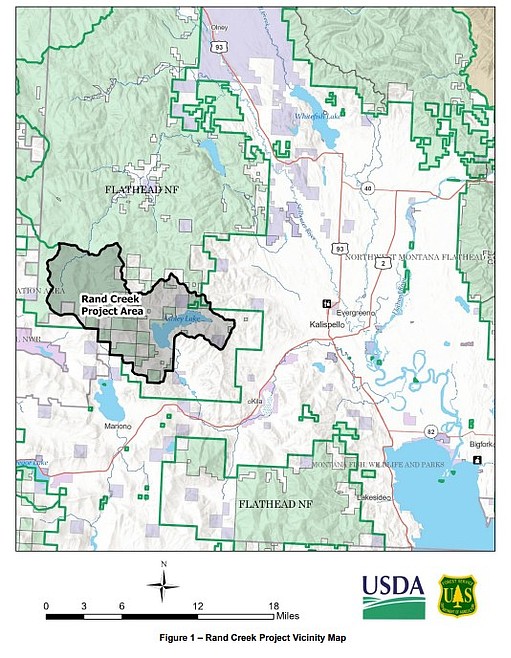
The Rand Creek Project includes about 7,000 acres near Ashley Lake. (Courtesy of U.S. Forest Service)
Flathead National Forest is moving forward with a 7,500-acre timber project near Ashley Lake.
The Rand Creek Project includes 4,595 acres of commercial timber harvest and 2,937 acres of noncommercial vegetation treatments in the Tally Ranger District of Flathead National Forest.
Officials say the project is necessary to mitigate the risk of extreme wildfires, but an environmental assessment released April 23 also found that the treatments could affect local wildlife, including lynx and grizzly bears.
The prescribed treatments, which range from clearcuts to controlled burns, are expected to occur over 10 years and produce about 32 million board feet of timber. Much of the focus will be on removing underbrush and decreasing canopy cover to reduce the chances of a fire reaching the forest crown.
“The proposed activities would modify fire behavior and fuel conditions, which improve opportunities for fire suppression, but the vegetation treatments by themselves would not prevent fires from burning or spreading,” reads the environmental assessment. “The proposed action would effectively reduce the acres of moderate and high-density canopy cover on a landscape level, reducing expected fire behavior and increasing firefighter safety in the event of a wildfire.”
Cutting back undergrowth also affects animals like lynx, which use downed trees and woody debris as denning sites and hunt for snowshoe hares in the dense forest understory. The big cats are listed as threatened under the Endangered Species Act, and several federally designated Lynx Management Units intersect with the project’s footprint.
In total, Forest Service officials estimate that the project will reduce critical lynx denning habitat by 6,951 acres.
“Given forest plan direction, and information that denning habitat is widespread, the reduction of denning habitat is likely to have little impact on lynx in the affected Lynx Management Units,” reads the assessment.
The project will also contract the amount of forage habitat available to lynx in the short-term. Those reductions are also consistent with forest plan direction and will be offset by long-term gains in forage habitat as logged stands regrow, according to the assessment.
“In the long-term, treatments in other lynx habitat could promote quicker growth to multistory habitat ... [and] help create a better mosaic of different forest successional stages than the existing condition, providing the physical or biological features essential to the conservation and recovery of the Canada lynx population,” wrote officials.
Grizzly bears, which are also federally listed as threatened, will similarly see reductions in hiding cover and forage habitat as the forest understory is slashed away, and may also face disturbances from the 11.6 miles of new road systems the Forest Service plans to construct as part of the project. Officials described the effects as minimal and temporary.
Wildlife biologists with the Forest Service reviewed early drafts of the plan for the Rand Creek Project to ensure treatments met federal conservation priorities, resulting in the removal and modification of some treatment units to exclude lynx habitat and adjustments to the proposed road locations to avoid grizzly bear habitat. The construction of berms on three existing roads was added to the project activities at the suggestion of grizzly bear specialists.
The project may also affect ungulates, including deer, elk and moose, by reducing canopy cover that acts as a barrier to snow in the winter and altering the amount of forage available. Both factors will remain well within the range to support a healthy ungulate population, according to the environmental assessment.
The project is expected to begin this fall. Nearby trails may close as treatments occur, but officials wrote that the exact timing and duration of restrictions was difficult to predict.
The project is being approved under an emergency action determination introduced by the Trump administration in April 2025, which allows the Forest Service to forgo analysis of alternative prescription options.
The public comment period for the environmental assessment extends through May 7, 2026. Comments may be submitted through the project’s webpage or emailed to Sarah Hash at [email protected].
Reporter Hailey Smalley can be reached at 406-758-4433 or [email protected]. If you value local journalism, pledge your support at dailyinterlake.com/support.
ARTICLES BY HAILEY SMALLEY

Trump stumps for Flint in Kalispell as Election Day nears
President Donald Trump, wearing a dark suit, red tie and red USA cap, ambled into the Majestic Valley Arena to the raucous roar of a crowd.
Flathead National Forest greenlights Swan Valley timber project
A 2,307-acre timber project is now under way in the Swan Valley.
Flathead National Forest greenlights Swan Valley timber project
A 2,307-acre timber project is now under way in the Swan Valley.