
Bigfork students learn to love the past in National History Day competition
ELSA ERICKSEN | Hagadone News Network | UPDATED 5 months, 1 week AGO
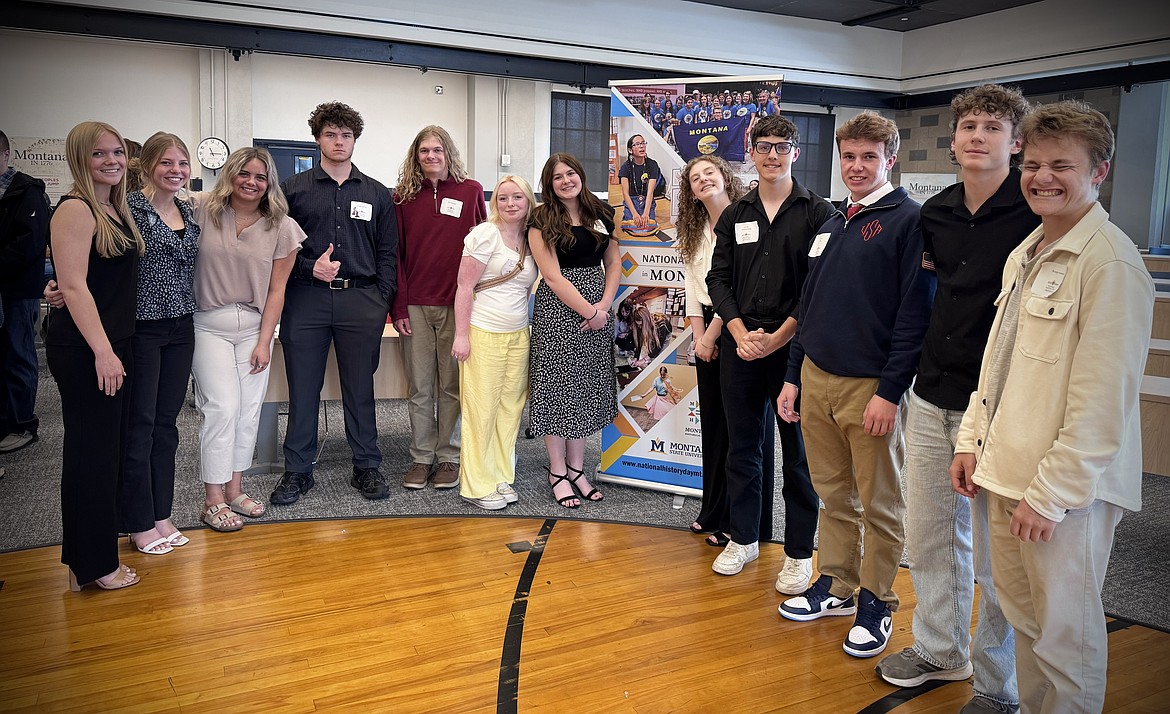
Bigfork High School students at the Montana National History Day competition on April 25 (Courtesy Annmari Sikon)
It’s a tale as old as time, or at least as old as history: Today’s youth don’t care to learn about the people who came before them.
At Bigfork High School, though, eight juniors are headed to Washington, D.C. to represent Montana in the National History Day contest. Since December, they’ve researched nuanced historical projects with topics ranging from "West Side Story” to vigilantes in Montana’s history. They earned top honors at the state level and will compete against 3,000 other students representing the top 0.5% of National History Day competitors.
Despite what their success suggests, these students aren’t natural history buffs. Before their projects, they admittedly didn’t spend much time thinking about the past.
“We had to become experts on the topic, whether you liked it or not,” said junior Lillie Suffia. “I wouldn’t say too many of us were interested in [history] beforehand, but once you dive into it, you learn to become fond of your topic.”
Suffia, along with her partner Kinsey Bradstreet, took home top honors at Montana’s National History Day state competition with their documentary exploring Magic Johnson’s impact on the HIV epidemic through the lens of the media.
“Doing all of the research helps us take a step back and look at culture from a different perspective,” said Bradstreet. "These tiny glimpses in history that our topics focus on have helped shape what the world looks like today in terms of what's accepted, what's talked about and how people react to things.”
The 2026 contest theme, “Revolution, Reaction, Reform in History,” helped shape how students view history and their relationship to events from the past.
“Sometimes it’s hard to get out of your tunnel vision and focus on separate events. But really, all of the events that you learn about do connect to each other, and it does lead up to your life today,” agreed Dora McCarthy. “It’s kind of hard to think about how these things that happened so long ago can personally affect you in your life, but learning and diving deep into specific events and topics can help you take of the horse mask and see that it is really important to you."
McCarthy, a self-described pop-culture aficionado, used the project as an opportunity to explore the musical “West Side Story.” As she closely examined the play and the movie based on it, she saw how the Civil Rights Movement influenced everything about the production, from the choreography to the soundtrack.
Through National History Day, students have the opportunity to explore topics they feel connected to, in ways they might not be able to in a traditional high school history curriculum. Curtis Scherfenberg said he didn’t share McCarthy’s interest in the Civil Rights Movement, but his group, which included Rye Peterson and Vander Barnes, did share a childhood love of superheroes.
As they considered their favorite crime-fighting masked men, they saw connections to Montana’s history of vigilantes. For their project, they created a website and explored how Hollywood’s western films reshaped the stories of the American West. Their research challenged even their own assumptions of these gun-slinging heroes from the past.
“I think the whole basis of our project was how the perception of Montana vigilantes was really about heroism and how they’re such great images of civil protection. And while they were that image of civil protection, they also did violent crimes. They’re very infamous for lynching and hanging. It was interesting because Batman, who I grew up with, was in our project, and he’s such a symbol of heroism. Yet the roots of vigilantes come from a more violent background,” said Scherfenberg.
English teacher Annmari Sikon and history teacher Cynthia Wilondek have teamed up for years to guide Bigfork juniors through the National History Day contest. The two have a knack for igniting an excitement for history with their students — last year, they took 11 students to Washington, D.C.
Over the years, as the ways their students consume media have evolved, Sikon has noticed students gravitating towards new formats to tell the stories of their historical topics. In the past, students tended to write papers or create display exhibits. Now, it’s much more common for them to produce their own documentary or develop a website.
But even as they experiment with modern mediums for their history projects, these students haven’t thrown out the time-tested methods historians have honed to understand the past.
As part of the preparation process, students traveled to the Montana Historical Society’s Montana State Archives in Helena.
“We had historians walk us through different articles and documents. We got to look at the original Montana Vigilante Oath,” said Scherfenberg. "We got to hold journals from all the way back then. I thought that was a really cool experience.”
For their project on Magic Johnson, Bradstreet and Suffia interviewed Connie Chung, the pioneering broadcast journalist who was the first Asian-American and second woman to co-anchor a major U.S. network newscast. They examined the pivotal role Chung’s CBS interview with Johnson played in the evolving public perception of the HIV epidemic.
As they worked with primary source materials and interviewed experts, these Bigfork students came to understand the work of historians in a new light.
“Now I know how extensive it is to take the time and learn all of this,” said McCarthy. “It definitely made me respect historians more because, before this, when people would recite history off the top of their head, I didn’t really think it was all that time consuming.”
The skills students gain from National History Day will serve them far beyond the contest, according to Sikon.
“What's so powerful about it, in my opinion, is it's not just the topic you select, but it's the skills that you gain through the process,” she said. “To have that confidence and that poise and those critical thinking skills and the ability to ask good questions, those are applicable skills in whatever industry these students land in.”
The students are now fundraising for their travel to Washington, D.C. Tax-deductible donations can be made directly to Bigfork High School by cash or check with NHD in the memo line. The group is also hosting a bingo night May 21 from 6 to 8 p.m. at Bigfork High School.
Here is the list of Bigfork’s National History Day national qualifiers:
Senior Group Documentary: “Where Magic Meets Media: The Conversation that Redefined HIV Awareness” by Kinsey Bradstreet and Lillie Suffia (National Qualifier)
Senior Group Website: “Hanging, Heroes, and Hollywood: Authors of the Vigilantes Reshape the West” by Rye Peterson, Curtis Scherfenberg, & Vander Barnes (National Qualifier)
Senior Individual Exhibit: “One Hand, One Heart: Cultural Revolution in West Side Story” by Dora McCarthy (National Qualifier)
Montana History of Science and Technology Award: “Sputnik: The Genesis of Modern America” by Quinn Kerr & Cavin Wiest (National Alternate)
ARTICLES BY ELSA ERICKSEN
The century club: Montana's centenarians reflect on 100 years of life
Completing those hundred laps around the sun is no easy feat. There are an estimated 108,000 centenarians in the United States.
Lakeside residents turn to citizen-initiated zoning to protect neighborhood
For the last three years, Fetveit has spearheaded a neighbor-led effort to create a new zoning district in Lakeside that would protect this area along the lakeshore from overdevelopment.
Effort to rebuild iconic Bigfork cross is underway
When completed, the new cross will stand 100 feet tall with a crossbeam that spans 53 feet. The metal roof trusses that will be used to construct the cross will be 5 feet wide.