
Delivering on decades: After years of waiting, the Columbia Basin moves closer to long-awaited surface water expansion
NANCE BESTON | Hagadone News Network | UPDATED 2 months, 2 weeks AGO
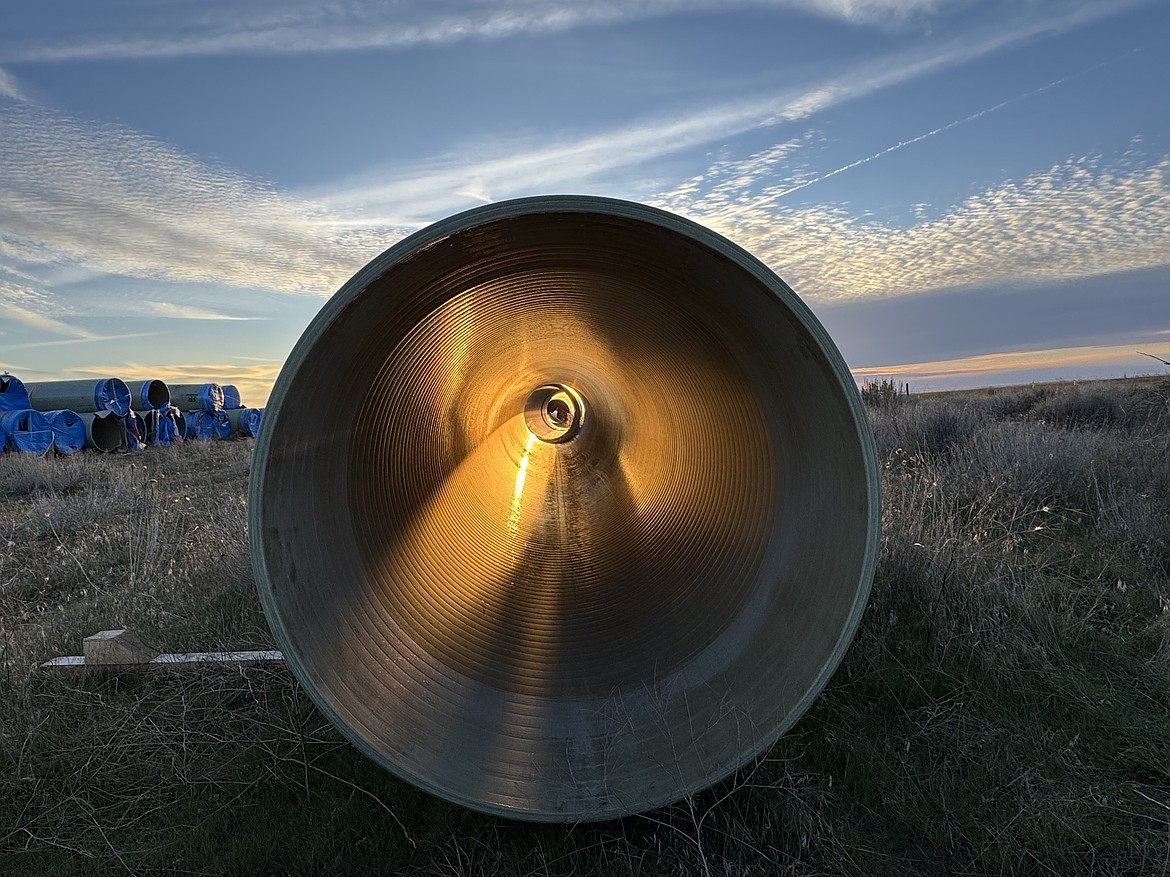
East Columbia Basin Irrigation District works on EL 84.7.
COURTESY PHOTO/EAST COLUMBIA BASIN IRRIGATION DISTRICT
For decades, groundwater powered agriculture in sections of Washington’s East Columbia Basin. Wells drilled thousands of feet deep transformed dryland acres into highly productive farmland, even as farmers waited for surface water promised under the Columbia Basin Project that never fully materialized.
That reliance on groundwater is now catching up with the region.
Water levels in the Odessa Subarea Aquifer have dropped steadily for years, forcing wells deeper, hotter, saltier — and far more expensive to operate. Some wells now reach more than 2,000 feet below ground, driving up energy costs and threatening long-term water reliability for both farms and nearby communities.
To confront that reality, state, federal and local partners have invested tens of millions of dollars to accelerate the Odessa Groundwater Replacement Project, a long-planned effort to shift irrigation away from a declining aquifer and back to surface water from the Columbia River.
What the project is
The Odessa Groundwater Replacement Project, or OGWRP, is designed to replace irrigation water pumped from a non‑replenishing aquifer with surface water delivered through the Columbia Basin Project. The goal is twofold: stabilize the aquifer, which also supplies municipal drinking water, and provide reliable long-term irrigation for agriculture.
Under the program, eligible farmers can exchange valid state‑issued groundwater rights for Columbia Basin Project surface water. That water is delivered through newly built pumping plants, pipelines and enclosed delivery systems constructed by the East Columbia Basin Irrigation District. When fully built, the project is authorized to convert up to 90,000 acres of farmland from groundwater to surface water.
“This is really about taking pressure off a non‑replenishing aquifer,” said Jon Erickson, development coordinator for ECBID. “At the same time, it gives farmers a dependable water source for decades to come.”
The project grew out of the Odessa Subarea Special Study, a joint federal and state environmental review completed in 2012. That study concluded continued reliance on deep wells was unsustainable and identified surface water delivery — using existing Columbia Basin Project infrastructure with targeted upgrades — as the most effective alternative.
How water gets from the river to the fields
Water for OGWRP originates at Grand Coulee Dam and moves south through the Columbia Basin Project’s canal system. One major problem, however, is historical: the East Low Canal, intended to serve much of the Odessa area, was never fully completed during the project’s original buildout.
As a stopgap, farmers were allowed to drill wells — a temporary solution that became permanent.
The replacement project fills that gap by expanding canal capacity through enclosed, pressurized pipe systems rather than open canals. The closed systems reduce water loss and improve efficiency.
“All of these will be enclosed pipe,” ECBID Secretary‑Manager Craig Simpson said previously. “It won’t be open canals.”
Some OGWRP delivery systems rely on pumping plants, while others use gravity to move water. One system that came online in 2025 delivers water entirely by gravity to the farm gate, though growers still boost pressure on‑farm for irrigation pivots.
Where the project stands
Two OGWRP delivery systems — EL 47.5 and EL 86.4 — are already operational, shifting more than 10,000 acres off groundwater wells. Two additional systems, EL 84.7 and EL 80.6, are under construction and expected to begin delivering water in 2027.
In March, ECBID directors approved seven new memorandums of understanding with landowner groups, allowing design work to begin on additional delivery systems north of Warden and east of Moses Lake.
Those agreements bring the project closer to full buildout.
“We’re looking to have all 90,000 authorized acres under design or contract,” Erickson said. “That’s a major milestone. At that point, we’re done seeking acreage and focused entirely on construction and delivery.”
Participation in the program remains voluntary, and landowner cooperation is essential.
“That’s why the memorandum of understanding process is so important,” Simpson said previously. “It allows us to work through what this looks like on individual properties before anything moves forward.”
The cost and who pays
Replacing groundwater irrigation on this scale is neither fast nor cheap.
“These delivery systems are expensive to design and build,” Erickson said. “At the end of the day, it always comes down to funding.”
To offset costs, OGWRP relies on a patchwork of state capital budget appropriations, U.S. Bureau of Reclamation support and USDA Natural Resources Conservation Service funding. In recent years, roughly $48 million in NRCS‑related funding has been secured to help accelerate construction and buy down debt for new delivery systems. That figure represents a portion of overall public investment, not the project’s total lifetime cost, which reaches into the hundreds of millions.
That public funding has significantly reduced long-term costs for participating farmers.
“It helps lower the debt the district would otherwise have to take on,” Erickson said. “And that directly lowers what farmers pay over a 30‑year repayment period.”
According to Erickson, normalized costs have dropped by about $75 per acre over the past several years.
“We started around $190 per acre, and now we’re down to about $115,” he said. “The federal and state dollars are what make that possible.”
The shift from drilling to delivery
With design work underway for the remaining authorized acreage, ECBID has stopped accepting new applications. Demand has reached the project’s limit.
“Water is limited,” Erickson said. “It’s expensive. And waiting costs money.”
For landowners already enrolled, the transition from groundwater to surface water is highly individualized. Each conversion involves water right verification, land eligibility, system design and easement agreements — a process project leaders describe as best handled one landowner at a time.
Erickson said he cannot predict specific crop changes, but having reliable surface water has already reshaped farming patterns in areas long dependent on deep wells and dryland rotation.
“You’re seeing increased production where ground used to be fallow or dry wheat,” he said. “Ninety thousand acres of dependable water is going to have an impact.”
ARTICLES BY NANCE BESTON
Grant County Sheriff candidates discuss transparency, trust
EPHRATA — As Grant County voters prepare to submit their primary ballots, three candidates are vying for the position as Grant County Sheriff including incumbent Joey Kriete and challengers Josh Sainsbury and Darrick Gregg are competing in the upcoming primary election. To help readers compare the candidates' priorities, qualifications and plans for the office, each was asked the same question and given an equal opportunity to respond.
Grant County Commissioner candidates deliberate fiscal responsibility, budgeting
EPHRATA — Four Republicans are seeking election to Grant County Commissioner Position 3 in the upcoming primary: Shannon Durfee, Kelly Raap, Seth Weeks and Janice Flynn. To give voters a clear comparison of the candidates' positions and priorities, each was asked the same set of questions and provided the same deadline to respond. Durfee, Raap and Flynn submitted responses by the deadline; Weeks did not respond.

Sheriff candidates discuss staffing, retention
EPHRATA — As Grant County voters prepare to select their next sheriff, incumbent Joey Kriete and challengers Josh Sainsbury and Darrick Gregg are competing in the upcoming primary election. To help readers compare the candidates' priorities, qualifications and plans for the office, each was asked the same question and given an equal opportunity to respond. This installment focuses on one of the most pressing challenges facing law enforcement agencies: recruiting, retaining and supporting qualified staff within the Grant County Sheriff's Office.