
Washington enters 4-year drought: What it means for Eastern Washington
NANCE BESTON | Hagadone News Network | UPDATED 5 months, 2 weeks AGO
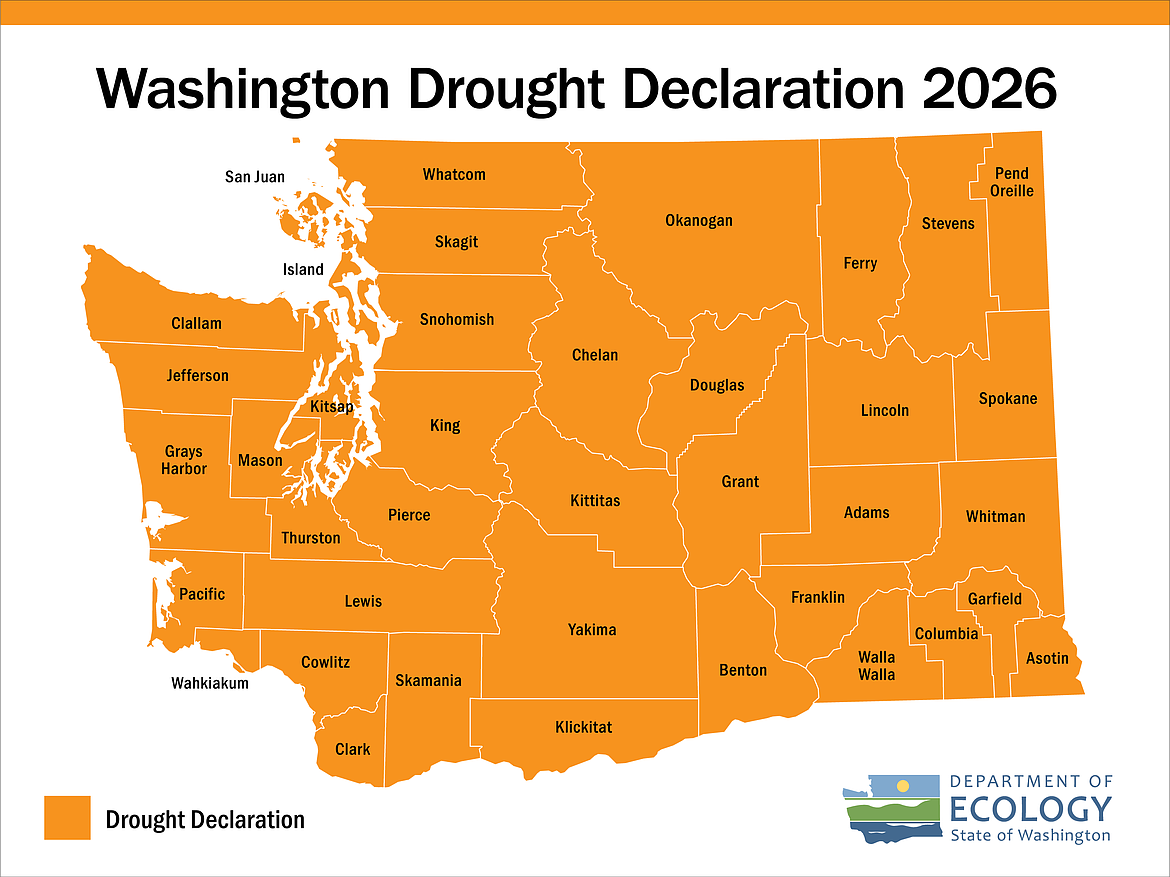
Washington is heading into another dry summer and its fourth consecutive year under a drought declaration. However, the impacts in Eastern Washington will look different from the rest of the state.
A warm winter, record‑high temperatures and a snowpack sitting at roughly half of normal levels have pushed the Washington Department of Ecology to issue a statewide drought emergency far earlier than usual.
“If you look at our mountains, the challenge we are facing is clear,” Governor Bob Ferguson said in the state’s announcement. “We’re taking emergency action to protect fish, farmers and communities across Washington.”
A snowpack problem
Despite a winter that delivered 104% of normal precipitation, too much of that moisture fell as rain instead of snow. Snowpack – Washington’s natural reservoir – never recovered.
According to Ecology, statewide temperatures from October through February were the third warmest on record, and the resulting snowpack was the fourth lowest in 40 years.
“Going into April with half of our usual snowpack is alarming,” Ecology Director Casey Sixkiller said during the conference. “Issuing a drought emergency now helps water users prepare for what is likely to be a very difficult summer.”
The state’s climatologists warn that the snow that accumulated is expected to melt out quickly.
“Precipitation has been basically normal when averaged statewide, but it’s been really warm,” said Karin Bumbaco, deputy state climatologist during the press conference. “Even the heavy snowfall in mid‑March was not enough to make up multiple months of poor snowpack growth.”
Eastern Washington
For Eastern Washington, the picture is more nuanced. Jaime Short, Ecology’s Eastern Region water resources manager, says Grant and Adams counties won’t feel the drought as immediately as other parts of the state.
“There are fewer surface water sources, so fewer streams, fewer rivers other than the Columbia,” Short said. “But most of the water use in the basin comes from the Columbia Basin irrigation project, and that is not anticipated to be affected by drought.”
That means the region’s agricultural landscape, dependent on the Columbia Basin Project, will largely look “business as usual.” But that doesn’t mean the region is immune.
“We might see declines in wells that we would not necessarily see if it weren’t for the drought,” Short said.
Residents who rely on private or municipal wells may feel the strain more acutely, especially during long stretches of heat.
Local streams and lakes, including Soap Lake, are also vulnerable.
“We certainly see a connection between ongoing drought and lower lake levels,” Short said. “I’m afraid that this year is not likely to get any better. It might get a little worse.”
Wildlife, fire and air quality
The Columbia Basin’s shrub steppe ecosystem is naturally adapted to dry conditions, but drought still brings ecological stress, Short said. Lower streamflows and warmer water temperatures can harm fish, while vegetation dries out earlier in the season.
Then there’s fire.
“Fire is always a concern,” Short said.
While Ecology’s water program doesn’t manage wildfire response, its air quality program handles smoke impacts each summer.
“As a lifetime resident of Eastern Washington… that is just kind of, unfortunately, our new normal, being ready for fire and ready for smoke,” she said.
Department of Natural Resources Eastern Washington Communications Manager Ryan Rodruck said it’s too early in the season to predict the severity of the fire season.
“We are obviously paying very close attention to the statewide drought concerns,” Rodruck said.
What Residents Can Do
Short emphasizes that personal conservation still matters, even in an irrigation‑supported region.
“It’s really pretty common‑sense solutions,” she said. Water lawns in the morning or evening, prioritize gardens over grass, and follow local watering ordinances. “The cost of infrastructure is incredibly high… the cities have really taken a leadership role in conservation.”
Looking Ahead
Ecology will watch snowpack, precipitation, and streamflow closely over the coming year. Lifting the drought declaration will require sustained improvement – something that hinges on winter weather patterns.
“We’re going to be reliant on rain,” Short said. “There’s not much to go around this year.”
Still, she hopes residents will approach the season with empathy.
“There are a lot of farmers who do not benefit from the Columbia Basin Project that are going to be hit hard this summer,” she said. “Let’s be kind to one another and work together toward solutions.”
ARTICLES BY NANCE BESTON
Sheriff candidates debate at Ephrata forum
EPHRATA — Incumbent Grant County Sheriff Joey Kriete and challenger Darrick Gregg highlighted differences in leadership style, accountability and jail operations during a candidate forum Wednesday night at the Art Semro American Legion Post 28. The two Republicans are competing in the Nov. 3 general election to lead the Grant County Sheriff's Office, with both candidates talking about decades of law enforcement experience and public servic
Martinez, Thompson emphasize affordability, local control in 13th District forum
EPHRATA — Republican candidates Deanna Martinez and Joshua Thompson discussed affordability, housing, water and government regulation during a candidate forum Wednesday night at the Art Semro American Legion Post 28 as they compete for an open seat in the Washington House of Representatives. The Position 2 seat in the 13th Legislative District was vacated by Rep. Alex Ybarra, who is seeking election to the state Senate after Sen. Judy Warnick announced her retirement and chose not to seek reelection. Both candidates presented themselves as conservatives focused on limiting taxes and reducing regulations, but each pointed to different experiences and priorities as qualifications for the job.
Dent, Garcia outline contrasting visions at forum
EPHRATA — Incumbent Republican Rep. Tom Dent and Democratic challenger Juan “Jerry” Garcia offered contrasting approaches to taxes, health care and state government during a candidate forum Wednesday night at the Art Semro American Legion Post 28 in Ephrata. The forum, hosted ahead of the Nov. 3 general election, featured candidates seeking legislative offices in the 13th District. Dent and Garcia, who are running for Position 1 in the Washington House of Representatives, answered questions about state taxes, bipartisanship and party influence.