
Four Democrats battle for dominance in Montana's federal primary
HAILEY SMALLEY | Hagadone News Network | UPDATED 5 months, 2 weeks AGO
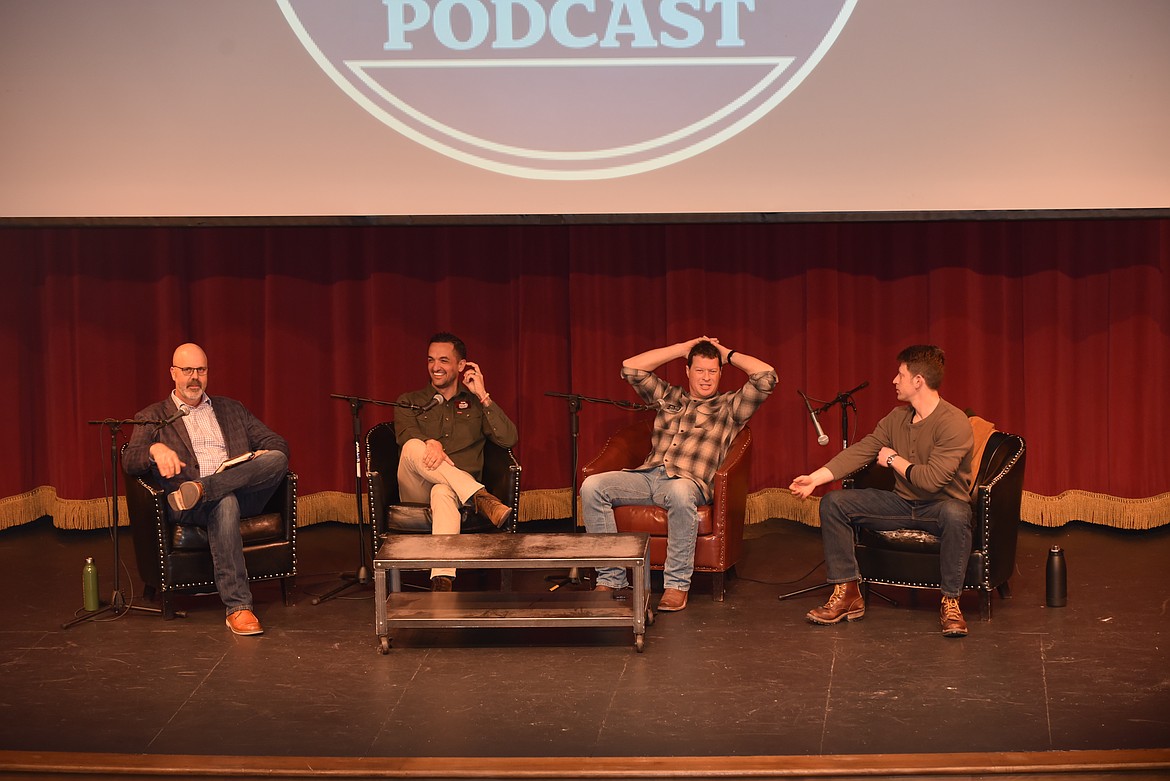
Ryan Busse, Russ Cleveland, Matt Rains and Sam Forstag speak at a forum for Democratic candidates in Whitefish on March 9. (Hailey Smalley/Daily Inter Lake)
It’s a dead heat between four Democrats vying for western Montana's U.S. House seat as the tightly packed primary election heads into the home stretch.
House District 1, encompassing Montana’s 16 most western counties, is seen as the Democratic Party’s best hope of securing a spot on the Treasure State’s congressional delegation. The Cook Political Report ranks the race as “likely Republican,” a step down from the “solid Republican” ranking given to the state’s other congressional races, and the Democratic Congressional Campaign Committee added the seat to its list of “districts in play” in February.
Republican Rep. Ryan Zinke, of Whitefish, plans to retire after his fourth term. The lineup of Democrats hoping for a chance to snag his seat includes Russell Cleveland from St. Regis, Matt Rains from Simms, Sam Forstag from Missoula and Ryan Busse from Kalispell.
Voters will have a chance to cast their vote in the primary election June 2. Absentee ballots will be mailed to registered voters in the district on May 8.
Russell Cleveland says he’s the independent Democrat of the bunch
Russell Cleveland can sum up his campaign for House District 1 in four words.
“Reeling in corporate greed,” he said. “That’s what all this comes down to.”
The first candidate to officially enter the race in April 2025, Cleveland set the tone for his campaign with a vow to accept individual donations only. His platform leans on his commitment to draining money out of politics and limiting corporate influence on elections, which he believes will free up more resources to combat everyday affordability issues like healthcare, childcare and housing.
“It’s not a matter of if there’s enough money. It’s where we’re spending it,” he said of the federal budget. “We really need to tighten up our fiscal responsibility, but to me that doesn’t mean cutting social programs. It means cutting some of the excessive spending in areas like corporate bailouts, defense spending, really trimming the corporate greed side of it.”
Cleveland believes he has the experience to make those cuts happen. The 41-year-old U.S. Navy veteran spent ample time analyzing large budgets and navigating existing federal subsidy and public service programs while running his own childcare company. His insights into the healthcare system are more intimate; Cleveland’s daughter, Madison, died of leukemia when she was 13 years old.
“It’s not just talking about universal healthcare, universal childcare,” he said. “It’s speaking about it through the lens of experience, which is pretty important, I think, to actually get the work done.”
Cleveland is specifically pitching what he described as “an improved version of Medicare for All” alongside investments in rural health facilities to combat concerns about the cost of health care. Other policies he promotes as solutions to the affordability crisis include access to universal childcare, increased wages and tax reforms that close corporate loopholes.
He has also targeted data centers as an emerging concern for Montanans and called for an immediate moratorium on further development of the facilities until a congressional committee can investigate potential impacts.
“It’s not good for Montana. It’s not good for power. It’s not good for water. It's not good from the sound aspect, for public health. It’s not good for jobs long-term,” said Cleveland of a recent push to build data centers near Broadwater, Butte and Bozeman.
“This is an opportunity to bring both parties together and take a stand and defeat this corporate greed on a broader scale.”
Despite a clear progressive leaning, Cleveland has been hesitant to fully align himself with the national Democratic Party, instead labeling himself as the independent Democrat in the race. If elected, he said his loyalty will lie with constituents and lawmaker coalitions like Take BAC Congress, which aims to reform political financing and limit congressional terms.
As a rancher, Matt Rains hangs his hat on rural issues
If there’s an odd man out in the Democratic primary, it’s Matt Rains. Sure, he’s the only one of the four Democratic candidates to sport a cowboy hat at several public forums, but it’s Rains’ policies that truly set him apart from the pack.
The 46-year-old rancher, U.S. Army veteran and former chief of staff for the Montana Farmers Union first differentiated himself by refusing to swear off campaign donations from corporate political action committees, as his competitors have done. He defended the decision as strategic, rather than political.
“To me, it’s a simple order of operations. You’ve got to get elected first,” said Rains. “It’s my responsibility as a Democrat to make sure I raise enough to go toe to toe with the GOP candidate.”
More recently, Rains has drawn attention as the only Democrat in the House District 1 race to voice open support for the United States’ allyship with Isreal, saying his time in the Middle East as a conflict photographer helped him understand the value of the two nations’ relationship.
A self-described central moderate Democrat, Rains said he represented the “forgotten middle” of the state.
“To me, it’s the majority of Montanans right there in [the middle],” said Rains. “That’s where the state is and where we really need representation.”
His campaign also leans into the state’s rural demographic, with promises to support farmers and ranchers by expanding local meat processing, advocating for country of original labeling and reforming the crop insurance subsidy system. Even his pitches regarding the affordability crisis have a decidedly rustic bent.
“When I was a kid, I was doctored out of the vet bag because my family was too scared to take me to the hospital because they didn’t know how much it would cost,” said Rains when asked about his top policy priorities. “We’re getting back to that now.”
He said that expansions to tax credits in the Affordable Care Act are needed to help drive down the cost of healthcare for rural families, along with federal investments in healthcare facilities in rural communities. To tackle the issue of affordable housing, Rains said the federal government should invest in the expansion of utilities and roads into new areas.
Rains is one of several candidates who lacks direct legislative experience, but he doesn’t see that novelty as a deterrent. Nor will it keep him from doing the job, if elected, he said.
“As a rancher, I get shit done,” he said. “I don’t sleep until the job is done.”
Union leader Sam Forstag hopes to represent the working class
No other Democrat in the race has garnered as much national attention as Sam Forstag. Maybe it's the 31-year-old's relative youth, or the allure of his career as a smokejumper. Perhaps his high-profile endorsement from U.S. Sen. Bernie Sanders has something to do with it.
Whatever the reason for his rise into national headlines, Forstag has made it clear his campaign is more than a vanity project. It’s a personal vendetta.
As a former union leader for regional U.S. Forest Service employees, Forstag said he was devastated to see many of his colleagues lose their jobs last year due to widespread cuts by the Department of Government Efficiency. He appealed to Zinke and other members of the Montana delegation for help, without success.
“It really felt like nobody was listening,” he said. “When we reached out to our congressman, I got crickets over and over again, and I decided if he’s going to come take my coworkers’ and my union members’ jobs, I’ll take his [job].”
In a race defined by issues of affordability and wealth disparity, Forstag may well hold the honor for most references to the working class. Ask what sets him apart from the competition, and he’ll talk about how he worked three jobs to get through college or had to rack up credit card debt to pay his rent.
“That is not the experience of most people in Congress,” said Forstag. “The average congressperson is worth 4 million bucks, depending on the day and how good the stock market is doing. The average Montanan is making $60,000 a year and struggling to get by. I’m the only working-class person in this race. I’m the only union member in this race.”
Forstag also emphasized his experience as a lobbyist in Helena for groups including the American Civil Liberties Union and the city of Missoula.
“I’ve been doing the work of fighting for public education and public libraries, for housing and homelessness, defending our civil liberties in spaces where it is mostly Republicans making those decisions, and I managed to actually get things accomplished.”
He hopes to make similar deals on the federal stage, expanding access to government services for those in lower- and middle-class income brackets while scaling back tax cuts for the rich. He supports investments in affordable housing, expanded Medicare coverage and Affordable Care Act subsidies and universal childcare, and is one of several candidates to call for a ban on corporate spending in elections.
“Normal people are falling behind,” said Forstag. “There’s an affirmative role that the federal government can and should play if we have a full-blown housing crisis and people are having to flee the state or ending up living on the streets in record numbers across western Montana. The government has a role to play in fixing that, and we can afford to fix that.”
Ryan Busse says election experience gives him an edge
The last Democrat to enter the primary for House District 1 is also likely the one most familiar to Montanans, having appeared on the ballot for the 2024 gubernatorial election. He may have lost that race to Gov. Greg Gianforte, but former firearms executive turned author Ryan Busse, 56, said the odds are firmly in his favor to secure a seat in the U.S. House this fall.
“Even before Zinke dropped out, I thought it was very winnable,” the Kalispell resident said. “Our polling shows us up by four, and I just thought, as dire as it probably would get, we need to do everything we can to change the trajectory of where the state is going, where the country is going.”
Top on his list of issues to course-correct is the privatized American healthcare system.
“I feel like there’s a lot of people who know we need universal healthcare, but they’re kind of afraid to say it,” said Busse. “I’m not afraid to say it. We need to get it done. We need to get the health insurance industry out of the system. We need a single-payer system. Every single person in the country needs to have a basic good available level of healthcare.”
He referenced first-time homebuyer and rental assistance programs as another strategy to alleviate the cost of living, but said that more reforms would eventually be needed to address what he described as a “disgustingly unfair tax code” that primarily benefits wealthier individuals.
“We need something that levels the playing field,” said Busse. “There’s short-term fixes that we should be instituting. Longer term, we have an economic system that’s out of whack.”
The other cornerstone of his campaign is a commitment to public lands, which he sees as a unifying issue for Montanans. He noted that residents in predominantly Republican Ravalli County recently mobilized to oppose adding the Sheep Creek Mine to a fast-track permitting system.
“We have these environmental laws. We asked for them. We elected representatives to put them in place, and we shouldn’t be stripping them away just so industry can make more money,” said Busse.
Beyond the policies, Busse has positioned himself as the strategic choice for Democrats hoping to overturn what has historically been a Republican seat. He’s the only candidate with experience in a general election, granting him a fair level of name recognition along with the political savvy to navigate what could be a heated general campaign cycle.
“I’ve run once. I’ve been vetted by Republican attacks. I know what’s coming,” he said. “I have a wide network of support because I’ve run once. I think it’s important that we take the advantages that we have and put them to work to win the race.”
Reporter Hailey Smalley can be reached at 406-758-4433 or [email protected]. If you value local journalism, pledge your support at dailyinterlake.com/support.
ARTICLES BY HAILEY SMALLEY

Trump stumps for Flint in Kalispell as Election Day nears
President Donald Trump, wearing a dark suit, red tie and red USA cap, ambled into the Majestic Valley Arena to the raucous roar of a crowd.

Flathead National Forest greenlights Swan Valley timber project
A 2,307-acre timber project is now under way in the Swan Valley.
Flathead National Forest greenlights Swan Valley timber project
A 2,307-acre timber project is now under way in the Swan Valley.