
Owl researcher to headline Audubon meeting
HEATHER MALLORY / Coeur d’Alene Audubon | Bonner County Daily Bee | UPDATED 2 months, 2 weeks AGO
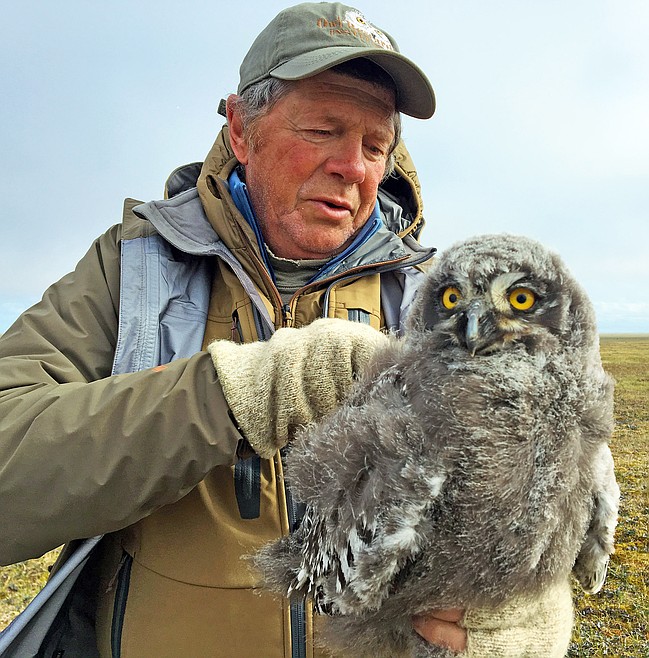
Denver Holt will be the keynote speaker at a special program hosted by Coeur d’Alene Audubon Society at the Coeur d’Alene Public Library on Wednesday, May 13.
Photo courtesy The Owl Institute
In the Arctic, the survival of a powerful predator often depends on a creature small enough to fit in the palm of your hand. For more than three decades, Denver Holt has been uncovering the ecological story linking the iconic Snowy Owl with the tiny but vital Brown Lemming.
That delicate balance of life on the Arctic tundra will take center stage this May when the internationally recognized owl researcher visits North Idaho to present a special program hosted by Coeur d’Alene Audubon Society at the Coeur d’Alene Public Library on Wednesday, May 13, from 7 to 9 p.m.
Holt’s presentation, “Snowy Owls & Lemmings: 35 Years of Predator–Prey Dynamics in the Arctic,” offers a fascinating window into one of the most remote ecosystems on Earth and the ecological relationships that sustain it.
For more than three decades, Holt and his team from the Owl Research Institute, located in Charlo Mont., have conducted field research near Utqiagvik, Alaska (formerly Barrow), the northernmost community in the United States and one of the few places where snowy owls regularly breed. Each summer, researchers traverse more than 100 square miles of tundra to monitor nests, track breeding success and study the owls’ primary food source: the brown lemming.
Holt’s long-term research, the longest running snowy owl study in North America, has documented dramatic fluctuations in both species. In some years researchers find dozens of nesting owls, while in others there may be none. These changes are shaped by a complex mix of environmental factors, including vegetation cycles, snow conditions and climate patterns that influence lemming populations.Understanding these predator-prey dynamics is vital for the broader Arctic ecosystem. When lemmings are plentiful, predators such as Arctic Fox and Jaeger focus their hunting on rodents rather than the eggs and chicks of other birds, indirectly benefiting many species that nest on the tundra.
When lemming numbers fall, the ripple effects move through the entire food web. Holt will also discuss long-term trends researchers have observed over decades of monitoring.
While population highs and lows are natural, evidence suggests that both snowy owls and their prey may be declining in parts of the Arctic, raising new questions about environmental change in one of the fastest-warming regions on Earth.
A widely respected authority on raptors, Holt’s research has been published in numerous scientific journals. He also serves as team leader for the Cornell Lab of Ornithology Snowy Owl species account. His work has been featured by major outlets including National Geographic, The New York Times, PBS, The Walt Disney Company and natural history broadcaster David Attenborough.Beyond the science, Holt’s presentations are known for bringing audiences directly into the field, from banding snowy owl chicks on the windswept tundra to witnessing the dramatic defensive dives of parent owls protecting their nests.
For bird lovers, conservationists, and anyone fascinated by wildlife, the program offers a rare opportunity to explore the hidden rhythms of Arctic life and the value of long-term scientific research.
The event is free and open to the public.
The Coeur d’Alene Audubon Society now meets at the Coeur d’Alene Public Library on the second Wednesday of each month from 7 to 9 p.m., and all who share an interest in birds, nature and conservation are welcome to attend.