
Flathead Lake stewardship is a generational responsibility
Coby Gierke | Daily Inter-Lake | UPDATED 3 hours, 37 minutes AGO
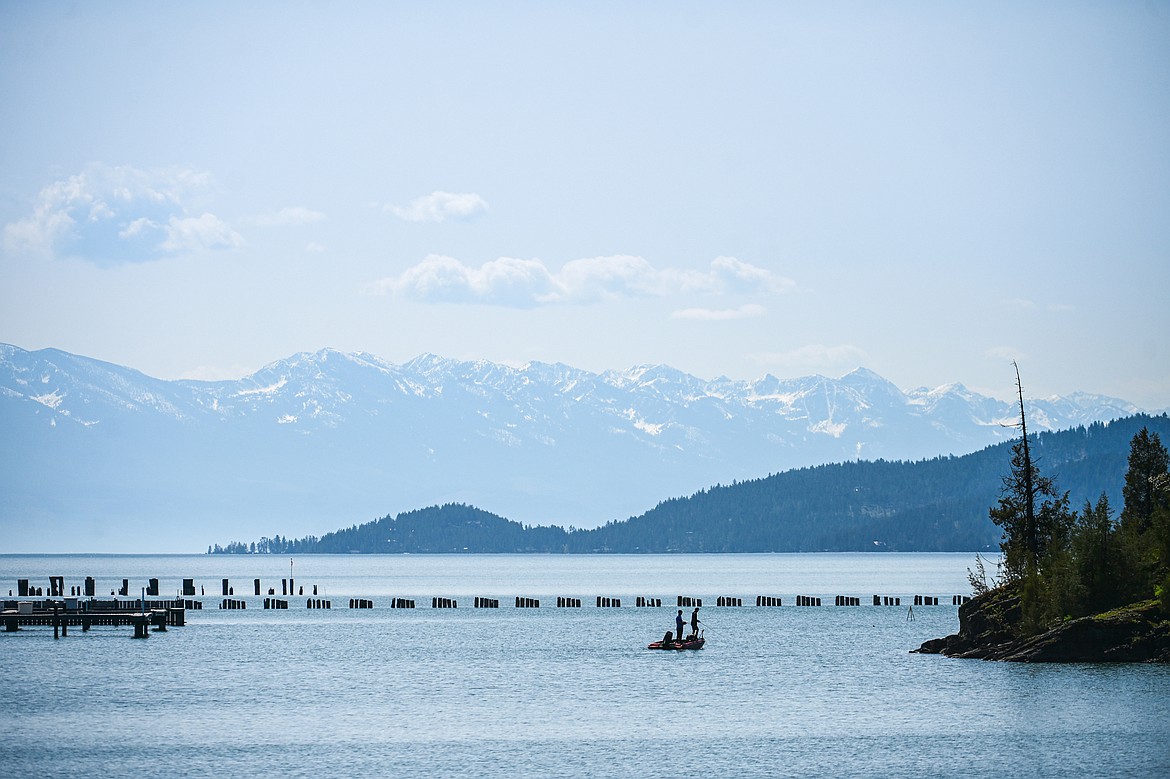
Fishermen cast lines into Flathead Lake in Somers on Saturday, May 2. (Casey Kreider/Daily Inter Lake)
Casey Kreider
It’s no accident that Flathead Lake is world class for clarity and water quality. It has been protected over time because leaders made sound choices — grounded in traditional wisdom, science and good governance, knowing that once water quality is lost, it is extraordinarily difficult to restore.
Flathead Lake remains pristine even with significant population growth in the watershed — growth that will continue into the future. We believe that growth and water quality are not competing concerns but can be managed in harmony through careful planning.
That is why the current wastewater proposal involving Flathead County, the Lakeside Water and Sewer District, and the Montana Department of Environmental Quality needs more scrutiny and accountability than it has received if we are to strike the right balance between growth and this irreplaceable natural and economic resource.
The flash point is that Flathead County faces a real environmental problem: how to manage septage, the concentrated waste pumped from tens of thousands of septic systems. This material is not ordinary wastewater or sewer sludge. It contains high levels of nutrients and contaminants, including PFAS (forever chemicals), pharmaceuticals, heavy metals and microplastics.
Originally, the county said it would treat this waste before handing it off to another entity for disposal. Officials were explicit — they would be “a client, not a discharger.”
Instead, the county now plans to deliver untreated septage to the much smaller Lakeside Water and Sewer District to be mixed into their domestic sewage, shifting both the technical burden of treatment and the risk onto a system not originally designed for it. That decision did not happen in a vacuum. It happened because no larger treatment plant would take responsibility.
That fact alone should give decision-makers pause.
Yet, DEQ has allowed the project to move forward piecemeal — approving major expenditures while serious questions about septage remain unanswered. This kind of phased approval may make projects easier to advance, but it makes risks harder to fully evaluate.
As it stands, treated effluent (sewage and septage) of up to 900,000 gallons per day, will be discharged into shallow groundwater less than a mile north of Flathead Lake,where the water table can be less than ten feet below the surface, and the complicated and not fully understood integration of surface and groundwater forms a pathway directly to Flathead Lake.
The proposed injection treatment focuses on nitrogen and phosphorus, and concludes natural soil processes will reduce nitrogen pollution over time but not phosphorus which will eventually reach the lake.
More troubling, an independent engineering analysis found the original modeling to be flawed and predicted contaminants could move far faster than the projected 30 years. Certain glacial outwash formations could vastly speed up transfer of injected effluent in a quicker path to the lake.
DEQ has this report, yet has not squarely addressed the conflicting predictions. So, we ask: Who is accountable if the original assumptions are wrong?
Is it Flathead County, which changed the plan and shifted responsibility? Is it the Lakeside district, which agreed to take on a role it was not designed to do? Or is it DEQ, which approved the project without resolving the scientific disagreement or evaluating the cumulative impacts?
The answer is unclear and that is the problem.
This is not how Montana has traditionally handled decisions of this magnitude. When uncertainty exists — especially credible scientific disagreement — leaders are expected to slow down, not push forward.
Ultimately, the true risk falls on the lake itself. Flathead Lake is a cornerstone of the region’s economy, ecology and identity. It supports tourism, recreation, property values and a way of life that depends on clean water. The impacts know no political boundaries and will affect all in the watershed and many, many beyond.
If this project moves forward as proposed and problems emerge later, there will be no easy fix — and no way to undo the damage. This moment is critical. Our growth needs careful management of the consequences.
Public officials cannot treat this as a routine infrastructure decision. It is a test of whether short-term expedience overrides long-standing commitments to protect one of Montana’s most important natural resources.
At a minimum, this plan should be paused until the full impacts are clearly understood, the science is openly reconciled, and responsibility is unambiguous. If this goes badly wrong, the consequences will last generations.
Coby Gierke is executive director of Flathead Lakers.