
Flathead basin posts above normal precipitation
LAKE COUNTY LEADER | Lake County Leader | UPDATED 1 week AGO
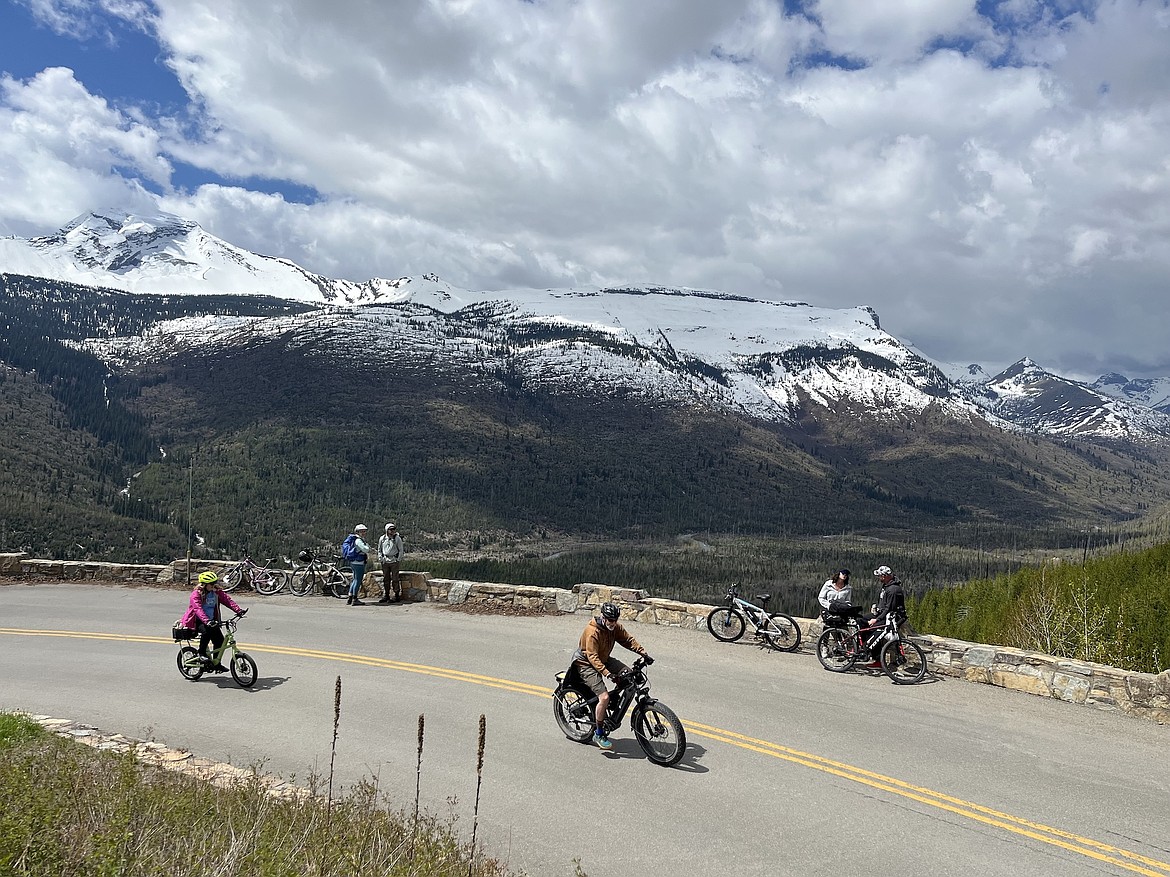
There's still snow in Glacier National Park, which feeds the Flathead Basin watershed -- and bike riding opportunities too, as these cyclists discovered while pedaling up Going-to-the-Sun Road on Mother's Day weekend, while it's still closed to cars and buses. (Kristi Niemeyer/Leader)
While snowpack conditions across much of the western United States remain uniformly poor, the snowpack across Montana watersheds paints a more nuanced picture.
According to the most recent report from the USDA Natural Resources Conservation Service, warm temperatures and variable precipitation defined the winter of 2026. As a result, the snowpack conditions varied greatly across aspect and elevation.
Still, the Flathead basin is among a handful with above normal precipitation and snowpack levels. The basin’s precipitation was 114% normal in April, with year-to-date (October-April) perched at 118%.
December’s atmospheric river was a major factor, bringing 211% median precipitation to the area; another key player was March with 167%.
The Flathead wasn’t alone. April brought near normal monthly average temperatures across the state for the first time this snowpack season, along with near to above normal precipitation across the state. While April storms stalled snowmelt, they still fell short of meaningfully improving snowpack conditions in most drainages.
As of May 1, snowpack statewide ranged from 40% to 100% of median. “In such a variable year, looking at smaller watersheds as opposed to major basins provides a more accurate picture,” explains Florence Miller, USDA Natural Resources Conservation Service hydrologist.
Regions that benefitted the most from spring storms, such as the Missoula and Flathead areas, Flint Creek, Mission, Swan and Blackfoot valleys, have near normal snowpack. Higher elevations in the Beartooths report near normal snowpack as well.
The rest of the state has well below normal snowpack at 40% to 85% of normal. The Bighorn, Powder and Tongue basins have 25% to 60% of normal snowpack, with the Powder and Tongue basins recording their lowest years on record.
Still, the Flathead is below the 20-year median, at 84% the median snowpack on May 1. East of the divide, most forecasts fall between 70% to 90% of normal.
In addition to causing significant variability in snowpack distribution, the warm winter also led to accelerated snowmelt. Most SNOTEL measuring sites reached peak snowpack accumulation, and transitioned into snowmelt, several weeks earlier than usual.
Thirty-two SNOTELs recorded their earliest melt-out date on record, which in turn triggered early runoff, with many watersheds across the state experiencing well above normal March and April streamflows.
Water-year-to-date precipitation totals remain near to above-normal, largely carried by December’s atmospheric rivers. As a result, soil moisture looks promising across much of northwestern Montana and parts of central and eastern Montana.
While most of the state remains under drought conditions, the Upper Clark Fork and Flathead Lake area are the exceptions, with the Flathead Lake area improving to no-drought status since last month.
However, well below-normal soil moisture is intensifying in many areas, with 87% of the state is in drought conditions, and extreme drought conditions persisting along the Rocky Mountain Front and in southwest Montana.
The NOAA Climate Prediction Center projects all of Montana to have above normal temperatures in the next 8-14 days. Below normal precipitation is predicted during this time period as well.
The NRCS Water Supply Forecasts for May 1 predict below normal streamflow statewide, with substantial regional contrasts. Regions favored by spring storms, including tributaries of the Upper Clark Fork, Blackfoot, Bitterroot, and drainages of the Swan and Mission Mountains, are forecast to see near normal streamflows, while the three forks of the Flathead River are predicted to have streamflows of around 80% of normal.
The Mission Mountain and Swan drainages are among only a handful of areas that can expect near normal flows between May and July at 85%-115% of normal.
Regions experiencing more severe drought conditions, such as the Beaverhead and the Three Forks of the Missouri, are projected to have 60% to 75% of median streamflow, while the Musselshell, Shields, Tongue, Powder, and Bighorn are forecast to have less than 65% of normal streamflow.
Most Montana reservoirs reported near to above normal end-of-April storage levels, including Flathead Lake, which sits at 82% capacity – higher than last year at this time, when it was at 49% capacity at the end of April.
“Spring precipitation and cooler temperatures to slow snowmelt could help improve these forecasts, though in most regions, full recovery to normal streamflows is unlikely,” said Florence. “Current predictions of warm temperatures and below normal precipitation could result in more severe streamflow deficits, with rivers reaching well below normal volumes.”
She also noted that with snowmelt occurring earlier than normal, “runoff volumes are likely to be shifted earlier in the season.”
For a complete report, visit nrcs.usda.gov/montana/snow-survey.