
Outstanding in his field, out hiking in the mountains: Whitefish scientist reflects on Nobel Prize
JULIE ENGLER | Hagadone News Network | UPDATED 5 months AGO
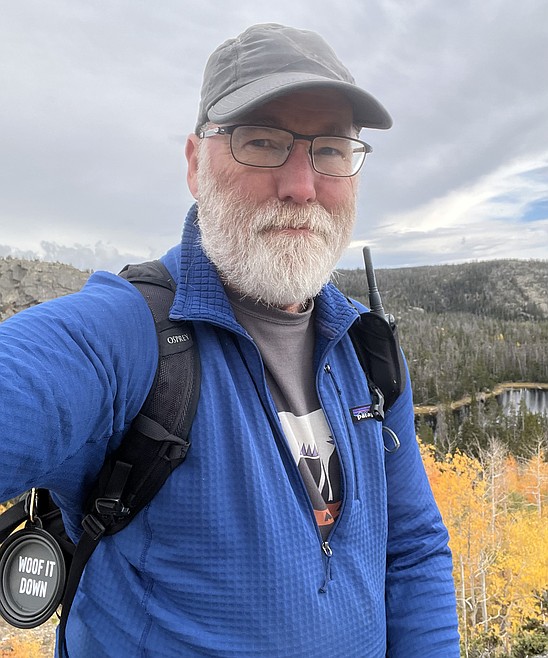
Fred Ramsdell spends half the year living in Whitefish and enjoying the outdoor recreation in the West. He was awarded the 2025 Nobel Prize in Physiology or Medicine. (Photo provided)
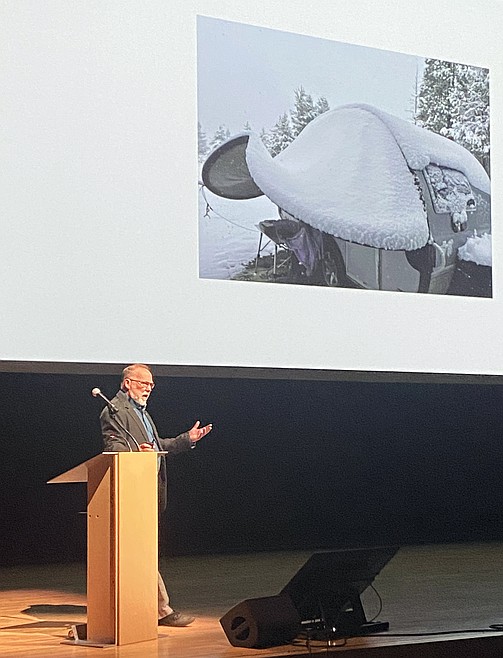
Fred Ramsdell told the audience at the Wachholtz Center about the Nobel Prize Foundation calling him six months ago while he was camping.. (Julie Engler/Whitefish Pilot)
Julie Engler covers Whitefish City Hall and writes community features for the Whitefish Pilot. She earned master's degrees in fine arts and education from the University of Montana. She can be reached at [email protected] or 406-882-3505. | May 20, 2026 1:00 AM
Dr. Fred Ramsdell, winner of the 2025 Nobel Prize in Physiology or Medicine, gave a talk at the Wachholz Center in Kalispell May 9, and although he collected the award six months ago, he said, “It’s still surreal.”
He and his wife, Laura O’Neill, built a house near Whitefish in 2019 and spend the colder half of the year hiking, biking and skiing nearby.
Ramsdell recounted the story of the Nobel Foundation phone call, which he missed, while he, O’Neill, and their dogs were on a camping trip in the Absaroka Mountains.
The next day, while driving back into an area with cell service, O’Neill’s phone lit up with hundreds of messages from friends, congratulating Ramsdell for winning the Nobel Prize.
"I was one of the last people to know I had won the prize,” he said. “It was an interesting experience. Apparently, I'm the hardest person they've ever had to find to tell them they won a Nobel Prize. I’m a little proud of that, actually.”
He shared a photo of the unusual mail he received – a handwritten envelope from the Nobel Prize, containing a 29-page instruction manual for Nobel Prize recipients. He wondered what the Whitefish mail carrier might have thought about the unique parcel.
“Once you get to Sweden, you get treated like, literally, a rock star, which was, again, very weird for me, but it was fun,” Ramsdell said.
The actual medal is solid gold, “quite heavy,” and is not to be worn around one’s neck.
RAMSDELL AND HIS colleagues, Mary Brunkow and Shimon Sakaguchi, were awarded the 2025 Nobel Prize in Physiology or Medicine for their research on how regulatory T cells keep the immune system from attacking the body’s tissues. The team also garnered the esteemed Crafoord Prize in 2017.
Ramsdell explained that T cells, named so because they develop in the thymus, control most of the adaptive immune response. When they see a virus, they grow, expand and begin to reject the virus.
“There are billions and billions of T cells in your blood, in your lymph node, in your tissues, and they all see different things,” he said. “The diversity of this adaptive immune response is really incredible, and it doesn't know what it's going to see before it sees it, which means it can see almost anything. Which means it could see you.”
He noted that in 1901, Paul Ehrlich postulated the body has tricks that prevent it from attacking itself. Fifty years later, scientists found that to be true, mostly because of T cells and a filtering system in the thymus.
“We have this great filtering system as a way to get rid of self-reactive cells, cells that can see our own cells and cause damage,” he said, adding that the filtering is not perfect because we have hundreds of autoimmune diseases, like rheumatoid arthritis, multiple sclerosis, psoriasis, ulcerative colitis and Crohn's disease.
"These are all cases in which your immune system recognizes your body, and it happens in about 10% of people,” he said. “That's where it got really interesting to people like me. What is it that prevents us, then, from attacking our own bodies?”
He said currently, most drugs to treat autoimmune conditions are chemicals, like statins and antibiotics. Other drugs are proteins, like Humira and Stelara. Ramsdell and his team are proposing to use the patients’ own cells.
“We're actually bringing back the normal immune system. We know these cells can live in people for decades, and we can cure people of their disease rather than treat people of their disease,” he said. “We're not there yet. It’s still aspirational. But I think anyone who works in this field now believes that there's a very legitimate path to getting to this point, which is something I don't think anyone could have said five years ago.”
RAMSDELL STUDIED for two years at community college before taking an undergraduate class from a well-known immunologist at the University of California San Diego that changed his life’s path. Although he admitted his grades were not great, he had intended to enter medical school before dedicating himself to immunology.
“I just got hooked because I think I said, even back in the early 80s, that this is responsible for all human disease and this immune system has its hands in everything,” he said. “I want to figure out how this works. Research is way more fun to me than medicine.”
Being wrong is an inevitable part of being a scientist, so being able to bounce back from that sort of adversity is a requirement. Ramsdell has that quality.
“I don't know what that is. I do think I'm a stubborn person. I don't like to lose, and I like to get to like to get answers,” he said. “Every scientist fails way more than they succeed. If you can't find a way to be comfortable with that, and get through that, then you should not be a scientist.”
He referred to a statistic about top ranked tennis players winning only slightly more than half of the points they play. They fail 46% of the time.
“You better be able to deal with that or you're not going to progress and be successful,” he concluded.
Between 1901 and this year, 990 people and 28 organizations have been awarded a Nobel Prize. Only 232 have won a Nobel Prize in Physiology or Medicine. Ramsdell knew the odds were stacked against winning, and he didn’t spend time thinking about it.
His older sister is rightfully proud of her brother and that’s fortunate, because his friends razz the Nobel Prize winner.
"My friends give me a lot of crap, which is totally appropriate,” he said. “There is no way this will go to my head.”
Reporter Julie Engler can be reached at 406-862-3505 or [email protected]. If you value local journalism, pledge your support at whitefishpilot.com/support.
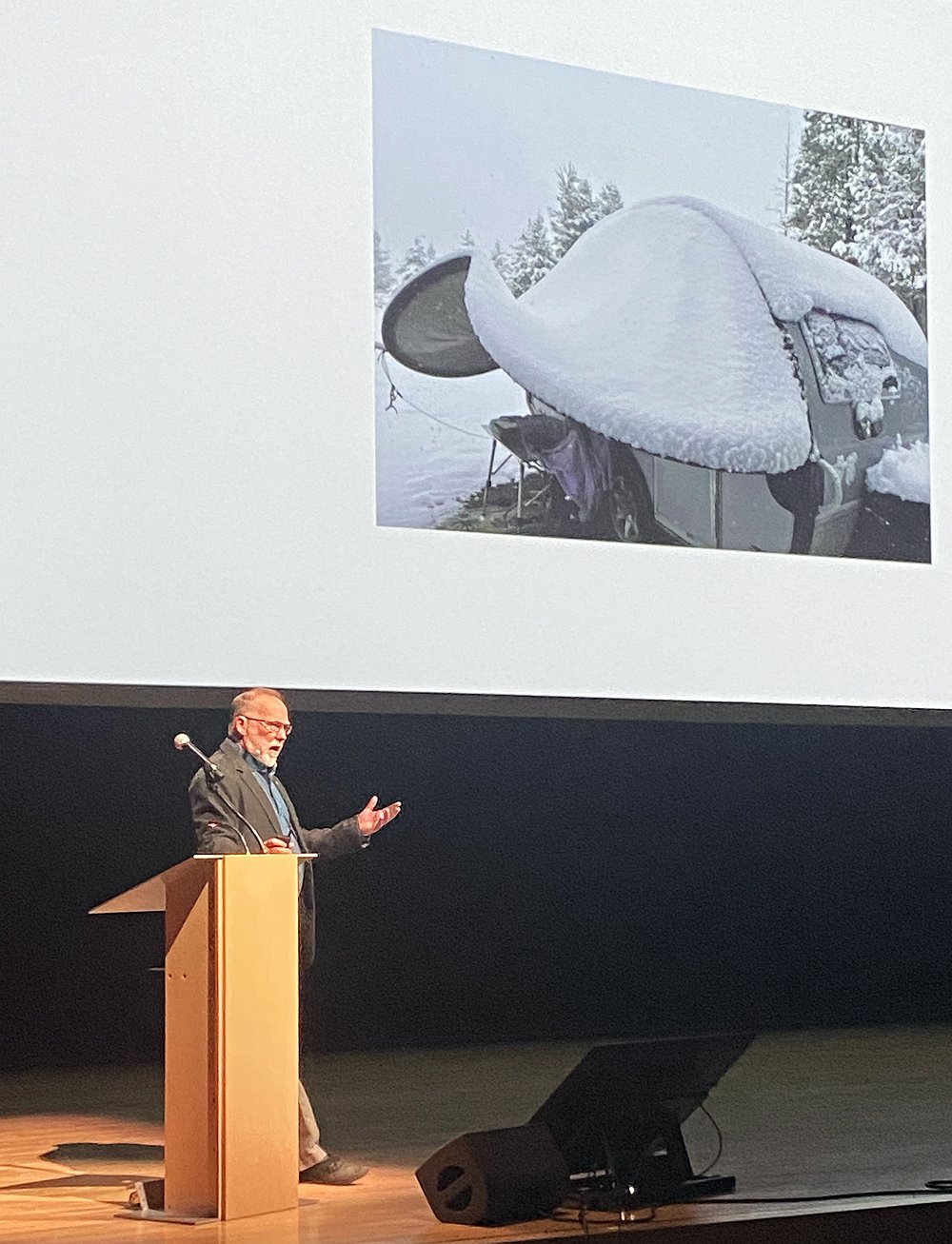 Fred Ramsdell told the audience at the Wachholtz Center about phone call he missed from the Nobel Prize Foundation while he was camping in Wyoming. (Julie Engler/Whitefish Pilot)
ARTICLES BY JULIE ENGLER
Photo: Water tank rises in Whitefish
The tank for the Whitefish south water tower was hoisted on Thursday, Oct. 8.
Whitefish soccer teams advance to state semifinal round
Whitefish soccer continued its winning ways in the quarterfinals of the Class A playoffs at home Saturday.
O’Shaughnessy Center gets upgrades and design refresh
Recent upgrades to the O'Shaughnessy Center have increased the building’s energy efficiency and prepared the nearly 30-year-old facility to serve the needs of the growing community into the future.