
Commissioner pens book on epic basketball team
KRISTI NIEMEYER | Hagadone News Network | UPDATED 5 months AGO
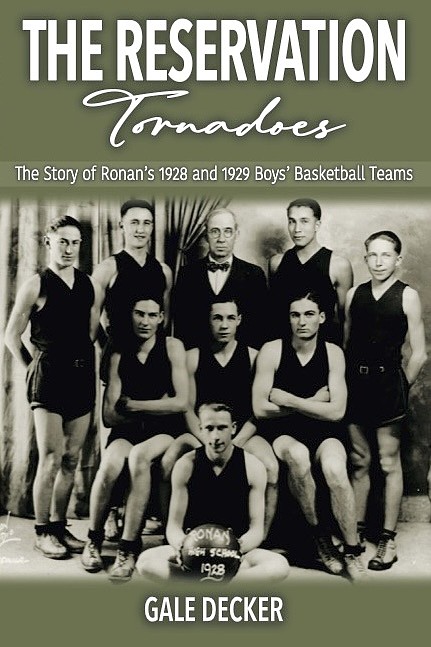
"The Reservation Tornadoes" by Gale Decker
Kristi Niemeyer learned her newspaper licks at weekly newspapers, beginning at the Mission Valley News in 1981, then at the helm of the Ronan Pioneer and, eventually, as co-editor of the Lake County Leader until 1993. She launched and co-published Lively Times, a statewide arts and entertainment monthly, before returning to the Leader in 2022, and serving as its editor until July 2026. Reach her at [email protected] | May 21, 2026 12:00 AM
Aside from his day job as Lake County Commissioner, Gale Decker is an unabashed sports fan – especially when it comes to his alma mater, Ronan High School.
That dedication to his hometown and high school sports fueled a deep dive into the evolution of basketball in Montana and the surprising success of Ronan’s 1928 and ’29 boys basketball teams that’s at the heart of his book, “The Reservation Tornadoes.”
“I am not a book writer by trade,” he notes in the introduction. “I’m better described as a researcher who is absorbed by history and sports.”
As a former player and a coach of Ronan girls and boys sports for 40 years, Decker brings an experienced eye to his topic. But his skills as a researcher carry the book well beyond the story of an epic team dubbed The Reservation Tornadoes.
Perusing the records of the plethora of smalltown newspapers in existence in the 1920s, he tells how basketball evolved to fill a niche for winter sports, offering exercise during the cold months between football and track and field; discusses the evolution of gymnasiums, which hadn’t been regarded as an essential component of public schools in those early years; and examines the Montana High School and Montana Official’s associations, created to oversee the fledgling field of school athletics.
He also shares nuances of the sport a century ago, when it was “bad form to jump in order to shoot the ball.”
His slim volume of less than 100 pages even touches on the Hellgate Treaty of 1855 and the subsequent opening of the Flathead Reservation to homesteading in 1908, and chronicles the development of small towns and schools across the reservation, from Arlee to Polson.
But his focus is a small team of five young men who nearly claimed the state championship in 1929, and their coach, Foster Polley, nicknamed “Prof” by his students. He arrived in Ronan with his family in 1921, and filled the role of both principal and math teacher.
He also coached girls and boys basketball, and both in the classroom and on the court, Decker writes that Polley demanded discipline and hard work.
In 1924, he took the Ronan boys to state, where they placed fifth – despite a school enrollment of less than 50 kids. The 1924 team was described as playing “a fast, rugged game” by the Daily Missoulian.
Four years later, starters Philip Roullier, Sam Clairmont, Kenneth Egan, Theodore “Bias” Stinger and George Hay played a more refined game. All were 19 or 20 years old and, with the exception of Hay, had played together since their freshman year. Three were enrolled members of the Confederated Salish and Kootenai Tribes. And since Polley didn’t believe in subbing players unless forced to, they were always on the floor.
In 1928, this crew bested St. Ignatius and Superior for the Western District tournament title and a berth at State, where losses to Great Falls and Manhattan landed them in fifth place.
The following year, the same “quint” claimed the Western District title again, with no losses all season, despite regularly playing schools with much larger enrollments. One sportswriter described the team as “smooth passers, marvelous shots, shifty, alert to every opportunity, dangerous on every play.”
Style, athleticism and teamwork took them to State again – where the team now commonly known as the Chiefs faced some stiff competition in Bozeman from 16 qualifying teams. They beat their first opponent, Great Falls (with a student population of 1,800), and bested Manhattan, but fell to Butte Central in the semi-finals. They won the consolation game against Anaconda, claiming third place, while finishing their season with a 23-1 record.
Why devote a book to a team that narrowly lost the state crown in 1929? The amateur historian and basketball buff casts them as “the greatest ever on the Flathead Reservation to don basketball uniforms.”
Don’t agree? Decker welcomes arguments to the contrary. “It would be a fascinating debate, something to look forward to during a long, cold Montana winter.”
Copies are available at Ninepipes Museum of Early Montana, by sending $20 (cash or check) to the author at 37814 Queen Point Lane, Polson, or at future book-signing events in Ronan and Pablo.
ARTICLES BY KRISTI NIEMEYER

Polson Farmers Market takes break after productive season
“My body’s ready for a break, but it’s been a good year,” said Eric Gedenk between sales at the Ploughshare Farm stand. The organic farm in Moiese is a regular vendor at the Polson Farmers Market, which wrapped up for the season last Friday morning.

The Ripple Effect: Poolside party raises more than $20,000 for aquatic center
The Ripple Effect, a fundraiser for Mission Valley Aquatics and Fitness in Polson, drew nearly 200 supporters to the poolside Saturday night for games, drinks, appetizers and auctions.

Incumbent Shelly Fyant faces Republican Charles Headley in HD 91 race
Incumbent Democrat Shelly Fyant is running for a second term in the House of Representatives against Charles Headley.