
Senate confirms Steve Pearce to lead the BLM in a party-line vote
AMANDA EGGERT / Montana Free Press | Bonners Ferry Herald | UPDATED 1 day, 15 hours AGO
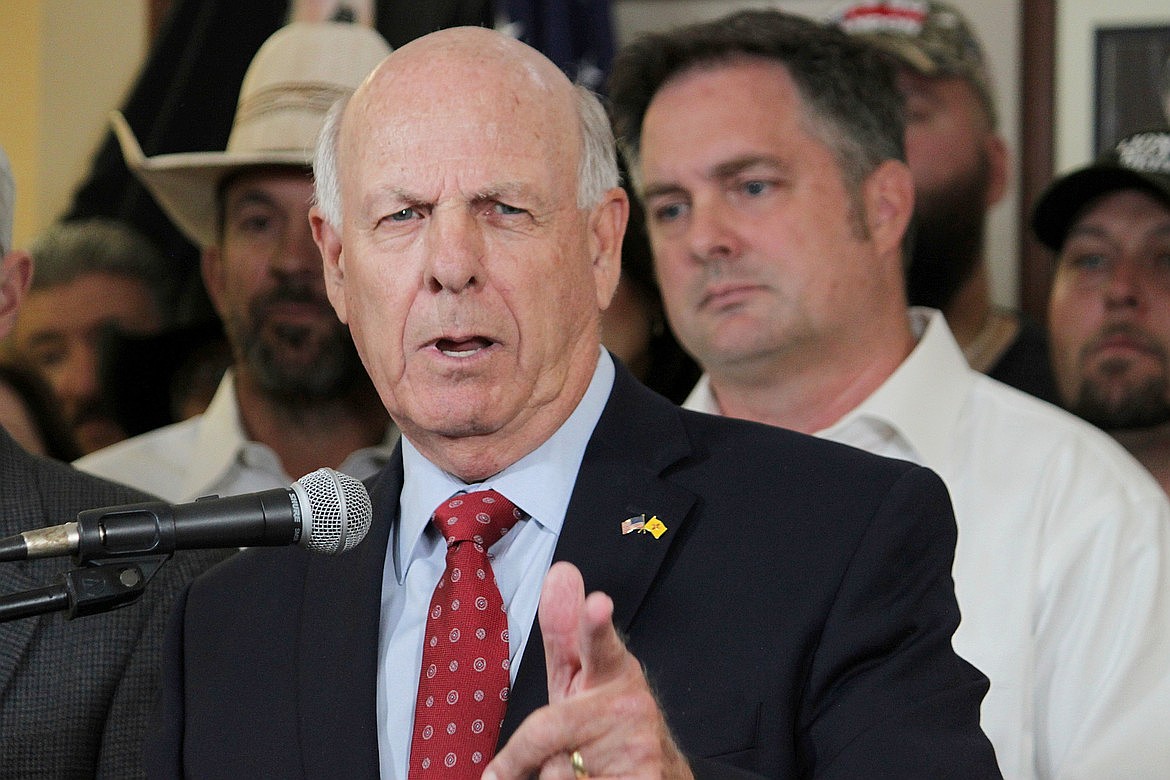
Trump public lands nominee and former Republican Party of New Mexico Chairman Steve Pearce speaks during a news conference in Albuquerque, N.M., Sept. 12, 2023.
AP Photo/Susan Montoya Bryan, File
The U.S. Senate narrowly voted to approve Steve Pearce’s nomination to lead the Bureau of Land Management. Pearce, a 78-year-old Republican, has deep ties to the oil and gas industry and a record of supporting federal land sales.
With a 46-43 vote along party lines, the former U.S. Representative from New Mexico has been cleared to lead the country’s largest management agency. As head of the BLM, Pearce will oversee 245 million acres of public land and 700 million acres of its subsurface mineral estate.
Montana Sens. Steve Daines and Tim Sheehy both voted to support Pearce’s nomination, which was considered “en bloc” alongside nearly 50 other positions, ranging from U.S. marshals to assistant secretaries of defense, among others. Idaho Senator Mike Crapo voted to support the nomination while Sen. Jim Risch did not vote.
The nomination of former U.S. Representative for New Mexico Steve Pearce to head the Bureau of Land Management has brought renewed concern about the fate of federal public lands in Idaho and the American West more broadly.
Prior to his political career, Pearce owned an oil and gas well-servicing company with his wife, Cynthia. A veteran pilot in the Vietnam War, Pearce has described his father’s employment in the oil fields of western Texas as pivotal to the Pearce family’s emergence from poverty.
More than 80 conservation and public land access groups wary of Pearce’s record on public land sales and environmental protection opposed his nomination in a January letter to the Senate Energy Committee.
Groups including the Center for Biological Diversity, Montana Conservation Voters and WildEarth Guardians argued in the letter that Pearce has demonstrated a willingness to play an “unwavering part in President Trump’s anti-environmental and anti-democratic agenda by heeding unpopular directives, propping up polluters, and selling off and selling out our public lands.”
Alan Zibel, research director with Public Citizen, a consumer- and citizens’- rights advocacy group, wrote in a Monday afternoon statement that Pearce is “primed to exploit his role at BLM for profit.”
“Unless you’re a fossil fuel or mining fat cat, his confirmation is a massive loss and a serious blow to anyone who cares about our nation’s extraordinary public spaces,” Zibel said.
Agricultural groups along with oil and gas lobbyists, including the National Public Lands Council, the National Cattlement’s Beef Association, and Western Energy Alliance, have supported Pearce’s nomination.
In an emailed statement, Western Energy Alliance President Melissa Simpson said that Pearce understands the agency’s multiple-use mission, which directs BLM to consider natural resource development alongside the conservation of resources for future generations.
“His tenure in Congress and his time as a small business owner in the oil field show he’s a champion of multiple-uses of public lands from expanding domestic energy production, supporting grazing and recreation, and protecting landscapes through targeted conservation,” Simpson said. “We look forward to his leadership at BLM.”
Trump has described Pearce as being supportive of the White House’s “drill, baby, drill” energy development agenda. During Trump’s first term, the Senate did not confirm a BLM director. Unconfirmed political appointees and acting directors administered the agency instead.
Pearce also signed onto a letter in 2012 advocating the federal government divest from its land holdings that notes “over 90% of this land is located in the western states and most of it we do not even need.” That letter continued, stating, "strategically transferring ownership" of these land holdings could improve federal revenues and foster "more productive and local land management."
Pearce's confirmation comes roughly a year after Idaho Congressman Mike Simpson signed on to co-sponsor the Public Lands In Public Hands Act to protect against most land sales or transfers and otherwise require congressional approval for land sales in excess of 300 acres and water-adjacent land in excess of five acres.
Also in 2025, Crapo and Risch both came out against a failed provision within the One Big Beautiful Bill Act that required the sale of millions of acres of federal public land holdings between the U.S. Forest Service and the Bureau of Land Management.
As a member of the Senate Natural Resources Committee, Risch directly questioned Pearce in February about his credentials to head BLM and pressed him on his public lands stance specifically.
During that exchange, Risch asserted “Idahoans do not want their public lands sold” and underscored that Pearce’s potential role would give him “nothing to do” with wholesale land sell-offs with the approval of Congress — a possibility Risch described as “extremely unlikely.”
Pearce responded he would follow the law and the direction of impacted congressional members when it comes to the “distribution of land.”
At the time, the Conservation Voters for Idaho issued a release commending Risch’s emphasis on federal public land protections and opposing Pearce’s nomination for the top role at BLM.
“When Steve Pearce sells America’s public lands for private development, they are gone forever,” Alexis Pickering, executive director of Conservation Voters for Idaho, said in a prior statement. “We can’t afford a BLM Director like Steve Pearce that will squander our most precious resource; the public lands that provide revenue, habitat, public recreation, and support our Idaho way of life.”
With Pearce now poised for confirmation, the Sierra Club, an environmental advocacy organization, issued a release Monday opposing Pearce’s nomination, asserting his past actions as a representative, as well as his ties to the oil industry, are indicative of a willingness to sell off federal public lands.
“Pearce has a track record of prioritizing corporate interests over people, no matter what ‘promises’ he’s made to Sen. Risch," Lisa Young, director of the Sierra Club Idaho Chapter, said in the release, "and with him at the helm of the BLM, Idaho’s pristine waters, wilderness areas, and outdoor heritage are all at risk."
The organization also contested Risch’s assertion that the head of BLM lacks the authority to sell off public lands without congressional approval. The Federal Land Policy and Management Act directs BLM to retain most public lands but authorizes the sale or exchange of lands marked for disposal.
Tracts with disposal designation can be sold if they are scattered or isolated and therefore uneconomic to manage, if they were acquired for a specific purpose and no longer needed for said purpose. Disposal of these lands is also permissible if done for recreational use or other public purposes that serve to benefit the community or local/tribal governments.
A map illustrating lands with disposal designation was released on X and the Theodore Roosevelt Conservation Partnership in August. The interactive map, which was previously highlighted by the Idaho Statesman, marks numerous parcels with disposal designation across southern Idaho.
As for notifying Congress of land sales, this is only required for the sale of federal public lands if they exceed 2,500 acres, Nick Gevock, a Sierra Club campaign organizer for the Northern Rockies, said.
Though the organization was “thankful” for Risch and Crapo for coming out against the aforementioned public land sale provision, Gevock said the expected confirmation of Pearce, which would in turn vest him with land sell-off authority, undermines this stance.
The concern was echoed by Josh Osher, public policy director for the Western Watersheds Project, an environmental organization focused on public lands management.
Osher said the concern around BLM's future direction extends beyond the opportunity for public land sales under Pearce's leadership. He pointed to a continued shift in how the federal government manages public lands through the signing of good neighbor authority (GNA) agreements with the states that hand over public land management responsibilities.
"I think it is a steppingstone toward shifting the lands to state management," Osher said, "and I think they're expanding on it substantially."
This expansion was observed in Idaho at the close of last year, when the state's GNA agreement was supplemented with a new shared stewardship agreement, heightening the state's role in the management of federal public lands. The 2025 agreement represented an expansion upon a similar measure implemented in 2018.
At the signing of the renewed agreement, Idaho leadership including Gov. Brad Little and Idaho Department of Lands Director Dustin Miller said the changes would allow for better forest management by addressing overgrown forests that have led to increased fire risk and suppression costs as well as higher risk of insect and disease infestation.
It is also poised to double timber production in the state in the coming years, a target U.S. Forest Service Director Tom Schultz said was about a quarter of the maximum sustainable annual timber yield for Idaho, which the Forest Service has calculated to be 400 million board feet.
"This is their long-term vision of how public lands should be managed, that management should be turned over to the state, that the state should handle most of the environmental review, that the state should handle most of the contracting and the actual work that happens on the public lands," Osher said. "That's what the agreements signify."
•••
ROYCE McCANDLESS of the Coeur d'Alene Press contributed to this report.