
Where Is our captain?
STEPHEN SHEPPERD/Moving History Forward | Coeur d'Alene Press | UPDATED 4 months, 1 week AGO
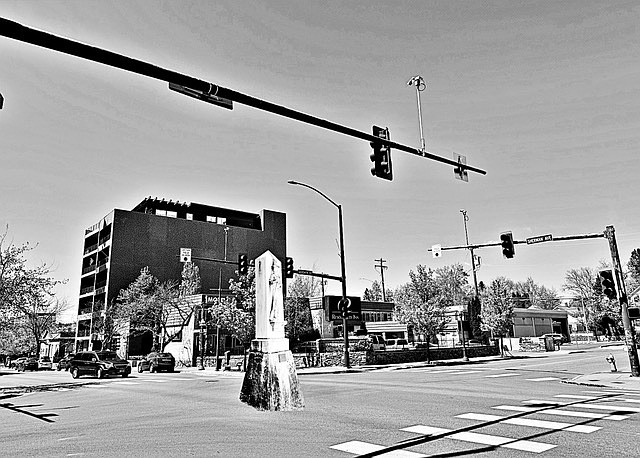
TRAFFIC HAZARD? There are no photos in the Museum of North Idaho archives showing exactly where Coeur d’Alene’s Mullan Statue was placed in the summer of 1918, but this photo-shopped picture of the statue placed at the modern-day 7th and Sherman, will give you some idea of how it might have looked.
Stephen Shepperd Photo
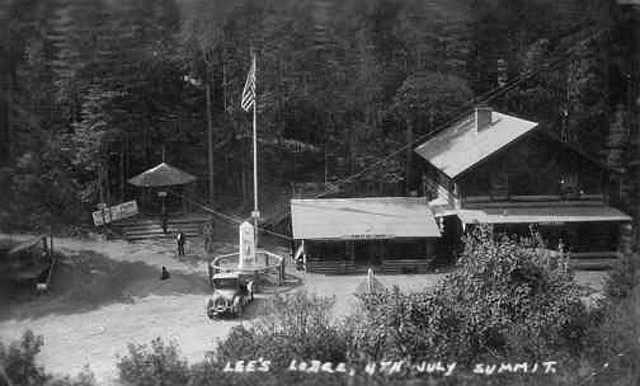
LEE LODGE: Lee Lodge, at Fourth of July Summit, was constructed from logs hewn from the nearby forest. The lodge was built on land adjacent to the Mullan Statue by S.J. Lee as a traveler’s rest, offering lodging, food, and fuel.
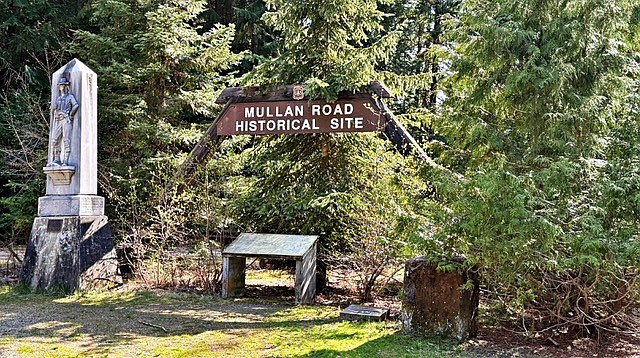
MULLAN ROAD HISTORIC SITE: The Captain John Mullan Statue as it appears today near the top of Fourth of July Pass. The statue and an explanatory sign sitting next to it appear to be suffering from some neglect.
There was once a total of 16 John Mullan marble monuments to be found along the path of the road that the Army captain had helped engineer from Fort Benning in Montana to Fort Walla Walla in Washington. Six of them were placed in Idaho communities.
The W.A. Clark family of Butte, Mont., presented one statue each to the communities of Mullan, Wallace, Kellogg, St. Maries, Post Falls and Coeur d’Alene in collaboration with the Society of Montana Pioneers and the Idaho Historical Society. They were intended to mark the route that Mullan and his men had taken nearly 60 years earlier as he managed the construction of the military road.
Each of the 9-foot-tall statues was carved from a single block of Vermont granite from a sketch of Mullan drawn by frontier artist Edgar S. Paxon. They were then placed on a 5-foot-tall concrete base. Paxon, a self-taught artist, moved to Montana in 1877 and spent most of his life working in communities along the trail.
Many of you reading this have probably seen one or more of the Idaho monuments while visiting the aforementioned communities. All except the one that was presented to Coeur d’Alene. The cause of your confusion is simple — the monument is no longer located in the City by the Lake. But it was at one time.
The city was notified in March of 1918 that it would be receiving a statue. Mayor C.H. Potts was then tasked with selecting an appropriate location for it to be displayed. He turned the decision over to a committee of two, comprised of realtor Fred Fitze and prominent lawyer Nicodemus D. Wernette, to investigate and make the decision.
The two men chose the intersection of Seventh and Sherman to place the statue, and on July 19, 1918, a concrete base was laid there by the Western Montana Granite and Marble Company. Five days later, the statue arrived and was hoisted into place.
It appears that the location led to complaints from the driving public, and I have reason to believe it was actually placed in the middle of the Sherman. Over the next two years, the number of complaints increased, so during H.P. Glindeman’s term as mayor in 1920, a petition was presented to the City Council to have the statue moved to City Park because it was increasingly seen as a traffic hazard.
Surprisingly, the City Council voted not to move the statue, so it stayed in place at Seventh and Sherman. But the petitioners won out when the council later authorized the statue to be moved to the park due to plans that emerged to pave Sherman Avenue.
The next move for the statue came in 1921. That is when it became part of a master plan to create a 50-acre park which would surround the historic Mullan Tree. At a dedication ceremony of the new park on Fourth of July Pass on Sept. 21, the statue was unveiled at its new location. Boy Scouts from Kootenai and Shoshone counties acted as color bearers, and then George Weeks and Addison A. Crane gave short remarks. Crane, the manager of Exchange National Bank, along with State Highway Department District Engineer W.I. Bennett, had coordinated the park project, arranging to truck the statue to its new home via U.S. 10.
The park became a favorite spot for travelers, especially when, in 1924, Lee Lodge, a rustic hotel, was built in the park from logs hewn from nearby trees. Owned by S.J. Lee, it offered lodging, food and fuel for weary travelers crossing the pass.
In 1930-31, Highway 10 was realigned, and a tunnel was constructed through the summit. To make the statue more accessible, it was placed at a spot just east of the tunnel, facing the highway.
When President Eisenhower’s Interstate Highway System pushed through the Canyon, the tunnel was closed and buried. This time, the statue was moved away from the highway to an abandoned section of Old Highway 10, which was dubbed the “Mullan Pass Historical Site” And that is where it resides today.
A recent visit to the statue revealed that the statue and the explanatory signage that was installed adjacent to it in 1988 do not appear to have been maintained. Sadly, Mullan’s face has been mostly broken away, and the statue’s once bright white marble has become tarnished by the elements. It appears in sad shape. Perhaps it is time to band together to bring the statue home to Coeur d’Alene? I know just the spot to put it … on the lawn adjacent to the Museum of North Idaho, where everyone can see and enjoy its history.
 LEE LODGE: Lee Lodge, at Fourth of July Summit, was constructed from logs hewn from the nearby forest. The lodge was built on land adjacent to the Mullan Statue by S.J. Lee as a traveler’s rest, offering lodging, food, and fuel.
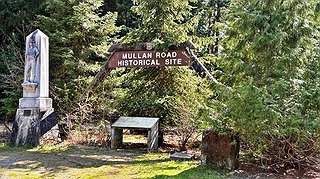 MULLAN ROAD HISTORIC SITE: The Captain John Mullan Statue as it appears today near the top of Fourth of July Pass. The statue and an explanatory sign sitting next to it appear to be suffering from some neglect.