
JUNE NIBJ: Idaho growth fueled by migration
JOSH McDONALD | Hagadone News Network | UPDATED 1 month, 3 weeks AGO
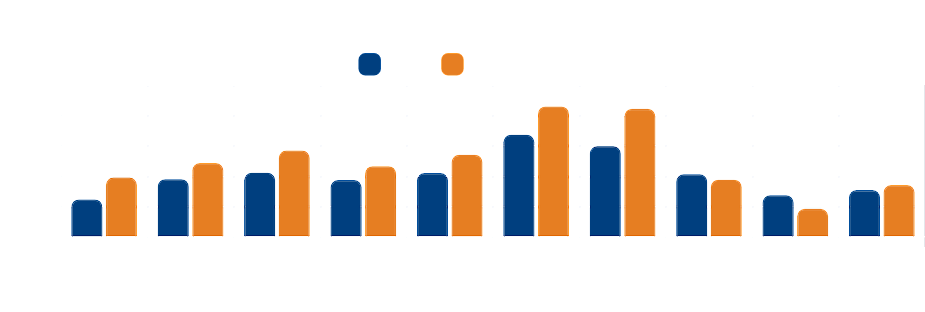
Data from the U.S. Census Bureau shows that North Idaho has largely outpaced the state as a whole in terms of population growth by percentage.
Graph generated using Microsoft Copilot
Over the past 16 years, Idaho has become a destination for hundreds of thousands of new residents, with most arriving from a small group of Western states. That steady influx, driven largely by migration rather than births, accelerated sharply during the COVID‑19 pandemic and continues to reshape communities across the state — especially in northern Idaho.
For many longtime residents, the question has remained consistent: Who is moving here, where are they coming from, and why Idaho?
Since 2020, Idaho has ranked alongside Florida as one of the fastest-growing states by percentage.
While the pandemic marked the most visible surge, the broader shift began years earlier. In the early 2010s, following the Great Recession, Idaho’s population growth was relatively slow, with net migration averaging only a few thousand people per year.
That changed in the middle of the decade. Between 2015 and 2019, migration increased significantly, with nearly 20,000 people moving into Idaho annually. The state’s population grew from about 1.57 million in 2010 to more than 2 million by 2024 — the most recent year with finalized data.
In a recent interview, Idaho Department of Labor economist Ryan Whitesides said the growth has continued but is increasingly concentrated in larger cities and surrounding suburbs.
“What we're seeing is Idaho's growth is broad but increasingly concentrated. In-migration is doing a lot of the heavy lifting,” Whitesides said.
Census Bureau estimates show those newcomers are coming primarily from a consistent group of states. California, Washington and Oregon account for the largest share of migrants into Idaho, with smaller but steady inflows from Utah, Texas and Arizona. In 2023 alone, more than 81,000 people moved to Idaho from other states, including roughly 17,000 from California and about 14,600 from Washington.
Those patterns did not change during the pandemic — they accelerated. Between 2019 and 2021, Idaho experienced some of the fastest population growth in its history, as remote work allowed more people to relocate and housing demand surged.
The drivers behind that movement are consistent across the data. Lower housing costs compared to West Coast markets, proximity to outdoor recreation and lower population density have drawn both working-age households and retirees. Migration has become the dominant factor in population change, accounting for the majority of growth in recent years.
During his opening address at the 2024 legislative session, Idaho Gov. Brad Little outlined some of the factors contributing to that growth.
“We are the least regulated state,” Little said. “We are one of the safest states in the union. We rank first for income growth. We have delivered more tax relief per capita than any other state. Idaho is one of the most fiscally responsible states, and we’re recognized for our ability to withstand any economic downturn. We’re number one for economic momentum. We’re a top ten state for best economy, rivaling Florida and Texas. In fact, Florida, Texas, and Idaho are the top three best states for small businesses.”
While growth has been statewide, it has not been evenly distributed. The Treasure Valley remains the primary population center, but northern Idaho has emerged as a major secondary growth region.
The five northern counties — Kootenai, Bonner, Boundary, Benewah and Shoshone — have collectively seen steady increases over the past decade, driven largely by expansion in Kootenai County. Between 2010 and 2020, Kootenai County alone added more than 32,000 residents, a 23.7% increase.
Growth in northern Idaho accelerated during the pandemic, when migration spread beyond major urban centers into smaller and more rural communities. Proximity to Spokane, Washington, combined with increased flexibility in remote work, contributed to rising population levels across the region.
Sarah Murphy, a Shoshone County-based Realtor with Local Real Estate, said she has helped many of those newcomers find homes in North Idaho. In her experience, many of the statistically backed reasons behind the influx are accurate, but lifestyle choices and politics have also played a role.
“I’ve seen a lot of Washington,” she said. “People want out of Washington because their tax rates are bad. So, definitely people looking to stay close to their family and jobs, but don’t want to deal with that tax base. But that isn’t really anything new for this region.”
Murphy also noted the range of people relocating to the area, including young people, single people, families and retirees.
In recent years, growth has continued to spread outward. Bonner and Boundary counties have seen steady gains as housing demand has pushed development beyond the Coeur d’Alene area, while Benewah and Shoshone counties have experienced smaller but consistent increases. State data shows nearly all counties in Idaho have grown since 2020, including rural areas that historically saw little change.
The impact of that growth is visible in infrastructure. Housing demand has increased sharply, with construction activity rising across the state. Transportation systems in high-growth areas, including the Coeur d’Alene region, have faced increased pressure as population levels rise.
The increased demand has also driven up housing prices. In 2021, Coeur d’Alene had one of the hottest real estate markets in the country, with the median home price rising dramatically. That surge left many lower-income residents struggling to find affordable housing and limited the ability of local officials to respond.
“We’re witnessing a lot of people relocating here from other parts of the country,” Kootenai County Commissioner Bruce Mattare said in 2024. “As long as people are willing to move here and pay whatever the market rate is for the properties, there’s little we can do to affect property values for workforce housing.”
Public services — including schools, utilities and emergency response systems — have also seen increased demand. In 2024, migration accounted for roughly 80% of Idaho’s population growth, underscoring its role as the primary driver of change.
Although population growth has slowed since its peak in 2021, Idaho continues to attract new residents at a rate above historical averages. The long-term trend remains clear: the state’s growth is largely driven by migration from other Western states, with northern Idaho playing an increasingly important role in absorbing that expansion.
ARTICLES BY JOSH MCDONALD

Sheriff confirms identity of remains found in St. Joe River
Sheriff confirms identity of remains found in St. Joe River

Mailou kicks off new era for Kellogg football
"We're going to be the hardest-working team on the field," he said. "We're going to bust our butts every day. No one is going to outwork us. I don't expect us to lose, but if we lose, that means we needed to learn something."