
130 years ago, the cornerstone was set for Old Main
Hungry Horse News | UPDATED 1 month, 2 weeks AGO
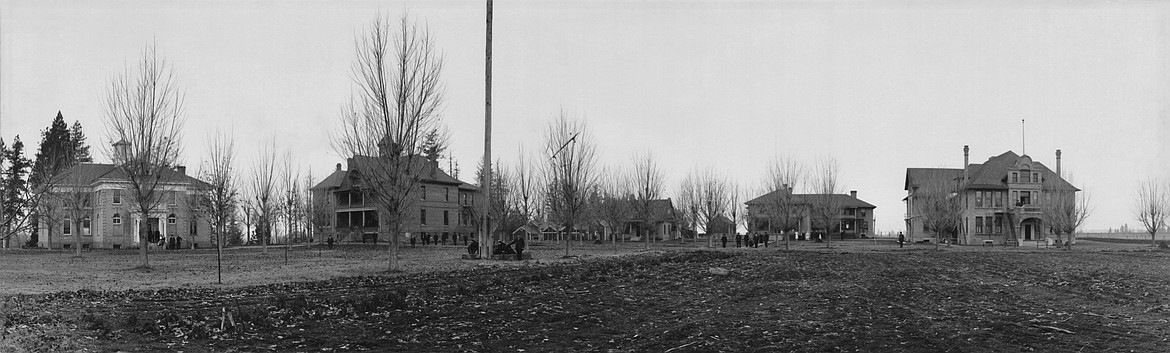
The Montana Veterans Home campus in the early 1900s.
Editor’s note: This article appeared in the Columbian Newspaper on June 4, 1896. Portions of the article are reprinted below.
A GREAT DAY
A Day Devoted to Honoring the Memory of the Dead, and to Comforting the Living, Soldiers who Preserved the Union of the States—The Greatest Gathering in Flathead County’s History.
A day of national colors, a day of enthusiasm, a day of patriotism, and a day of genuine enjoyment. Such was Memorial Day of 1896 to the three thousand people who gathered at Columbia Falls last Saturday. Years may roll along before so large a crowd is again seen in Flathead Valley, but patriotism and devotion to the union and its preservers has a monument in Montana, of which a cornerstone was so auspiciously laid on Saturday. It was an ideal day, an ideal gathering with not an incident to mar the pleasure of the throng.
The local Grand Army of the Republic (G.A.R.), Women’s Relief Corps (W. R. C.), and the Sons of Veterans joined civic societies and citizens at 8:45 a.m. to form columns at the Odd Fellows Hall in Columbia Falls. They marched to the day’s first formal exercises at Columbia Cemetery (Woodlawn Cemetery today).
One hundred vehicles followed the procession of fraternities to the impressive memorial service. A salute was fired over the grave of Veteran Milo D. Apgar while individuals placed flowers on the mounds of dear ones. Martial music and salutes made the Decoration Day ceremony particularly impressive.
Teams of all descriptions, troops of equestrians, and people afoot began arriving in Columbia Falls and at the soldiers’ home grounds as early as 7 o’clock. A balmy morning, good roads, and the expectations of an interesting program combined to bring to this city residents from every part of the county. Whole “neighborhoods” came from 20 to 30 miles away, and the roads from every direction poured living streams of humanity to the common center, until at 12 o’clock the large grounds of the soldiers’ home contained a throng variously estimated from 3,000 to 4,000 souls.
At the cemetery, the line was reformed at the railway crossing near the home. A special train from Kalispell brought Governor and Mrs. Rickards, escorted by the John A Gibbon Camp of Sons of Veterans. The Nat Lyons and George B. McClellan Posts, W.R.C. and I.O.O.F members, the Kalispell band, county and city officials and 300 school children disembarked from the train.
All were placed in carriages, followed by the citizenry. When the governor’s carriage reached the grandstand, the line extended to the railway, and the carriages were traveling three to five abreast.
The exercises opened with 300 school children singing patriotic songs, which formed one of the most enjoyable features of the exercises. The clear, young voices rang out with an enthusiasm and a musical earnestness that trained voices never attain. D. F. Smith welcomed everyone. Chaplain Ayres opened the ceremonies with prayer. Commander Garr dedicated the monument that had been erected in memory of the fallen comrades. The memorial monument was decorated.
At noon, the vast crowd scattered over the grounds and into shady groves for an old-fashioned picnic dinner. Friends and families from different parts of the county came together. The Ladies of the W.R.C. had a restaurant, ice cream, and lemonade stands for those who came without their lunch basket.
One gentleman counted 450 carriages, wagons, and buggies on the grounds. Quite a number of “wheelmen” went from Kalispell on their bicycles. Many of the wheels were decorated with bunting.
The Corner Stone Exercises.
At 2 p.m., Col. Dollman, president of the Soldiers’ Home Board, addressed the crowd. Then, Governor Rickards, orator of the day, spoke in part:
“What means this audience? Why are men, women, and children congregated today all over this fair land of ours? From the Atlantic to the Pacific, from the upper lakes to the gulf, in almost every hamlet, town, and city, are scenes like this. What does it mean? It is an expression of the nation’s gratitude and love.
“Memorial Day,” it is called. A memorial of what? In memory of our brave dead; in memory of those who laid down their lives in defense of our nation’s honor, in defense of our country’s flag.
“It is thirty-one years since the close of that terrible war; but ‘Memorial Day’ means as much to us today as ever, and it will be celebrated so long as flowers bloom.
“Today we feel that those who died, died not in vain; we owe to the living heroes who with them shared the hardships of the war, the hand of helpfulness and the heart of praise. Those who escaped the fatal shot and shell, weathered the miasma of the southland, or survived the horrors of the prison dens, are today bowing before the restless onslaughts of time. Yet a few more decades, and the magnificent army that burned away the barriers to universal liberty will have surrendered to the generalship of Father Time. Swiftly, his scythe is decimating their ranks, and battalion after battalion goes marching on to ‘the bivouac of the dead.’
“The further we get away from the stirring scenes and horrors of that war, the more we learn to appreciate the fruits of that great contest for freedom, the larger will grow the appreciation of American soldiery.
“In the years to come, no monument in marble will point its spire heavenward so impressively, no painting will so vividly portray to eye and ear, like patriotic song appeal to the ear, like the new earth buildings, preserved in reverence by the people that once did duty as the Soldiers’ Home.
“Gratitude to the living soldier is far more important in this practical world of ours than showing respect for the memory of those who have gone before. The nation owes to the survivors of the war its warmest affection and its most tender care. Thank heaven, the spirit of gratitude still lives, and the great throbbing heart of the American public is loyal to the interests of those who defended the flag.
“Old age and sickness finds many of our noble soldier boys helpless and in want. To meet these conditions, homes have been built and equipped for their support and comfort. Today we meet to lay the cornerstone of such an institution, that will when completed be dedicated to the patriotism of a grand Treasure state. No greater monument has been, or will be, erected upon the soil of this state than this tribute to the patriotic soldier of Montana.
“In selecting a location for the soldiers’ home, the board of managers made no mistake. So far as I know, no one has ever accused any member of that board of being a poet, yet they have located this home where it will be surrounded with one of the most beautiful poems ever written upon the scroll of nature by the infinite God. The rhythm of his magnificent river is an echo from fairyland; your splendid lakes, skirted by the rich verdure of your productive valleys, are dreams of loveliness. In no other portion of this great state are the elements of beauty and grandeur so finely blended into one, until their inspiration kindles the fires of admiration upon the altar of the most appreciative heart. Living within such environments as those, where ‘A thing of beauty is a joy forever,’ the old soldier will patiently await the call that will muster him out of the service for a greater and grander campaign of eternal bliss over the range.
“Yes, the board of managers did well. They conserved the interests of the old soldiers when they selected a site amid the generous bounties of nature and in a locality peopled by progressive and enterprising citizens. While I congratulate this garden spot of the state in securing the home, I feel that I should still more warmly congratulate the old soldier citizens of this state on the good fortune that located it upon the classic banks of the Flathead River.
“There can be no prouder moment for the patriotic heart than this, which witnesses the beginning of an era of reciprocity with the soldier boys, who, having once protected us in their old age, are entitled to our protection.
“This edifice, now in course of erection, reminiscent of the long ago, will mean more to the future than it does today. Dedicated to the noblest of purposes, expressive of Montana’s gratitude to the brave defenders of the nation’s honor, it will stand through the long roll of years as an incentive to patriotism. The nation that is most appreciative of its protectors in times of danger, that sustains the aged and cares for the infirm among its valiant soldiery, commands the greatest loyalty to its flag, for human nature finds its level upon the sea of life’s activities, in whatever form they may come.
“Let, then, this Memorial Day have solemn significance to the heart, for while we reverently bow before the memory of the worthy dead, we lift our hearts in gratitude to the worthy living and commemorate the noble deeds of all.”
At the conclusion of the governor’s masterly address, Col. Dollman concluded the impressive ceremony of laying the cornerstone, in which the governor and Commander Willson assisted. The articles to be deposited in the cornerstone were exhibited to the audience with a brief history of each, and included: the Constitution of Montana, a blueprint map of the vicinity, a Confederate $100 note, copies of the area newspapers, and many other items. The box into which the articles were placed was made of Butte copper and measured 11x5x4 inches. In the cornerstone was a niche in which the box of offerings fitted exactly.
The audience cheered enthusiastically as Col. Dollman placed the box into the niche in the cornerstone, and Governor Rickards struck the stone and said:
“To the future we relegate these emblems of our hopes, our ambitions, and our fears, trusting that the centuries may roll by before profane hands shall break its solid masonry that curious eyes may look within. In the order of things, the time will come when the work of today will be revealed to human eyes, and philosophers and scientists will read with interest and care the story of the cornerstone of the ‘soldiers’ home.’ Let us indulge the hope that long before that day shall have come the brightest beam of humanity will be realized and the nations will have beaten their swords into plowshares and their spears into pruning hooks and learned war no more.”
(To read more of the events and Governor Rickards’ speech, we refer you to the newspaper, The Columbian, dated June 4, 1896.)
This article was prepared and edited by Craig Blair using the Columbian Article dated June 4, 1896, and the edited portions of the Columbian article found in the Hungry Horse News Article of May 30, 1996, by Mary Tombrink Harris.