
DNRC provides guidance on windstorm damaged forests
By Holly McKenzie/DNRC Kalispell Unit Service Forester | Hungry Horse News | UPDATED 3 months, 2 weeks AGO
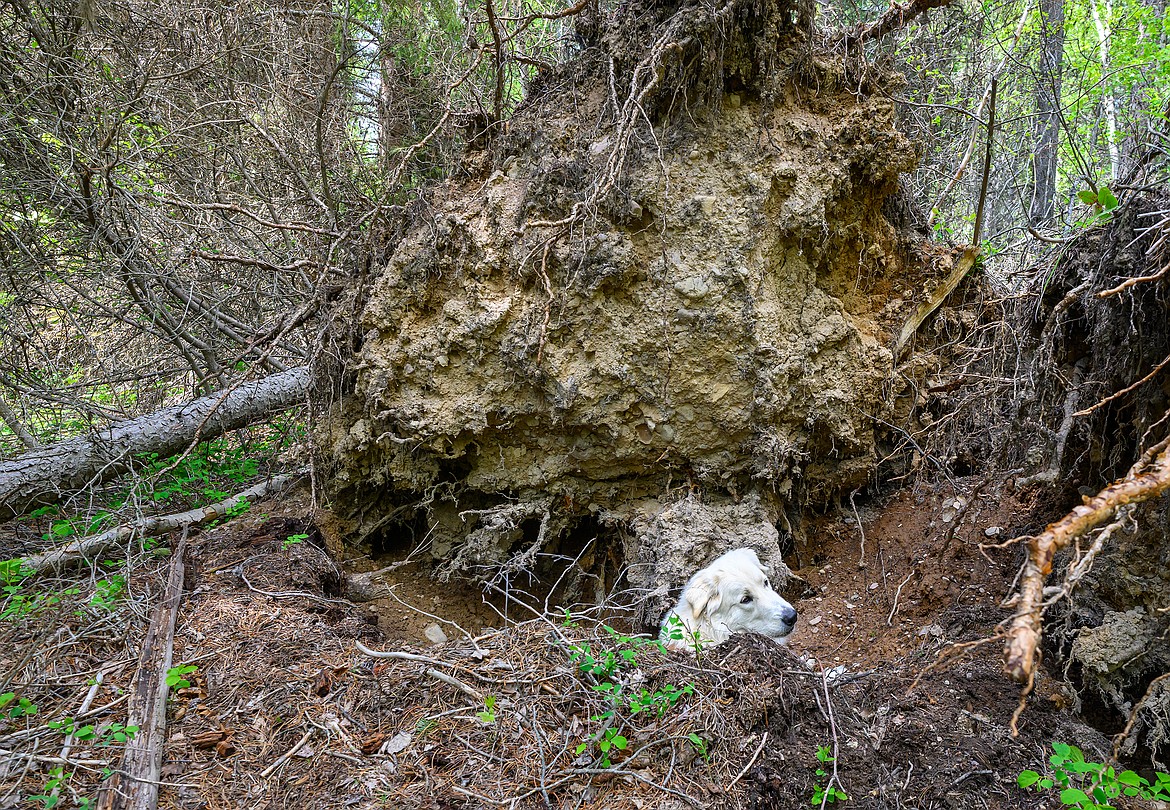
A dog cools off in the dirt of a blowdown in the Flathead National Forest.
The December 2025 winter windstorm event brought 50-75 mile-per-hour winds that caused extensive damage to forestland across much of Western Montana, particularly on exposed slopes or higher ridges. For many landowners, the storm left downed trees and concerns about how and when to salvage them.
Pine stands should be addressed soon to avoid wood degradation as warmer weather arrives in June. Blue stain, a discoloration caused by fungi carried by bark beetle, may develop within 3-6 weeks and can significantly reduce a log‘s value at the sawmill. Blue stain is not as severe a defect for lodgepole pine as it is for ponderosa pine, but landowners should still make sure they have a purchaser’s agreement from the sawmill before hauling lodgepole into town.
Douglas-fir blowdown may have more time before it dries and becomes a concern, so immediate salvaging is less critical in the first months of summer. However, downed Douglas-fir can still attract bark beetle or other wood-boring insects that flock to stressed trees or downed logs.
For most landowners, the best approach is to salvage usable material or work with a contractor to move it to a sawmill or firewood yard. Leaving logs stacked beyond late fall could contribute to beetle outbreaks in 2027, when beetles that move in the area lay eggs that emerge as adults the following spring.
While the salvage process may feel overwhelming, help is available. The Montana Department of Natural Resources and Conservation, Natural Resources Conservation Services, and Montana West Economic Development, and local Forestry Consultants, maintain lists of thinning and logging contractors, and local sawmills often have foresters who can visit properties and provide guidance.
DNRC also offers site visits to answer forest health questions and connect landowners with resources based on their property conditions and management goals.
In many cases, working with neighbors is the most economical option. Coordinating across property lines or with contractors already working in the area can reduce equipment move-in costs and make smaller projects more feasible.
A contractor usually can’t afford to move logging equipment for only a few truckloads of logs, but a combined project across several parcels may produce enough material to make the work more affordable.
DNRC forest pest entomologist, Amy Gannon, shares the following recommendations for landowners concerned about insect activity in damaged stands.
• The MCH anti-aggregate pheromone is fairly effective in deterring Douglas-fir bark beetle during May and June flights. MCH only repel Douglas-fir beetle.
Packets must be hung by April 15 to be effective, before beetles fly mid-May.
Packets only last for one season.
• Double Bubble from Synergy (1000 mg) can be hung on a grid of 15 per acre. Single-tree protection still requires 2 to 3 per tree, depending on diameter. Hang on the northwest or northeast side if possible.
Single Bubble (400 to 500mg) can be applied on a grid of 33 per acre. Single-tree application also requires 2 to 3 per tree, depending on diameter.
MCH has an EPA registration number and is therefore treated as a pesticide. Please be sure to wear proper protective gear when hanging packets.
• Pheromones are also available to repel mountain pine beetle, but that species is not currently at outbreak levels in Montana. Verbenone only repels mountain pine beetle and does not work on western pine beetle or Ips, also known as pine engraver beetle.
• Ips are often the most immediate concern in slash and downed pine trees. These beetles can build up in fresh slash and may kill surrounding trees. The best way to reduce that risk is to burn the slash, remove downed trees, or process the material into firewood as soon as possible. Trees need to be cut into firewood and stored in a dry place or sent to the mill where the bark will be removed. Because Ips larvae need moist inner bark, called cambium, to survive, once that layer dries out or is removed, they cannot complete their life cycle.
Large slash piles are less concerning because beetles tend to move deeper into the pile rather than flying onto nearby trees. However, smaller slash piles, especially hand piles in pine stands, can harbor Ips beetles and should be burned as quickly as possible. Slash is less of a concern in Doug-fir, larch, spruce, or cedar stands.
As always, one of the best long-term defenses against beetles is a thinned and healthy forest where trees have the water, sunlight, and nutrients they need to remain vigorous.
If your property was affected by the winter storm and you are unsure where to start, reach out to your local DNRC service forester to find more resources.