
Tribal groups join lawsuit seeking restoration of $127 million in canceled farm grants
NORA MABIE Montana Free Press | Daily Inter-Lake | UPDATED 3 months, 1 week AGO
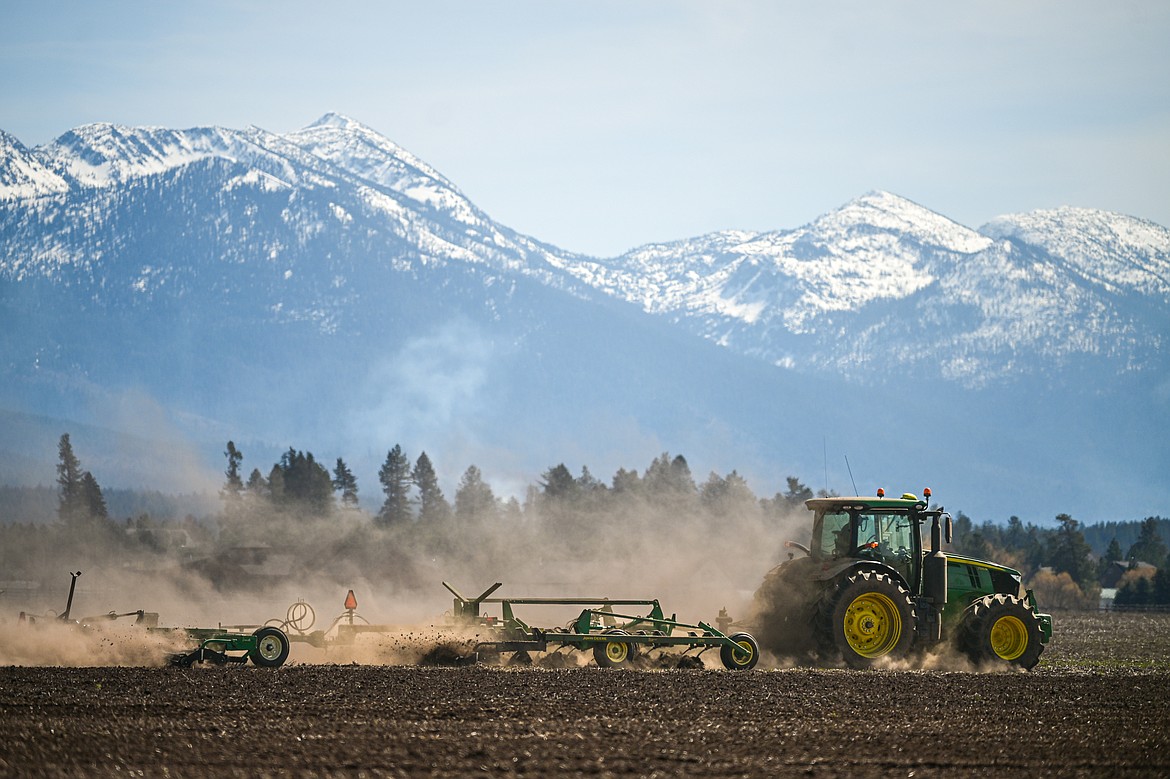
A farmer cultivates a field along Highway 35 and Mennonite Church Road on Friday, April 10. (Casey Kreider/Daily Inter Lake)
Casey Kreider
Twenty-four organizations, including one that serves tribes in Montana and the surrounding region, on Tuesday joined a lawsuit against the U.S. Department of Agriculture, alleging that grants supporting farmers and ranchers were unlawfully terminated.
In March, the USDA canceled 49 of 50 Increasing Land, Capital and Market Access Program grants designed to support “underserved” farmers and ranchers.
At least three projects in Montana were affected: Piikani Lodge Health Institute, headquartered on the Blackfeet Reservation, lost a nearly $9 million grant to improve operations for farmers and ranchers in the region. The Chippewa Cree Tribe in north-central Montana lost a nearly $6 million award to purchase land and train young farmers and ranchers how to manage it. And South Dakota-based Four Bands Community Fund lost an $8.5 million grant to train and financially support at least 25 low-income agricultural producers in Montana, North Dakota, South Dakota and Wyoming. At the time, Montana-based awardees said they’d received just fractions of the grant funds and described the terminations as “devastating.”
In several termination letters obtained by Montana Free Press, the USDA wrote that the grants had been canceled because the associated projects “involved discriminatory preferences based on Diversity, Equity and Inclusion and wasteful spending that did little to further lawful agricultural land purchases.”
A lawsuit against the USDA seeking reinstatement of the grants was originally filed in June 2025, after several other grants were terminated following President Donald Trump’s executive orders deprioritizing climate action and Diversity, Equity and Inclusion (DEI) programs. In August 2025, a federal judge in Washington, D.C., ordered the USDA to reinstate six grants awarded to the original plaintiffs. This week, 24 additional organizations, including Four Bands Community Fund, which serves Montana and other states in the region, joined the lawsuit.
The new plaintiffs are represented by lawyers from a variety of advocacy organizations, including FarmSTAND, Farmers’ Legal Action Group and Earthjustice. They argue that the USDA’s March grant terminations were unlawful and have caused irreparable harm.
“Plaintiffs are faced with layoffs, abandoning projects and investments, reputational harm in the community for failing to deliver promised programs, and drastic reductions in their organizations’ operations, or in some cases, having to shutter their organizations entirely,” the complaint reads.
A USDA spokesperson said the agency would not comment on pending litigation.
The plaintiffs allege that the USDA terminated the grants “without individualized review but rather based on vague allegations that the projects were not aligned with the President’s newly stated goals of eliminating funding for DEI and climate initiatives — without any effort to determine whether the projects could be brought into line.”
The plaintiffs specifically allege that in 2023, Four Bands Community Fund was approved for an $8.5 million grant to increase access to land and capital in Mountain Plains tribal areas, but in March received notice that the grant had been terminated, in part because the project “violated equal protection principles by selecting beneficiaries based on race, ethnicity, sexual orientation, or sex.”
The plaintiffs describe the Four Bands grant termination as “particularly arbitrary and capricious,” and argue that the federal government’s reasoning “ignores the unique status of tribes, tribal citizens and tribal lands” and “fails to acknowledge tribal status is not a race-based classification,” as would be subject to DEI programming. It’s well established in federal Indian law that tribal citizenship is a political classification, not a racial one.
Representatives of Four Bands Community Fund could not immediately be reached for comment.
The plaintiffs are asking the United States District Court for the District of Columbia to restore the grant awards, which total $127 million, and prohibit the USDA from terminating the grants in the future.