
Lacewing IPM clinics scheduled for June
CHERYL SCHWEIZER | Hagadone News Network | UPDATED 3 months, 1 week AGO
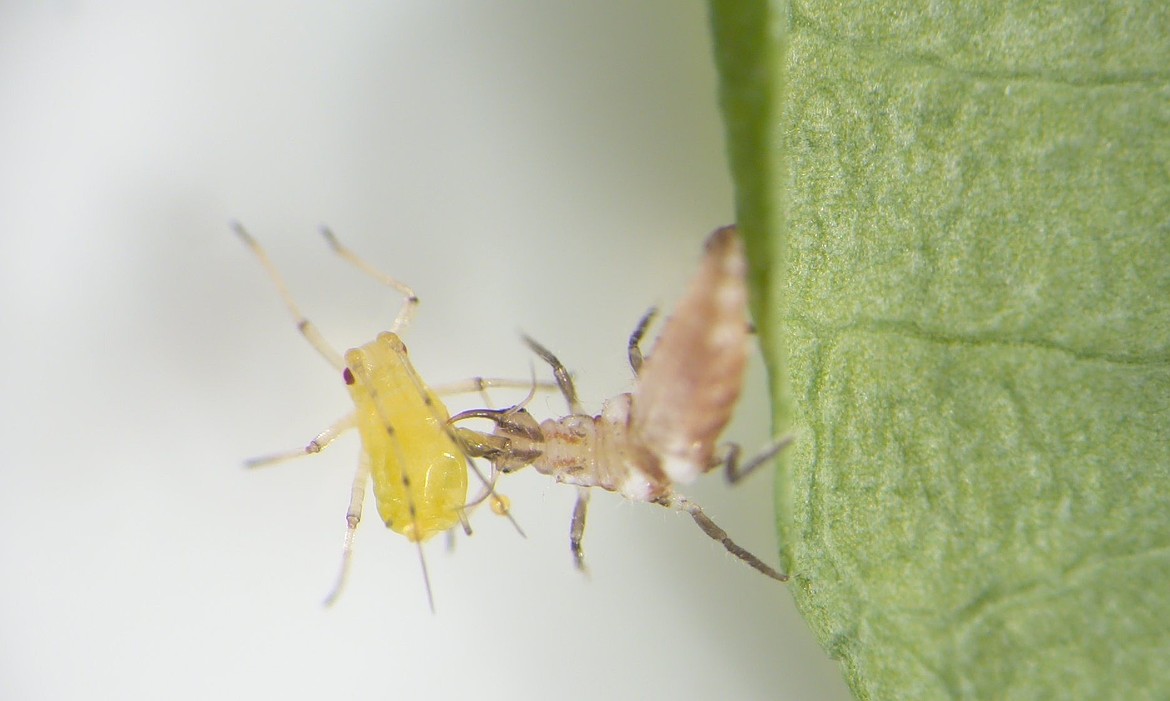
A lacewing bug feeds on an aphid. Clinics on the role of lacewings in orchard IPM are scheduled for June.
COURTESY PHOTO/REBECCA SCHMIDT-JEFFRIS USDA
Senior Reporter Cheryl Schweizer is a journalist with more than 30 years of experience serving small communities in the Pacific Northwest. She began her post-high-school education at Treasure Valley Community College and enerned her journalism degree at Oregon State University. After working for multiple publications, she has settled down at the Columbia Basin Herald and has been a staple of the newsroom for more than a decade. Schweizer’s dedication to her communities and profession has earned her the nickname “The Baroness of Bylines.” She covers a variety of beats including health, business and various municipalities. | May 29, 2026 4:32 PM
ROYAL CITY — The results of a three-year trial to test the use of lacewings to control orchard pests will be the subject of three field days in North Central Washington in late June. The clinic is free.
Tianna DuPont, tree fruit extension specialist for Washington State University Extension in Wenatchee, said researchers wanted to see if lacewings could be another tool in the toolbox for growers.
“The goal of this project is to develop those best management practices for the release of lacewings to improve the control of aphids and mealy bugs in apple orchard,” DuPont said. “We're looking at the best timings, rates, life stages of the lacewings to release, so that we can incorporate those releases into your IPM program. And particularly of interest to growers, is looking at an assessment of drone releases, whether that can be as effective as hand releases, in order to make these releases more cost effective.”
Clinics are scheduled for 9 to 10:30 a.m. June 24 at an orchard on Watson Draw Road north of Pateros; 9 to 10:30 a.m. at CRO Orchards, about 10 miles south of Rock Island and from 3 to 4:40 p.m. at Dain Craver Orchards, 111 Road D SW in Royal City.
“Participants will observe lacewing release demonstrations including by hand, four-wheeler and drone. A hands-on activity will allow participants to learn about beat tray recovery of lacewing larvae,” DuPont wrote in a press release.
Rebecca Schmidt-Jeffris, the project lead, and other speakers will talk about the research results and the best ways to put it into practice. Subjects include the best species of lacewing to release, the best time to release them and which sprays are compatible.
Schmidt-Jeffris will be joined by Chuck Weaver of GS Long/ParaBug and growers from each orchard, including Mike Brown of Gebbers Farms, Teah Smith of Zirkle Fruit and Dain Craver of Dain Craver Orchards.
“Each separate event contains the same content in different locations,” DuPont said.
The project was funded through a USDA Sustainable Agriculture Research and Education grant project.
ARTICLES BY CHERYL SCHWEIZER
Road projects on hold for Labor Day weekend
MOSES LAKE — With Labor Day weekend dead ahead, drivers will be able to move freely about the state. Most road projects are on hold for the holiday weekend. Nobody will be working on the Hansen Road overpass on Interstate 90, but the lane restrictions that are in effect will continue through the end of the project.

Cost estimates for water source alternatives given to Moses Lake City Council
Protected under the U.S. Endangered Species Act, efforts are ongoing to keep it self-sufficient
MOSES LAKE — It’s going to cost a lot of money to provide alternative water sources for the city of Moses Lake, but some of the possible alternatives will cost more than others. City officials provided the Moses Lake City Council with costs for various alternatives Tuesday.

Dryer vent cleaning is important -- but often overlooked
MOSES LAKE — Not all the maintenance a house needs is visible. Sometimes a potential problem just goes unnoticed until it causes trouble, sometimes serious trouble. But a lot of potential problems give off warning signs. Clothes dryers often do when they need a good cleaning.