
Microscopic mussel shell prompts heightened invasive species monitoring on Whitefish Lake
HAILEY SMALLEY | Hagadone News Network | UPDATED 1 week, 1 day AGO

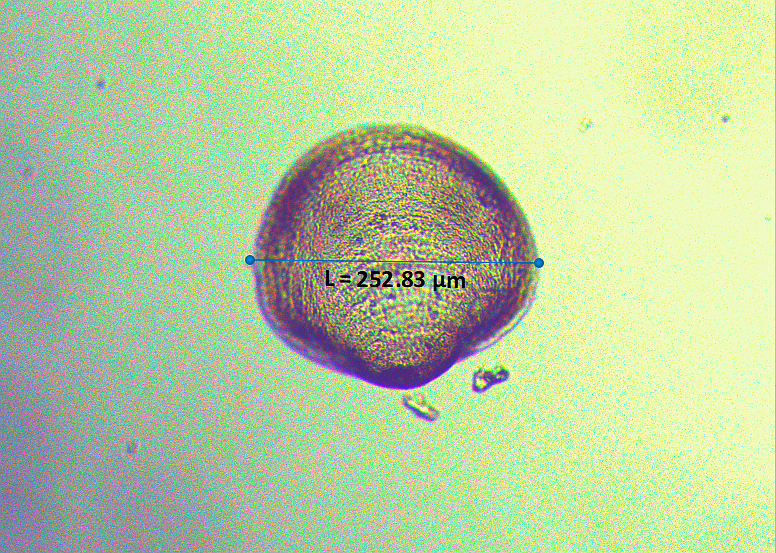
Officials fished a scrap of shell from an invasive mussel larva out of Whitefish Lake over the summer, though the intensive follow-up investigation has yet to surface more signs of the non-native bivalves.
"While the negative results are encouraging, they do not definitively rule out the presence of invasive mussels in the lake," Montana Fish, Wildlife and Parks Aquatic Invasive Species Supervisor Tom Woolf said in an Oct. 30 statement. "With a detection like this, sometimes no other evidence is ever found."
The bit of evidence that officials do have is also far from conclusive. No soft tissue was attached to the shell, so officials are unable to conduct DNA analysis on the sample or determine whether the mussel entered the lake dead or alive.
The state wildlife agency sent microscopic imagery of the shell to six experts in two different labs, all of whom agreed that the shell came from either a zebra, quagga or golden mussel, though they were unable to say with certainty which of the three invasive species was the most likely culprit.
The shell measured just a quarter of a millimeter across, and the larva was likely 2-3 weeks old when it died, far from reproductive age.
"The fact that we caught this thing, at that size, and then it showed up under the microscope in Helena is kind of amazing," Whitefish Lake Institute Executive Director Mike Koopal said.
The nonprofit has long led aquatic invasive species prevention efforts on Whitefish Lake, including a routine monitoring program that takes water samples from seven heavy-use sites around the lake every few months. It was one of those samples, taken the week of July 4 from City Beach, that turned up the suspect mussel shell.
Following the detection, Koopal said the nonprofit would be increasing the number of water samples it submits for invasive species testing.
The group has already worked with the state wildlife agency to collect and analyze several additional water samples from the lake, which have so far returned no further evidence of invasive mussels. Divers scouring the lake bottom last week also found no signs of adult mussels. A second dive and more water sampling is scheduled to take place this week, though Koopal said impending winter weather will likely impede any further monitoring actions until springtime.
"We just have to wait until next year, and we'll hit it early," he said. "We're just going to monitor the heck out of it."
INVASIVE MUSSELS have wreaked havoc on water systems throughout the United States.
In the mid-1980s, zebra and quagga mussels native to eastern Europe hitched a ride to the United States in the ballast water of ships. The freshwater mollusks reproduced voraciously, clogging water pipes and causing widespread infrastructural damage to dams, docks and other shoreline facilities as they spread through the Great Lakes region.
Golden mussels native to eastern Asia have caused similar disruptions in California since they were first detected in 2024.
A 2019 analysis from the University of Montana found that the colonization of non-native mussels in Montana's waterways would likely cause somewhere between $288 million and $497 million in private property value losses. The state would likely need to spend another $72 million to $122 million on mitigation, and another $23 million to $112 million would be lost through reduced tourism, recreational fishing and property tax revenues.
A mussel infestation could prove especially problematic for the city of Whitefish, which draws much of its water supply directly from Whitefish Lake. Miniscule mussel larvae are often swept into water pipes. Some attach to the interior of the pipe itself, gradually clogging it as they grow. Other larvae might make it all the way to a water treatment plant before they settle, causing similar damage to the machinery and equipment inside the facility.
A single detection doesn't always lead to an all-out infestation. In 2016, state wildlife officials detected zebra mussels in Tiber Reservoir in eastern Montana. Unlike the detection on Whitefish Lake, the larvae were found alive, but an extensive follow-up stirred up no signs that the mussels had become established or reproduced. The state wildlife agency declared the reservoir mussel-free in 2022.
The larva in Whitefish Lake marks the first invasive mussel detection in the state since 2016 and the first indication of non-native mollusks in western Montana.
Mussels are typically transferred between waterbodies on watercraft, including in the ballast water of boats. Inspections have been mandated for all watercraft entering Montana since 2011, with additional regulations for the Flathead and Columbia River basins. At the local level, boats coming from areas with known invasive mussel infestations are required to be flushed with hot water to kill any lingering larvae before they can be launched in Whitefish Lake.
Koopal said that, while concerning, the detection of the larva in Whitefish Lake is also proof that the state's extensive prevention and monitoring apparatus is operating like it should.
"I think this is a good example of things working right," he said. "It was found. We're jumping on it."
Reporter Hailey Smalley can be reached at 406-758-4433 or [email protected]. If you value local journalism, pledge your support at dailyinterlake.com/support.
 State wildlife officials identified half of an invasive mussel shell while viewing a water sample from Whitefish Lake under a microscope. Courtesy of Montana Fish, Wildlife and Parks.
ARTICLES BY HAILEY SMALLEY

Forstag flips western congressional district amid wave of blue votes
The blue wave left its mark on Montana Tuesday, as Democratic candidate Sam Forstag clinched victory in the western congressional district and his party made gains in the statehouse.

Northwest Montana Republicans enter election night in high spirits, despite close congressional race
Spirits were high at Republican Congressional candidate Aaron Flint's election night watch party, despite projections of a long night waiting on results.

Northwest Montana groups threaten new lawsuit in years-long legal battle over logging roads
Local environmental groups are threatening to sue the U.S. Forest Service and U.S. Fish and Wildlife for "fail[ing] to rationally consider the impacts" of logging roads on endangered species, further entrenching the federal agencies in a legal battle that has already spanned eight years and three lawsuits.