
Meet the biologists manning the Fish Creek check station
MONTE TURNER | Hagadone News Network | UPDATED 2 days, 12 hours AGO
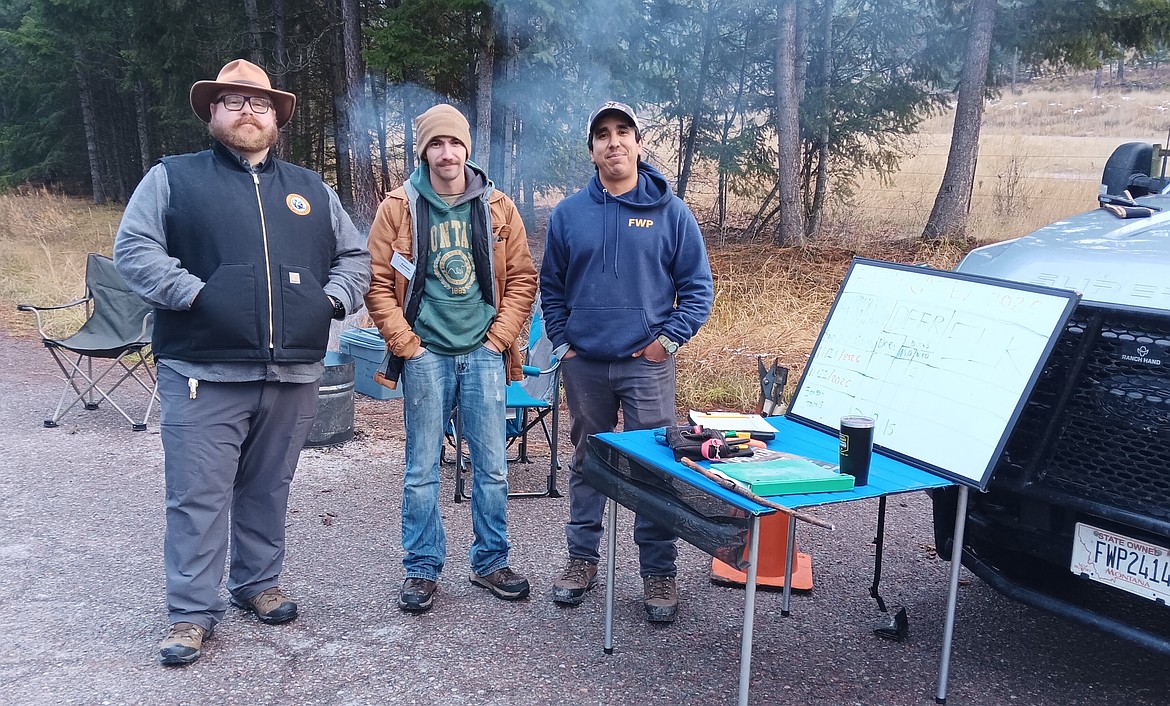
From left, Goldy Goldbach, FWP's Region 2 Recreation Ranger, UM student Conner Harris and Sam Martinez, FWP Region 2 Wildlife Biologist staff the Fish Creek Game Check station last Saturday. (Monte Turner/Mineral Independent)
With less than a week to go to fill the freezer, Mother Nature hasn't exactly been cooperating, again.
Instead of the snow that traditionally helps hunters track big game, rain has made things challenging. Hunters are accustomed to seasons that seem a little cattywampus, with hotter summers, earlier springs in some years and fewer circumstances to get out the snow shovel. The weather patterns have changed enough that hunters are disappointed, but not particularly surprised.
At the Fish Creek game check station last Saturday, the weather wasn't the only thing contributing to a quieter-than-usual season. The Brawl of the Wild was taking place in Bozeman, so many football fans opted to watch the game rather than beat the brush in the cold rain.
Fewer hunters were coming through, although Montana Fish, Wildlife and Parks say the actual harvest numbers aren't nearly as far off previous years as the activity at the check stations might suggest.
“We've had about 40 go through today,” said Sam Martinez, wildlife biologist for Region 2, as the afternoon approached 5 p.m.
Martinez is in his first year in the position, having transferred to Missoula in July. Before that, he spent a year and a half working as a biologist in Region 1 stationed in Libby, so he isn't entirely unfamiliar with the country or its wildlife.
“The habitat here is just perfect for the number of animals that go through, and I'm learning the history of the area, but still surprised that it's not producing better than it has,” he said.
Nevertheless, he's taking pleasure in his new assignment.
“I enjoy doing the public interactions that we have, some of the WMA (Wildlife Management Area) work. Being in a regional office, we get a lot of support by being involved in more things, urban and wildlife. It's a larger scale from where I came from,” Martinez explained.
The check station tally board offered a little snapshot of the season. Seven white-tailed does had been checked, with Martinez explaining that it was the first weekend of the season when either-sex hunting was allowed. No elk had made the board that day, although game wardens had checked some during the weekdays when the station wasn't staffed.
Martinez had a little help keeping an eye on the hunting traffic, thanks to UM student Conner Harris who was assisting, along with Goldy Goldbach, FWP's Region 2 recreation ranger. Goldbach is becoming more familiar with hunting practices, although he didn't grow up hunting himself.
“He gets asked a lot of questions, so this one-on-one interaction gives him a strong sense of the check station process,” Martinez said.
And that's part of what makes these roadside stops worthwhile. They aren't simply about counting animals. They're opportunities for state wildlife employees to visit with hunters, answer questions, gather information and learn what's happening out in the field.
For many big game hunters, stopping at the check station helps them understand how others are doing and where next weekend might be a place to go. Hunting has been handed down through families for generations. It's about the camaraderie, the fresh air, the thrill of the hunt and the time spent with family and friends. For many who call this corner of Montana home, those experiences are woven into the very reasons they live here.
But there is another side to hunting that sometimes gets overlooked. For some families, bringing home venison isn't just a tradition or a recreational bonus. It's a necessity.
With household expenses climbing, money is tight for many. The sticker shock of recent property tax assessments hasn't worn off, Christmas is approaching and putting meat in the freezer can make a considerable difference in the family budget. Even with gas prices having dropped about a buck since the midterm election, making ends meet has become a bigger challenge. That makes a successful hunt especially meaningful.
Martinez said that while the check station feels slow, the overall numbers are within a few either direction of past hunting seasons.
“Numbers wise, it just feels slow, but the count is within a few either direction from past hunting seasons in both harvest and hunters,” he said.
Wildlife populations are not always easy to measure, particularly in the thick timber that covers much of western Montana. As other biologists have explained over the years, counting animals from the air can be difficult when the forest canopy makes them nearly impossible to see.
Still, the numbers indicate populations are stable.
“Recruitment has been good the last couple of years. The elk that we do have, they're doing well, but we want them doing better,” Martinez said.
There is also some important research underway involving mule deer. Hunters who drew a mule deer buck permit for Hunting District 202 should watch for a letter Martinez sent requesting that they remove a tooth from their harvested animal for research purposes. The tooth helps biologists gather valuable information about the animal.
Hunters can drop the tooth off at Region 2 headquarters on Spurgin Road in Missoula or bring it directly to Martinez at the Fish Creek game check station this coming weekend. It also provides an opportunity to meet the biologist and put a face to the name on the letter.
Originally from New Mexico, Martinez earned both his bachelor's and master's degrees there and spent approximately five years working on an elk project in wildlife biology. He's enjoying Montana's Big Sky country and the opportunity to work with the wildlife and people of this region. Fish, Wildlife and Parks is still looking to hire a game warden for Mineral County, but in the meantime, wardens from Missoula and other regions are helping fill the gaps during hunting season.
Martinez also has another local wildlife project on his calendar. He assisted Ashley Hodge last winter with the state's mountain lion monitoring and management strategy in Region 1 and will be helping her again as her project begins in Mineral County on Dec. 1. Hodge is based in Missoula but is technically a statewide employee, with her work rotating throughout Montana.
Those interested in hearing more about the hunting season won't have to wait long. Martinez will attend the Mineral County Resource Coalition meeting on Tuesday, Dec. 1 at 10 a.m. in the Mineral County Commissioners Conference Room. He plans to provide members with the latest semi-tabulated hunting season numbers. The meeting is open to the public.
Wildlife check stations sample only a portion of the overall hunting effort and harvest, but the information collected helps biologists understand population trends and make management decisions. Hunters are required to stop at every wildlife check station they pass, whether they've harvested an animal or not. Even an empty pickup can provide useful information.
As the afternoon light faded along I-90, Martinez, Harris and Goldbach had one thing in common. All three appreciate the outdoors and the wildlife that makes this part of Montana special. They warmed their hands around the roadside campfire, waiting for the next pickup carrying hunters in orange.
ARTICLES BY MONTE TURNER
Tarkio's Two Hot Chili Pot winners
Superior Volunteer Fire and Rescue Department’s Second Annual Two Hot Chili Pot was fun, educational and successful in raising money for their Tarkio Fire Station building on Nov. 14.
Superior holiday dinner celebrate togetherness
The celebration will include a free traditional Christmas dinner featuring turkey, potatoes, stuffing, cranberry sauce, rolls, yams and vegetables. There will also be crafts, a gingerbread house decorating contest, an opportunity to visit with Santa and the return of the kids-only gift shop.
Christmas spirit will shine at Alberton community event
The newly formed Alberton Community Association is keeping that community spirit rolling with plans for Christmas in Alberton, set for Saturday, Dec. 5, from 5 to 7 p.m. at the Alberton Community Center/Library, 701 Railroad Ave.