
MOVING HISTORY FORWARD: The Long-Forgotten Pandemic: The Spanish Flu of 1918 — Part 1
STEPHEN SHEPPERD/Moving History Forward | Coeur d'Alene Press | UPDATED 36 minutes AGO
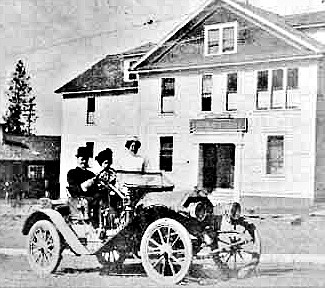
The Coeur d’Alene Hospital: Dr. John Wood and his wife Margaret sit in their 1910 Hudson roadster in front of the Coeur d’Alene Hospital at 315 Garden Avenue that he co-owned with Dr. Alexander Barclay. The hospital would find itself on the front lines in the battle against the Spanish Flu. The hospital’s head nurse, Marie Acton, is shown standing on the running board of the automobile. The hospital was the city’s second medical facility, the first having been at Fort Sherman. — MONI Photo CDA-18-009
Courtesy of MUSEUM OF NORTH IDAHO
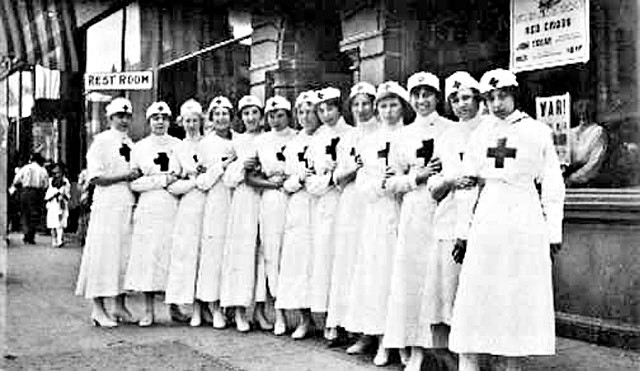
Red Cross Nurses: The Spanish Flu epidemic of 1918 heavily taxed the capabilities of the medical services that were available in Coeur d’Alene. Red Cross nurses like those shown posing in front of a recruitment poster were at the center of an organized response to the killer virus. They worked alongside an organized corps of local nurses and volunteers formed by local health authorities that came to the rescue by working tirelessly to treat the sick. MONI Photo AS-18-004
I recently came across several articles about the toll that the Spanish Flu took on the people of Coeur d’Alene back in 1918 and 1919. The story looked like a promising topic, so I did further research to share it as this month’s story. The records show that fully one-third of the global population was infected by the Spanish Flu, and the virus killed an estimated 50 million worldwide. That number included 675,000 victims in the U.S., of which 23,000 were in Idaho. An exact total of local deaths could not be found, but looking at the daily reports in the Coeur d’Alene Press, the number who succumbed was likely in the neighborhood of several hundred citizens.
It is pretty well established that the Spanish Flu started at the Funston U.S. Army camp in Haskell County, Kan., where the first case was reported March 4, 1918. From there, it was carried by soldiers headed for the trenches of World War I, where it began to kill more soldiers each week than succumbed to the wounds of battle.
The respiratory-based virus was soon spreading around this country, but it would take six more months before the first cases began to be recorded in Idaho. It would be the first of three waves of influenza that would attack the population before it began to run its course in the summer of 1919.
Since the first symptoms were often similar to the common cold, medical officials at first downplayed its seriousness, predicting it would be brought under control in three or four days. However, many cases intensified into a virulent strain of pneumonia that attacked the lungs and other organs of both young and old. Deaths then began to pile up, sometimes taking the lives of multiple members of a household in one week.
Lacking a guide on how to respond to the epidemic, communities implemented rules they hoped would contain the flu. For example, public spitting was banned in some towns, gauze masks were made mandatory in others, and in Coeur d’Alene’s case, a physician was named to make and enforce the local rules. On Oct. 9, 1918, Idaho’s State Board of Health took extraordinary action, issuing an order closing all public places and places of amusement until further notice. At first the order did not include private and public schools, but on Oct. 10, the Coeur d’Alene School Board met to close all schools in District 1. Parochial schools soon followed suit. The City Council also met and voted to comply with the state directive.
On Oct. 10, the County Board of Health took action to go one step further than the state, closing churches, lodges, and other places of social gathering. Almost immediately, groups announced that they were shutting down in compliance, and on the first day of the quarantine it appeared that everyone was staying home and getting “acquainted with their families.” It was hoped that this would be enough to keep the citizens safe. But it wasn’t.
In our next installment, we will look at what other measures were implemented, the effect that the end of World War I had on the enforcement of the quarantine, and what the state did to hasten a second wave of the flu to spread over the city.
 Red Cross Nurses: The Spanish Flu epidemic of 1918 heavily taxed the capabilities of the medical services that were available in Coeur d’Alene. Red Cross nurses like those shown posing in front of a recruitment poster were at the center of an organized response to the killer virus. They worked alongside an organized corps of local nurses and volunteers formed by local health authorities that came to the rescue by working tirelessly to treat the sick. MONI Photo AS-18-004