
SHS advisor gains tools to help rural students navigate college admissions
Bonner County Daily Bee | UPDATED 4 days, 6 hours AGO
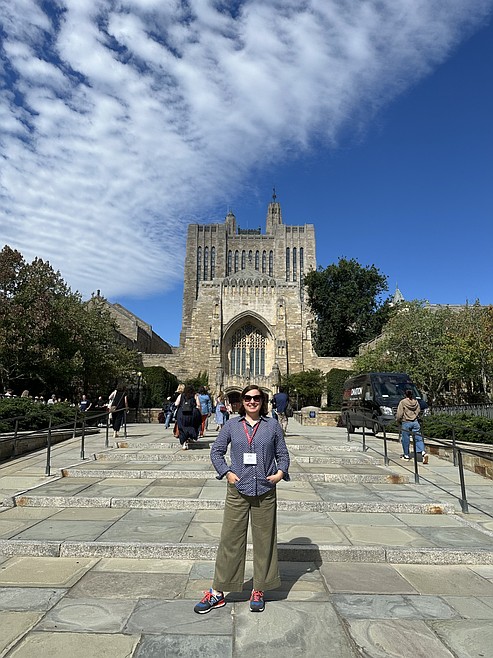
Sandpoint High School college and career advisor Angie Dail smiles for a photo at Yale University during a tour of several Ivy league universities.
Courtesy photo
SANDPOINT — For many budding high school graduates, college applications can be a source of anxiety. It's an overwhelming feeling that Sandpoint High School college and career advisor Angie Dail knows all too well.
It wasn't too long ago that Dail helped her own son through the college application process and realized how extensive it was.
"There's no way I could have survived this process without knowing the bank of knowledge I had," she recalled thinking.
Last April, Dail received an email from the Small Town and Rural Students College Network, a coalition of top U.S. colleges partnering to ensure that students from rural and small-town America have the information and support they need to enroll and graduate from the college or university of their choice, according to the organization.
Wanting to stay abreast of the coalition's activities, she subscribed to their email list and was surprised to receive an invitation to apply for a program that would provide resources for helping students from rural communities navigate the college application process.
Dail submitted a request to attend, not expecting anything to come of it.
"All of a sudden, over the summer, I was like 'Oh my gosh, I got a spot,'" said Dail.
Dail left Sandpoint in mid-September to tour several Ivy league universities, including Brown, Columba and Yale, where she met with admissions staff to discuss how high schoolers can improve their college applications.
One of the exercises Dail participated in was a mock admissions case study, where she and other attendees stepped into the role of admissions officers, reviewing real university applications and deciding which students they would admit, deny and waitlist.
The exercise was especially helpful for Dail because all representatives from the universities she toured were present during the trip to offer their expertise.
"It wasn't just the rep from Yale with you there at the case studies; we had MIT, Brown, Amherst, Colby, Dartmouth,' said Dail. "They were all there giving us their feedback, what they're looking for and advice on how to help students craft or curate their application."
Applying to college as a student from a rural community may feel daunting, particularly when they feel they have had fewer resources and opportunities to showcase than students in larger communities.
However, Dail learned that universities take many aspects into consideration when reviewing student applications.
"Something that kept getting repeated over and over was contextual review," said Dail. "What they kept reminding us is that in admissions, they are reviewing within the context of the students' environment and the resources available to them."
Dail used the amount of advanced placement classes offered at high schools as an example.
Where larger high schools in the country may offer 20 or more AP classes, SHS offers around eight. Admissions officers are likely to acknowledge that difference and consider students within that context, said Dail.
With a holistic approach to admissions, Dail said small town, rural students shouldn't be discouraged.
"It's nice to know that they are not pitted against those kids that may have access to a lot more. They're held within the context of our school," said Dail.
In fact, Dail said their upbringing can be a leg up for universities in search of untapped talent.
While touring Amherst, a highly selective private liberal arts school in Massachusetts, Dail said staff noted an increase in the use of campus fire pits as the school has placed a growing emphasis on recruiting students from small communities, "because there's kids that actually know how to start a fire."
"A lot of kids from the middle of the city, they may not have ever had that experience," said Dail.
The students that call Sandpoint home are fortunate to bring those experiences to universities that can enhance campus life, said Dail.
"I think they have so much to offer these universities and really bring a different point of view," said Dail. "Knowing that they have an equal shot of getting in as that kid from a private school in New York is pretty awesome."
Moving forward, Dailk said she anticipates sharing her findings with hopeful college applicants.
"If we do have a student who's trying to go for a selective or highly selective school, I feel like I have so much more basis now to help them prepare their application and actually be a strong candidate," said Dail.