
Part I. Before the Candy
KELLI TAYLOR/Press Staff | Coeur d'Alene Press | UPDATED 2 days, 14 hours AGO
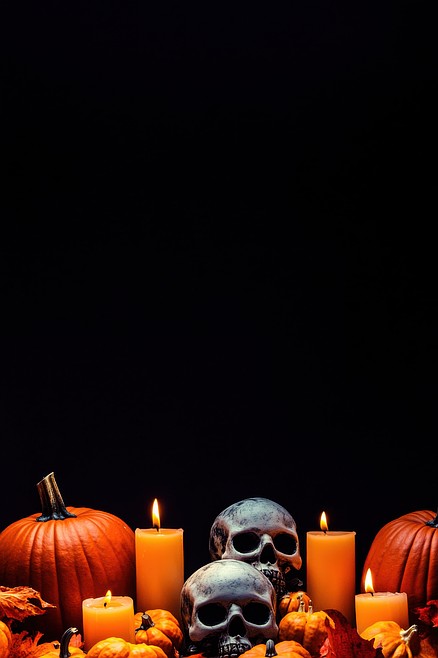
Halloween has always been my favorite holiday. Part of it is the obvious stuff. I love the costumes, the decorations, the creepy stories and the general permission October gives us to be a little weird. There is something about the mystery of it that I've always enjoyed.
The older I get, the more I realize that what fascinates me most about Halloween isn't what we've turned it into. It's what came before.
Every October, we willingly turn our homes into haunted houses. We hang skeletons from trees, cover our porches in fake spider webs, carve faces into pumpkins and dress our children as witches, ghosts, superheroes and whatever pop-culture character they happen to be obsessed with that year. Then we hand candy to strangers who show up at our doors demanding it.
When you really think about Halloween, it's a remarkably strange holiday. And it gets even stranger when you look at what came before the candy.
Long before Halloween became costumes, candy aisles and inflatable skeletons, the season was tied to something much older: the changing of the seasons, the end of the harvest and the beginning of winter.
One of the traditions most often connected with Halloween is Samhain, an ancient Celtic seasonal festival associated with the end of the harvest and the beginning of winter. It marked an important transition in the year, and later traditions connected the period with supernatural beings, divination, feasting and the dead.
This is where the history of Halloween gets a little murky, which I actually find more interesting than a perfectly tidy origin story.
Modern retellings often make Samhain sound remarkably similar to the Halloween we know today, complete with people dressing as monsters to confuse wandering spirits. The historical record isn't quite that neat. What we know about early Samhain comes from a mixture of historical accounts and traditions recorded much later, making it difficult to draw a straight line from one ancient celebration to the Halloween party down the street.
What is clear is that the season carried a strong association with the supernatural and with the transition from harvest into winter. And honestly, the symbolism makes sense. The harvest was over. The days were getting shorter. Winter was coming. Food had to be stored, livestock had to be prepared, and survival became a more immediate concern. Nature itself seemed to be dying.
It was probably inevitable that humans would start thinking about death, too.
There are other figures from ancient mythology who seem almost tailor-made for October. One of them is Hecate, an ancient Greek goddess associated with crossroads, pathways, night and magic.
I find the idea of a goddess of crossroads particularly fitting for this time of year. A crossroads is a place between places. You're neither here nor there. You're standing at the point where one path ends and another begins. In a way, Halloween has always occupied a similar space — between summer and winter, light and darkness, the living and the dead, what we understand and what we don't.
Hecate wasn't a Celtic goddess, and she isn't the origin of Halloween, but her mythology reflects something much older and broader than any single holiday: our fascination with thresholds, mystery and the things waiting just beyond the familiar.
Christianity adds even another layer.
Nov. 1 became All Saints' Day, also known as All Hallows' Day. The evening before became All Hallows' Eve — eventually shortened to Halloween. All Souls' Day followed on Nov. 2, creating a period of religious observance centered around saints and the dead. Over time, Christian traditions and older seasonal customs mingled with European folklore, creating the holiday we recognize today.
Then came the costumes.
Forms of disguise and going door-to-door were part of European folk traditions long before the modern American child stood on a porch yelling, "Trick or treat!" In Scotland and Ireland, a practice known as guising involved people going door-to-door in disguise and receiving food or other treats in exchange for songs, jokes or performances.
Another tradition, known as souling, involved people going door-to-door asking for food or money in exchange for prayers for the dead. Eventually, those traditions crossed the Atlantic and evolved again.
The jack-o'-lantern followed a similar path. The original carved lanterns weren't necessarily pumpkins. In Ireland and Scotland, people carved turnips and other root vegetables into lanterns. When the tradition arrived in America, the pumpkin — larger, softer and considerably easier to carve — was a natural replacement.
And we can't forget about Stingy Jack.
According to Irish folklore, Jack was a miser who managed to outwit the Devil, only to find himself rejected by both Heaven and Hell after his death. He was condemned to wander in darkness with only a burning coal inside a carved turnip to light his way. Whether Jack ever existed is beside the point. His legend helped give us the imagery of the jack-o'-lantern.
Somewhere along the way, an old folk tradition involving carved vegetables became one of the great American autumn decorating opportunities. I, for one, am grateful for the pumpkin.
The trick-or-treating we recognize today developed much later. Its exact origins are debated, but historians have connected modern trick-or-treating to several older traditions, including guising and souling. The phrase "trick-or-treat" itself began appearing in the United States in the 1920s. After World War II, trick-or-treating became increasingly popular, and individually wrapped candy eventually became the quintessential Halloween offering. And that's how we arrived at the holiday I love.
What began as a seasonal transition became intertwined with religious observance, folklore and traditions surrounding death and the supernatural. In America, it gradually became a community celebration, then a children's holiday and eventually a massive commercial event. We've traded turnips for pumpkins, folk rituals for costumes and offerings for fun-size candy bars.
Perhaps the strangest thing about Halloween isn't how much it has changed, though. It's how much of the original idea remains. We still gather when the days grow shorter. We still light things against the darkness. We still tell stories about the dead. We still dress ourselves as things we're not and we still look for signs of something beyond what we can see. And every October, we deliberately invite a little darkness into our homes — then decorate it with orange lights and make sure there's plenty of candy. That may be why Halloween has remained my favorite. Not just because I enjoy the spooky parts.
I love that underneath all the costumes and candy is a history stretching back centuries. I love that some of the traditions we casually participate in every October began with people trying to make sense of the changing world around them — the harvest ending, winter approaching, life and death existing side by side.
The costumes change and the traditions evolve. The pumpkins eventually end up in the compost pile, the inflatable ghouls and witches' brooms go back in storage for another year, but the one thing that remains certain about this time of year is that humans have always been fascinated by the darkness, by death, by the unknown and by the possibility that there might be something just beyond what we can explain.