
Reading between the lines: Flathead High School librarian champions literacy, critical thinking and choice
HILARY MATHESON | Hagadone News Network | UPDATED 1 hour, 22 minutes AGO
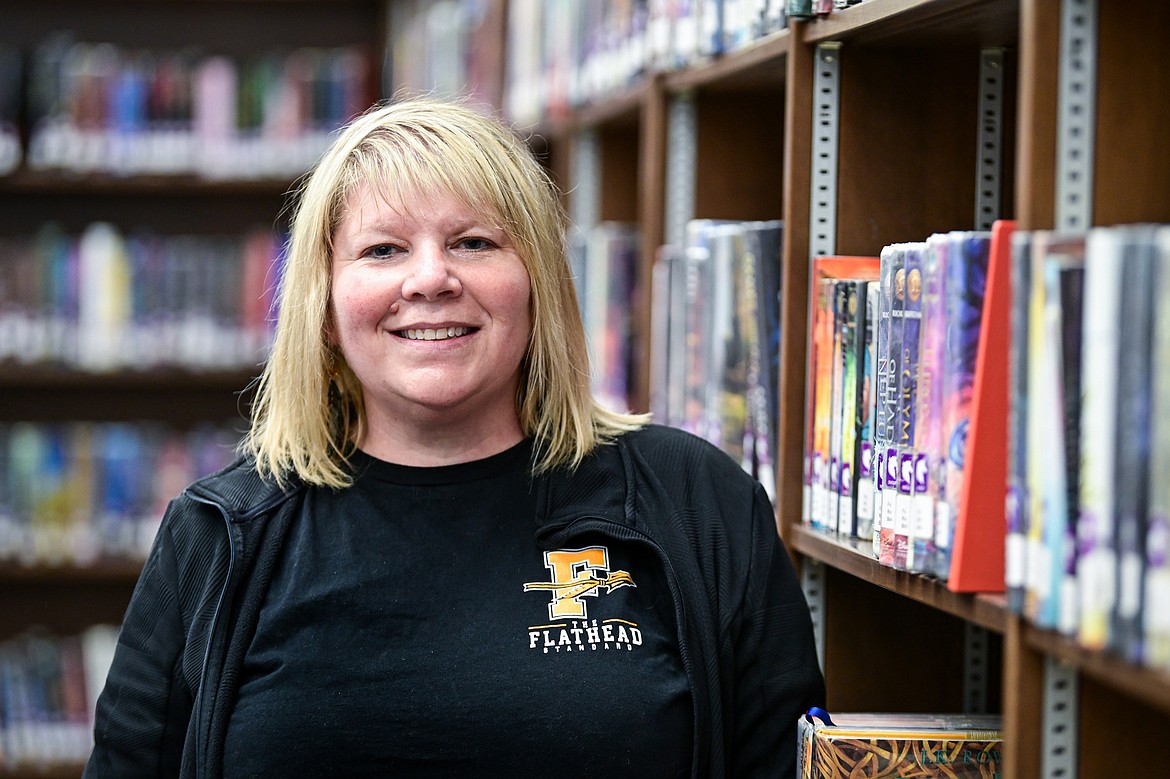
Flathead High School Library Media Specialist Aarica Phillips on Wednesday, Sept. 23. (Casey Kreider/Daily Inter Lake)
Casey Kreider
EDUCATION REPORTER Hilary Matheson covers education for the Daily Inter Lake. Her reporting focuses on schools, students, and the policies that shape public education across Northwest Montana. Matheson regularly reports on school boards, district decisions and issues affecting teachers and families. Her work examines how funding, enrollment and state policy influence local school systems. She helps readers understand how education decisions affect students and communities throughout the region. IMPACT: Hilary’s work provides transparency and insight into the schools that serve thousands of local families. | October 5, 2026 12:00 AM
Reading didn’t come easily to Aarica Phillips as a child. She is now in her 28th year as a school librarian, a role that evolved into the position of library media specialist.
While she could read the words, she sometimes struggled with comprehension. It wasn’t until fifth grade that she picked up a mystery book to read while visiting her grandmother in Harlem, Montana.
“And something clicked and I was hooked. Like — I love this. I love this genre. I love this writing and I can’t even remember what the book was,” Phillips said with a smile.
“... finally realizing that I can read and I can comprehend and I do love books. That was a huge step in my education. And I’ve just been a reader from then on.”
Mystery remains her favorite genre, specifically historical fiction mystery.
Phillips said her personal experience gave her empathy toward students struggling with reading or comprehension.
“Because I was there, you know, and I totally understand that kids learn in different ways,” she said.
Phillips went to college intending to become a classroom teacher, earning a bachelor’s degree in K-8 education. Phillips also picked up a library endorsement, giving her more options in the job market at a time when teaching jobs were harder to find in some areas.
“I've always loved the library, not necessarily always reading, to be specific, but I like — just the feel of the libraries — I love the books. I was like, this is something I possibly want to do,” Phillips said.
As part of her degree and endorsement requirements, Phillips student-taught at Elrod Elementary and interned in the school library, which she found enjoyable.
After graduating, she moved to Oregon and took a librarian position. Eventually, she wanted to be closer to family in her hometown of Whitefish and moved back to Montana, where she returned to Elrod as the school librarian.
“The kids at the elementary level are so much fun,” Phillips said.
AS THE technology landscape changed vastly from her days as an undergrad, Phillips completed a master’s degree in education technology in 2005.
She moved to the high school when the library media specialist position opened due to the librarian at the time relocating to Glacier High School when it opened in 2007.
She said the transition from an elementary to a high school library was a “good challenge,” from learning the curriculum and International Baccalaureate program to getting up to speed on a significantly larger collection.
Rather than weekly visits from elementary students, Phillips began making trips to classrooms, meeting with staff and developing programming to support high school students and teachers, which extends to a lot of software troubleshooting.
“I had to sell what I wanted to do with the kids in the library,” she said. “But it just made me grow and it made me realize that I really enjoyed working with the older students that could have conversations with me — especially about the books ... just watching my avid readers come in so excited about the books.”
As the She-Ra Book Club adviser, Phillips said discussions and casual conversations about books are key to getting students excited and engaged in reading. Members choose a book and meet once a month to discuss it. Members also share their passion for reading with elementary reading buddies.
Phillips also refreshes the library’s collection about three times a year, researching book reviews and lists from sources from the “School Library Journal” to bookstore bestseller lists. Title suggestions also come from students and teachers.
“A lot of my orders come from student requests these days because we do have a ton in our library that I still get the kids to check out and read, but they can definitely request something and I’ll review it and if it’s appropriate, I will purchase it for them and that gives them student agency,” Phillips said.
STUDENT AGENCY plays an important part in developing lifelong readers, she said. Phillips allows students to check out as many books as they want. Books that are removed from the collection and declared obsolete property by the school board are put on a cart and labeled as free for students to take. Any remaining books in fair condition are donated.
“My big thing is fostering a lifelong love of literacy,” Phillips said.
That focus on literacy now extends beyond books. As artificial intelligence becomes an everyday tool in students’ lives, Phillips said part of her job is teaching them how to use it — and how not to rely on it.
“We’re in the realm of teaching the kids what AI can do and what it cannot do, and that’s part of where our literacy has changed,” she said.
She views AI as an assistive tool that can be helpful for finding research or developing a thesis statement, for example, but not as a replacement for critical thinking, comprehension and media literacy.
Teaching students how to evaluate information is especially important with AI embedded in software, internet browsers, academic research databases, phones and educational tools like Google Classroom.
“Some of the teaching of research is analyzing and evaluating the sources that you’re looking at. So, if you ask AI to pull something for you, and it cites it for you, I teach them how to check that citation because most AI citations, if they [AI] can’t find what they want, they [AI] just make it up.”
“We have to teach them that AI may be able to do it for you, but it’s probably not going to be accurate and what those pieces look like of, if this is not accurate, what am I looking for?” she said.
For Phillips, that question of how students evaluate information also connects to one of her favorite weeks — Banned Books Week.
DURING THE Sept. 28 interview in the high school library, Phillips was preparing her next Banned Books Week display and trivia challenge. This year, Banned Books Week is observed Oct. 4-10, according to the American Library Association and the Banned Books Week Coalition. This year’s theme is “Let Books Be. Protect the Freedom to Read.”
“One of the things about Banned Book Week that I like is just bringing attention to — that this is still happening — they're still censoring books. They're still trying to ban books in different realms — in school libraries, in public libraries. They're trying to censor what you read and what you have access to, and it's not necessarily saying it's a good or a bad thing. I want them to know that this still happens, and that's why I celebrate Banned Book Week,” she said.
Displaying books that have been banned or censored and often prompts students to ask why, Phillips said.
Often, books that are banned reflect the zeitgeist. In 2025, the Office for Intellectual Freedom of the American Library Association tracked 4,235 titles that were challenged and of those titles, 1,671 “represent the lived experiences of LGBTQIA+ people and people of color,” according to ala.org.
In previous years, Phillips has collaborated with English classes on a banned book assignment where students chose banned books to evaluate.
“They really had to research, OK, why, truly, was this censored? Why was this put up for a challenge, and what was the process of going through that challenge, and what was the outcome of it? Because they don't always get all of that — how that process works.”
Phillips named a couple of her favorite banned books — "Harry Potter" and "Are You There God? It's Me, Margaret."
“As librarians, we want to keep the choices open for our kids because what is relative to them is something that they can see themselves in when they read. They want to see themselves in the character ... they want to. And so, if we limit what they’re reading, they don’t get that choice. And we want to make them critical thinkers again.
“We want to be able to help everybody and give something to everybody and censoring what’s in a library does not do that. That is making the choice for them,” Phillips said.
Phillips said there haven’t been any books challenged at Flathead in her tenure and honors parent requests for their respective children.
“If the parents say, ‘No, I don’t want my kid reading that. That’s fine. It’s their choice. But it’s not your choice to say, ‘I want it off the shelf — for everyone, everybody,'” Phillips said.
“I have a problem when they challenge a book and want it out of the library — to take the rights away from everyone else — the freedom to read,” she said.
Reporter Hilary Matheson can be reached at 406-758-4431 or [email protected]. If you value local journalism, pledge your support at dailyinterlake.com/support.
ARTICLES BY HILARY MATHESON
Reading between the lines: Flathead High School librarian champions literacy, critical thinking and choice
Aarica Phillips went to college intending to become a classroom teacher, earning a bachelor’s degree in K-8 education. Phillips also picked up a library endorsement, giving her more options in the job market at a time when teaching jobs were harder to find in some areas.
FVCC trustees debate contract for new president
The appointment is contingent on final approval of her contract, which trustees tabled, delaying a final vote for up to 10 business days while an attorney reviews the proposed contract, and trustees can ask questions about its terms.
FVCC offers president position to Florida community college leader
The Flathead Valley Community College board of trustees offered the president position to Deborah Kish Stephan after deliberations concluded Tuesday.