
Local students take seat at the table in AI policy debate
CAROLINE LOBSINGER | Hagadone News Network | UPDATED 9 hours, 42 minutes AGO
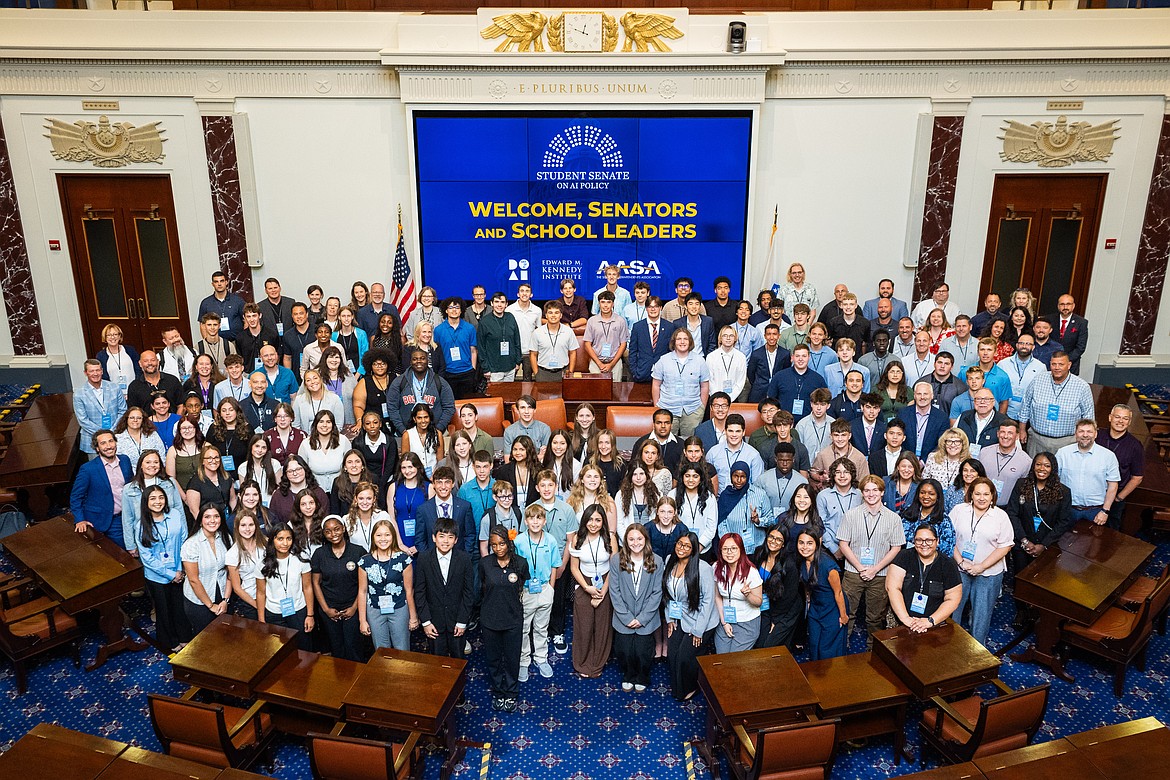
America’s Youth AI Festival's student senators pose for a group photo.
Courtesy photo
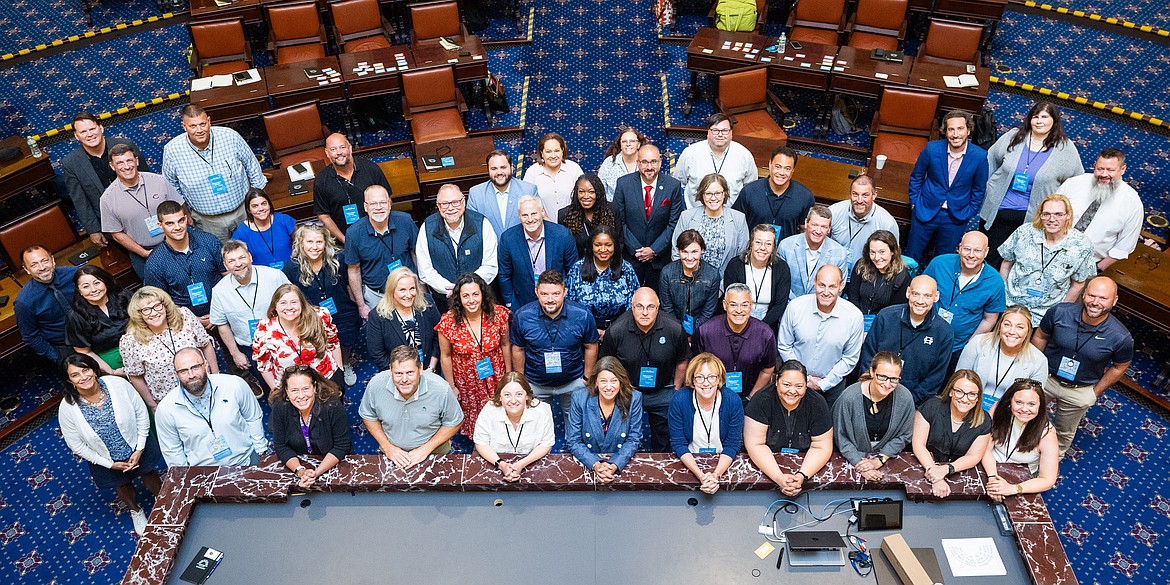
Educators from throughout the United States gather for a group photo at America’s Youth AI Festival, held July 17-21.
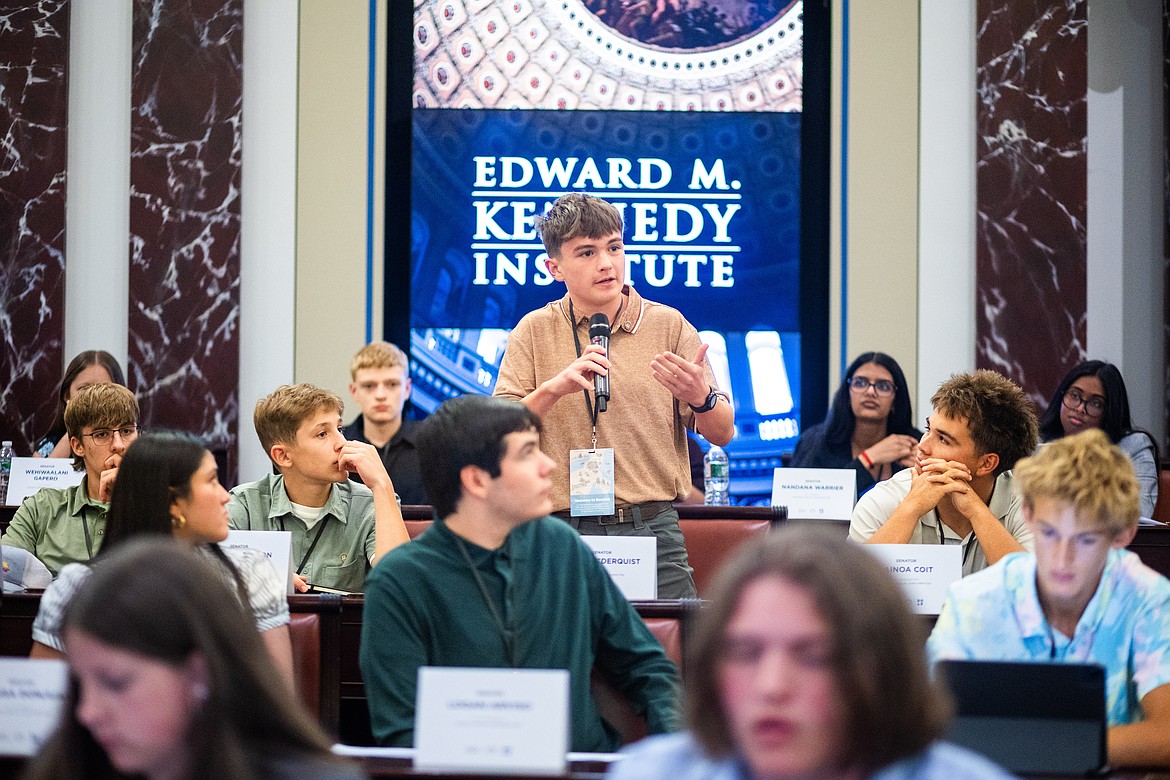
Boundary County Middle School student James Cederquist speaks on AI's role in education in the EMK Institute’s full-scale replica of the U.S. Senate Chamber.
I grew up in the Tri-Cities, Wash., and have always loved to write. I attended the University of Washington, where I earned a double major in journalism and political science, with an area of emphasis in history. I am the fifth out of six kids — don't believe any of the stories that my siblings tell. To be able to tell others stories and take photos for a living is a dream come true — and I considered myself blessed to be a community journalist. When I am not working, I enjoy spending time with family and friends, hiking and spending time outdoors, genealogy, reading, and watching the UW Huskies and the Seattle Seahawks. I am a servant to my cat, Frankie, who yes, will eat anything and everything in sight … even wedding cookies. | October 8, 2026 1:00 AM
BONNERS FERRY — Ninety-eight students. Three days. Two local youth. One AI policy.
The students, part of the America's Youth AI Festival, were tasked with developing a sweeping national framework for the responsible use of artificial intelligence in K-12 education. The act proposes protections for authentic learning, student privacy, fairness, human judgment and the relationships at the heart of education.
The first-of-its-kind gathering, held July 17-19 on the UMass Boston and MIT campuses, brought students and school leaders together with researchers, artists, visionaries and others for a weekend centered on AI literacy, student voice, civic engagement and responsible innovation.
The student-authored proposal rejects an outright ban on artificial intelligence and its unrestricted adoption. Instead, event organizers said it establishes clear boundaries around when AI can support education and when original student work, professional judgment and human connection must remain paramount.
"As the STUDENTS FIRST Act of 2026 states, educators should avoid AI use in situations where 'human connection is irreplaceable in the learning environment,'" officials said in a press release.
Among its recommendations:
• Require AI literacy instruction when students first use digital devices in school
• Prohibit students from using AI to complete artistic assignments or generate written assignments
• Starting in ninth grade, allow students to use AI, with teacher permission, as a supplementary aid for brainstorming, studying and editing
• Give students the right to appeal accusations of improper AI use and require meaningful human review
• Prevent schools from using AI to profile students or independently determine grades, discipline or hiring
• Allow students to demonstrate subject matter mastery through oral defenses, handwritten assessments or in-person discussions
• Protect sensitive student information and establish transparency around data collection
• Preserve the right of high school students and educators to decline AI use in appropriate circumstances
Recently, two of the student senators who helped craft that framework, James Cederquist and Colton Larsson, spoke to Boundary County School District trustees about the experience. Also attending the conference was Bonner County Middle School Principal Mark Fisk.
Fisk was in a meeting when BCSD Superintendent Jan Bayer asked if he knew of any students who might be interested in representing the state to craft a policy exploring the future of artificial intelligence and its role in education.
It didn't take long before Cederquist's and Larsson's names came to mind.
When he was asked to come to the principal's office, Cederquist said he wasn't sure what to think.
"I thought I was in trouble for something," he said. "Luckily, I wasn't."
When he and Larsson learned they'd been picked to attend the gathering, there was a moment of doubt about whether the trip would happen because many of the other students selected were high school students.
However, the school was assured that the students were still welcome to participate in America's Youth AI Festival.
"We were probably the only middle schoolers there," Cederquist said. "Everyone else was juniors, seniors and some sophomores."
Larsson was in his digital technology class when his teacher asked him into the hallway and, like Cederquist, he also briefly wondered if he was in trouble for something. Instead, his teacher explained the AI policy conference and asked if he'd be interested in being a part of the event.
"He told me that MIT was asking for kids to go to Boston and draft a bill for AI regulation," Larsson recalled. "I've always dreamed of going to MIT and I was stoked because I just never thought that MIT would reach out to Bonners Ferry."
A member of the Parent Subcommittee, Cederquist said the student senators focused on how to include parents in the process, from keeping them up to date on curriculum issues and homework and families' concerns about AI.
Because students only had two days to draft the policy, a survey was sent to the student senators to begin the process, Cederquist said.
"People were getting ideas and they built a draft bill that we went and edited," he said of the process. "There were contradictions in this bill, and we needed to take ideas to build our own policy."
Much like policy and procedures drafted, debated and passed in the U.S. Congress, Fisk inserted.
Larsson served on the Student Subcommittee, where, like in the other committees, there were contradictions that needed to be sorted out.
"We were only able to change so many and when the president of the Senate heard everyone talking about how there were so many contradictions that the students didn't like, he gave us another 30-minute period to fix one contradiction per subcommittee."
When the full group reconvened on the final day, the debate took place in the full-scale replica of the U.S. Senate chambers. There, Fisk told trustees, the students debated the proposed act.
"They got to see what it would actually be like," Fisk said. "They came forward to the podium and then they argued for or against the act, the bill they were trying to pass, and that was interesting as well. I was sitting in the foyer, thinking, 'Where's Idaho? When is Idaho coming up to speak?'"
While he didn't speak on the final day, Cederquist said he did talk on the first day, noting to other student senators that AI is here to stay.
"I mentioned things like AI is not going away so we shouldn't try to ban AI in schools," Cederquist said. "It needs to be taught. We're not going to get rid of AI and it needs to be taught as a tool."
Larsson told BCSD trustees he spoke toward the end of the final day to point out a contradiction regarding AI use in art. While banned under the policy, he pointed out that at MIT's Media Lab, humans collaborate with AI on performances and art.
Instead, he proposed amending the policy to allow specific assignments using AI.
While they didn't agree with every provision, such as ones saying "parent must" or specifics on regulations, overall both said they liked more about the proposal than they didn't.
"It's definitely a good start," Larsson said.
The students said the event gave them a chance to add their voice to AI regulation, something Fisk said they were aware of and appreciated.
"Although we all acknowledge that it's not a perfect document, it's the one that was the best version of it that we can come up with, given the restraints and stuff," the BCMS principal said.
Fisk noted that the Bonners Ferry students' conversation on AI's role in education, or in day-to-day life, didn't end when they left the institute's chambers. They all couldn't help but notice AI's presence, from helping design sets to translating plays.
"It was interesting that they kept like at night," Fisk said. "We would have our meal or whatever, but then we would go places, and almost all of it was using AI and art collaboratively, and I found that kind of ironic."
Both said that, following the experience, they could see themselves attending a school like MIT, for Larsson, a computer science or cybersecurity degree, and for Cederquist, an aerospace or chemical engineering degree.
In the end, the student senators passed the STUDENT FIRST Act of 2026 in an 82-16 vote. Both Cederquist and Larsson voted in support of the act.
For more information on the proposed policy, go online to dayofai.org.
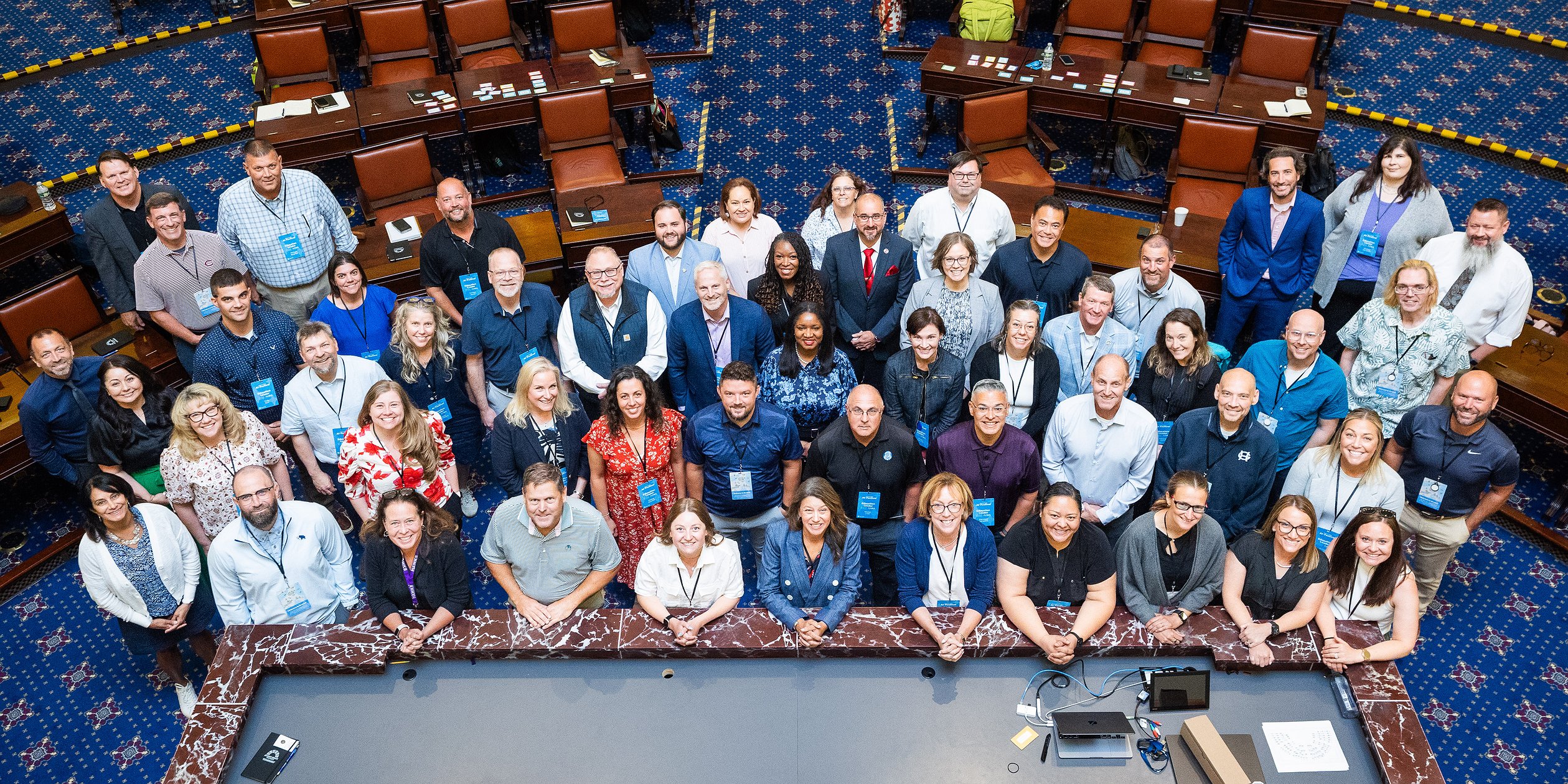 Educators from throughout the United States gather for a group photo at America’s Youth AI Festival, held July 17-21.
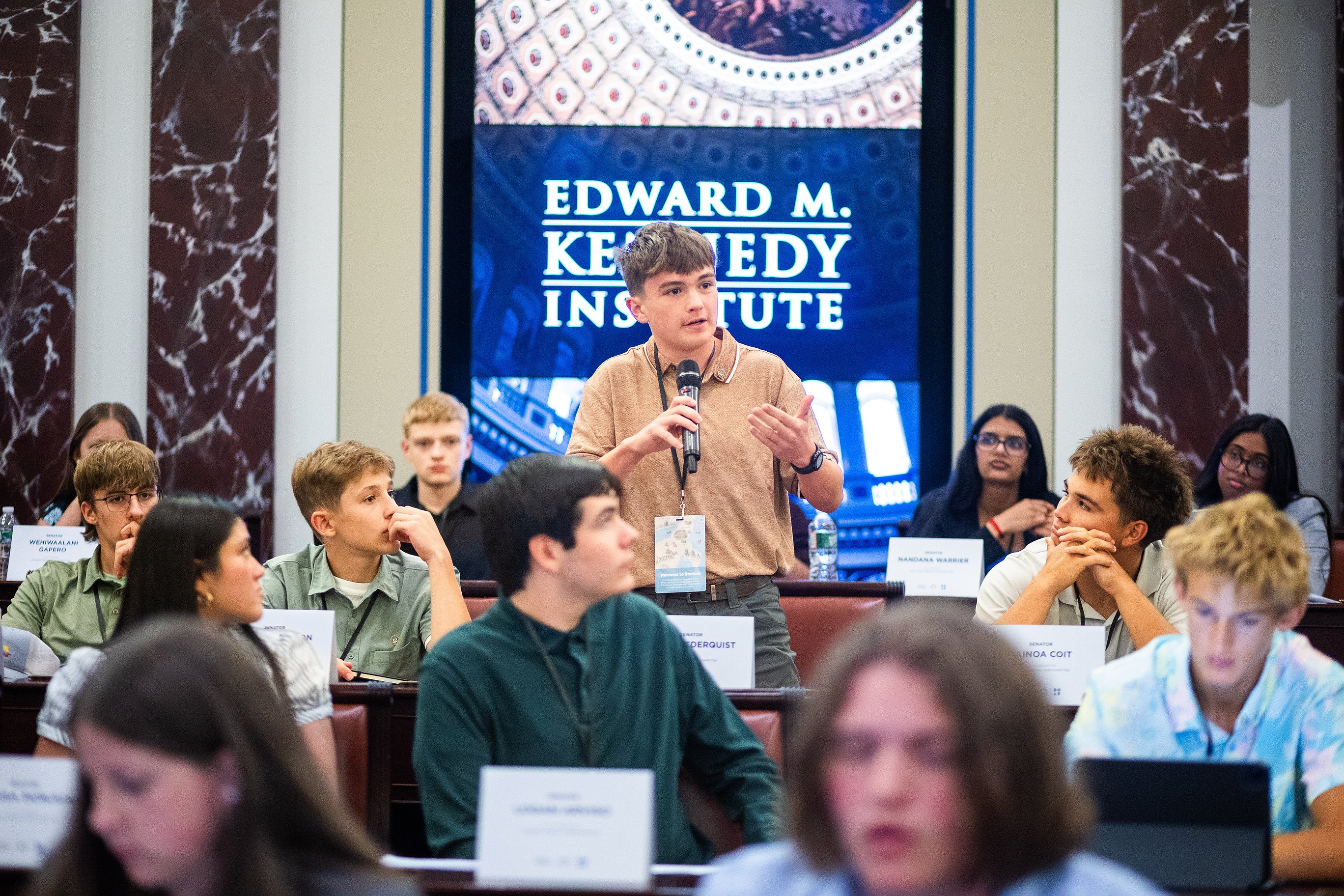 Boundary County Middle School student James Cederquist speaks on AI's role in education in the EMK Institute’s full-scale replica of the U.S. Senate Chamber.
ARTICLES BY CAROLINE LOBSINGER
Local students take seat at the table in AI policy debate
Two Boundary County students — James Cederquist and Colton Larsson — traveled to Boston to help draft a national framework for artificial intelligence in schools, contributing to recommendations on AI literacy, privacy, academic integrity, student rights and responsible classroom use.

Trio praised after fire rescue
A Priest River Police officer and two Bonner County Sheriff's deputies pulled a resident from a burning apartment, while a rapid response from firefighters helped prevent injuries and limit damage during a Sept. 29 fire.
Local students take seat at the table in AI policy debate
Two Boundary County students — James Cederquist and Colton Larsson — traveled to Boston to help draft a national framework for artificial intelligence in schools, contributing to recommendations on AI literacy, privacy, academic integrity, student rights and responsible classroom use.