
From vision systems to robotic dogs, local industry leaders share thoughts on automation and AI
TAYLOR INMAN | Hagadone News Network | UPDATED 2 hours, 45 minutes AGO
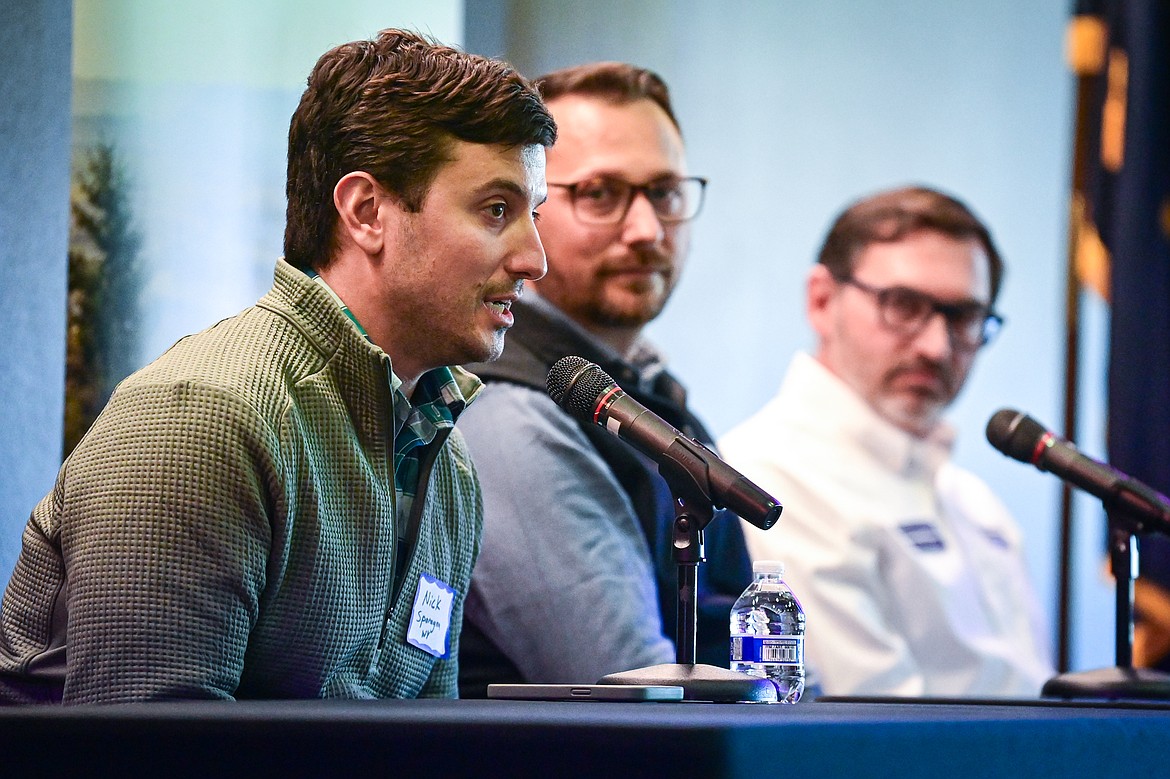
Nick Sparagna, left, with Weyerhaeuser, speaks during a panel discussion on the use of artificial intelligence, automation and robotics in Flathead Valley businesses during a Kalispell Chamber of Commerce luncheon held at Flathead Valley Community College on Tuesday, Oct. 13. At center is Bryon Riotto with Applied Materials. At right is Clint Finlayson with Montana Manufacturing Extension Center. (Casey Kreider/Daily Inter Lake)
Casey Kreider
REPORTER AND PODCAST HOST Taylor Inman covers Bigfork and the north shore of Flathead Lake for the Bigfork Eagle and the Daily Inter Lake. Her reporting focuses on local government, community issues and the people who shape life in Northwest Montana. Inman began her journalism career at Murray State University’s public radio newsroom and later reported for WKMS, where her work aired on National Public Radio. In addition to reporting, she hosts and contributes to Daily Inter Lake podcasts including News Now. Her work connects listeners and readers with the stories shaping communities across the Flathead Valley. IMPACT: Taylor’s work expands local journalism through both traditional reporting and digital storytelling. | October 18, 2026 12:00 AM
When Weyerhaeuser Electrical Superintendent Nick Sparagna thinks about opportunities to bring automation to the lumber company’s facilities, he looks for tasks that are undesirable.
"I think about the tasks like, would I want my family members doing this? ... And that's where I really connect the big opportunities and value for the projects that I lead," Sparagna said.
Weyerhaeuser’s Flathead Valley facilities produce thousands of feet of plywood every day, but quality control previously required employees to check panels for inconsistencies. Sparagna said the task was a great case for artificial intelligence and automation.
"Simply deploy a vision system. If you can automate that task, you can move people elsewhere," Sparagna said.
Investing in automation or artificial intelligence is a hot topic for many businesses in Northwest Montana, but how companies choose to implement new technology is just as important as ever before, according to local industry leaders.
Kalispell Chamber of Commerce’s monthly Business Matters Luncheon last week brought together a panel of business leaders who have overseen the implementation of artificial intelligence and automation in their own local facilities or advised others on how to best go about the process.
Dorothy Meyer, workforce development recruiter and community outreach specialist for Nomad GCS, doled out questions to Sparagna, Applied Materials Manufacturing Engineer Bryon Riotto and Montana Manufacturing Extension Center Business Advisor Clint Finlayson.
Riotto echoed Sparagna's thoughts on when to bring in new technology, adding that safety hazards also present an opportunity to automate certain tasks throughout their facility.
"There are absolutely tasks in the factory that you know are less desirable. They're monotonous. They represent safety and ergonomic hazards that are repetitive in injuries," Riotto said.
He said safety is at the top of a set of performance indicators titled SQDC, which stands for safety, quality, delivery and cost.
The acronym was shared by Finlayson earlier that morning at the 2026 Flathead Manufacturing Symposium, where he spoke about automation.
Before a company decides to make a major investment in the machines, equipment and training necessary to automate a task, Finlayson said the company should take a hard look at its metrics.
There are many situations where a company has an issue to solve, and those at the helm want to use automation to address it, but looking at all sides of the problem may reveal a less expensive and easier solution.
"We help companies to justify a return on investment for automation implementation ... It's very important to look at those metrics that are driving somewhat emotional decision-making of where we think the bottleneck is or what we think is going to help us improve," Finlayson said.
He spoke about two companies he recently advised on automating processes in their facilities.
One company was well-established and learned through years of growth that it was using high-cost labor for a bottling process and nearing the edge of its capacity. With the analytics and justification lined up, Finlayson said it was easy for him to analyze the need for automation.
A different company that was in its infancy brought him different ideas for automation but didn't have a firm understanding of where the bottleneck was in their process.
"We worked through some of those discussions, and it turned out that instead of a containerization packaging at the end of the line, they actually need a forklift because they're doing a lot of tasks manually at the front of the line, material handling-wise, that would be saving a huge amount of money," Finlayson said.
WHEN ASKED about what kind of robotics are being utilized, Sparagna said Weyerhaeuser’s Kalispell and Columbia Falls facilities have a few different kinds. One places protective panels in units, which is a repetitive task that comes with an ergonomic safety risk, he said. Another multi-access robot stencils units and prints unique customer information and their logo. There's also a crane-type robot that helps manage inventory.
But there's one robot that's different from the others: a Boston Dynamics dog.
"Our dog has a camera with a vision system. It has acoustic monitoring to monitor sound throughout the mill, as well as a thermal camera. This dog executes a routine route that's pre-programmed with multiple inspection points ... It can look at gauges and handles of belts and it reports back every single day the same way every time," Sparagna said.
These inspection tasks, now carried out by the robot dog, are another way the plants have automated a task and reallocated employees.
Riotto said while Applied Materials doesn't have anything “as cool as a dog," their facility employs many kinds of robotics. They use a robotic welding arm in assembly and vertical lift modules for inventory, warehousing and storage.
"It's also got built-in AI that learns what parts you use together. So, if you're building one assembly and you use part A and C and D, the system learns that you use those parts together. Then it'll start telling you to change your storage to move those parts to be on the same shelf," Riotto said.
The panelists were also asked how to address the concerns of employees who feel like automation could mean fewer jobs. There's also the challenge of implementing new technology and requiring workers to learn about and understand large, expensive machines.
Sparagna and Riotto said automation at their companies has only grown the number of jobs offered. Because they have been strategic in what parts of their processes they choose to automate, it has allowed them to grow enough to bring in more people for the non-automated tasks.
Although, Sparagna emphasized that training is key when implementing new technology.
"I guess I'm an employee too, so I have the same concerns that they have. How are we going to troubleshoot this thing? How can I work around it safely? In preparation for that, we sent people to school. We started with an online training platform and then we sent them on the East Coast to get formally trained in robotics and troubleshooting and maintenance," Sparagna said.
Finlayson said that it's important for company leaders to take seriously the concerns of their employees when thinking about AI and automation.
"You do have to have trust in your workforce, too, if you're implementing these things, that they are the experts,” he said. “You're not removing the human from the process, and they need to be accountable for the work product they produce. AI is a tool; it's not a replacement.”
As part of Manufacturing Month, the Kalispell Chamber of Commerce is facilitating tours of manufacturers throughout the Flathead Valley. To learn more, visit business.kalispellchamber.com/chamber-calendar/.
Reporter Taylor Inman can be reached at 406-758-4440 or [email protected]. If you value local journalism, pledge your support at dailyinterlake.com/support.
ARTICLES BY TAYLOR INMAN
From vision systems to robotic dogs, local industry leaders share thoughts on automation and AI
Investing in automation or artificial intelligence is a hot topic for many businesses in Northwest Montana, but how companies choose to implement new technology is just as important as ever before.
Montana State University unveils new College of Nursing building in Kalispell
The two-story, approximately 20,000-square-foot building at 311 Heritage Way is equipped with modern technology and student-centered spaces.

Trump first sitting president to visit Northwest Montana since Gerald Ford
Donald Trump’s Wednesday night rally in the Flathead Valley will mark the first time in 51 years that a sitting president has visited Northwest Montana.