
View from above: Pilot coordinates firefighting efforts from the sky
ELSA ERICKSEN | Hagadone News Network | UPDATED 4 hours, 23 minutes AGO
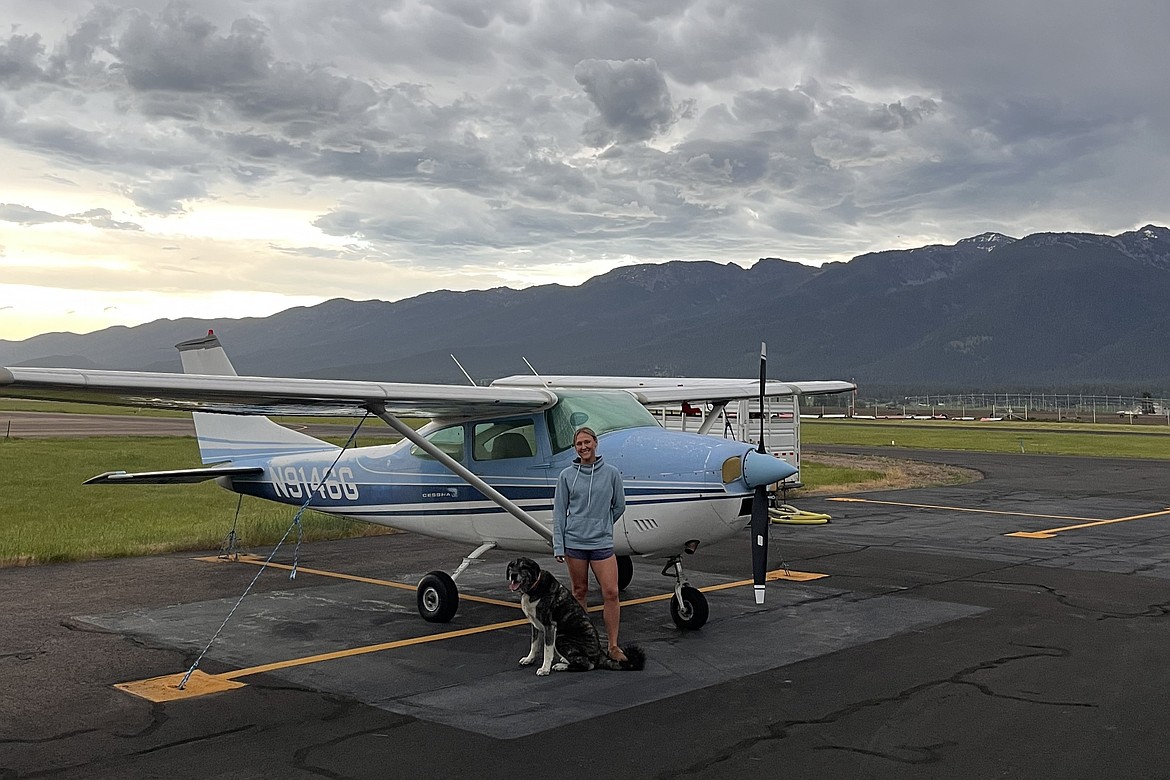
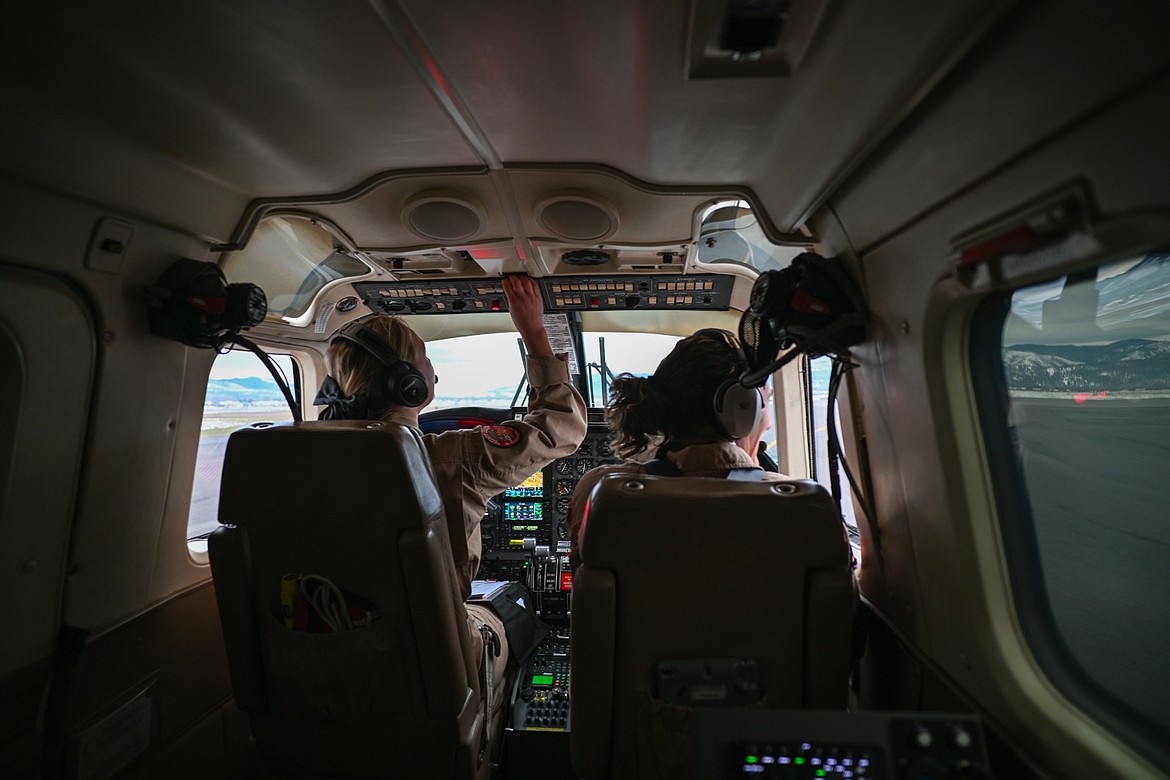
Circling for hours in a turboprop Twin Commander above the Skillet Fire near Olney last summer, Kait King watched thousands of acres of smoldering heat and flame in the dense forests along the border of Flathead and Lincoln counties.
It wasn't the first fire King has watched burn from 2,500 feet above earth, but it was the first time she had watched one burning so close to home. Her flight route took her over the road she drove to church each Sunday in the summer, and at the hastily assembled base camp, her friends were delivering meals to firefighters.
In the battle against wildfires, there are two fronts: one on the ground and one in the sky. Aerial firefighting consists of helicopters, single-engine air tankers and large air tankers that drop water, foam and fire retardant on blazes, often in remote mountainous regions.
Someone must coordinate and navigate the airspace above these blazes, and that’s where King comes in. Her official title is Air Attack, and she’s the eyes in the sky above the fire. Along with the air attack ground supervisor, usually a United States Forest Service employee, King is part of the Air Attack platform, and it’s their job to communicate between the incident commander on the ground and the aircraft circling above.
She spent her summer chasing fire during a wildfire season that wasn’t record-breaking but still saw more than 9 million acres across the United States burn. She deployed to Nevada and to Idaho for 12 days at a time, flying in circles above different fires in different mountain ranges and watching as the air and ground crews worked to fence in the flames.
“I think in a situation with so many problems, it's nice to be part of the solution. Fires are getting crazier. It feels a little helpless sometimes when you're just standing back,” King said. “It's kind of nice to be on the front lines, to a degree. I think that's also just personality type.”
At 26, King is young enough to be the daughter of most of her coworkers and is often the only woman, but she’s been flying planes for more than a decade. Originally from Spanaway, Washington, she grew up in the shadow of Mount Rainier and downwind of the C-17s that took off from McChord Air Force Base.
As a teenager, she went on a discovery flight with her grandfather, and as she banked and climbed in the small plane, she knew this was it.
“They call it the bug,” King said. “Either you get it or you don’t, and after I flew, I thought, ‘Oh, dude, I could do this forever.’”
But King cycled between passion and burnout as she chased a career in flying. By 19, she was a certified flight instructor with an instrument rating and worked as a flight instructor for two years before it got to be too much and she headed to Polson, where her parents were building a house.
In retrospect, King’s arrival in the Flathead Valley was more of a crash-landing than anything. It was winter, and she was 22 years old, living in a trailer with her dog who was dying of cancer. She couldn’t find a flight instructing job, and it felt as though her days in the sky were behind her.
But she couldn’t stay away. She would show up to the Polson Airport with a box of doughnuts in hand, and hang around the veteran pilots, men in their 70s who got together to shoot the breeze and talk about planes and relive the glory days. One had flown with John McCain in Vietnam, and some of them had played cards with Ronald Reagan.
Those days reignited King’s love for flying, and, with a gentle shove from one of her new friends, she got back in the sky.
In a few short months, King was flying as a government contractor for the National Oceanic and Atmospheric Administration and the National Aeronautics and Space Administration. Flying low over the Appalachian Mountains and above the desolate landscapes of South Dakota while measuring gravity and methane and anything else that the scientific organizations needed. She spent time in Alaska and was at one point stranded in the village of Utquiagvik, the northernmost settlement in the United States, because of bad weather. She jumped in the ocean just so she could say she had swum north of the Arctic Circle.
King loved her job, loved flying, but she was struggling with being gone for 10 months of the year. And in the back of her mind, she knew she wanted to work fires. It was in 2020, when she was living in Twin Falls, Idaho, that she was first exposed to the pilots who worked on fires, and she was drawn to the camaraderie.
She applied for a job with Neptune Aviation in Missoula, a leading aerial firefighting company, and was denied. It felt like a defeat, but she knew she couldn’t keep living on the road, so she moved back to the Flathead Valley without a plan, in search of the community she knew she couldn’t find jumping between government contracts. Two months later, Neptune called back with a job offer, and King was launched into the world of aerial firefighting.
This past summer was her first fire season, doing her part in the battle against blazes across the United States. She maxed out her flight time twice after spending so many hours in hazy skies.
The Skillet Fire was a dirty burn, unlike any of the other fires King worked on this summer. The fire erupted in pockets, rather than decimating everything in a straight line. King watched on, perplexed, as individual trees would burst into flames before sputtering out, the trees around it untouched.
On one of the days working the fire, an aerial ballet was playing out a thousand feet below King. The wind had picked up, and the cockpit of King’s small plane smelled like campfire. Voices crackled through six radios as the incident commander, running the operation from somewhere on the ground below, called in a pair of single-engine air tankers from Ronan.
She watched as the air tankers scooped water from Tally Lake and buzzed through the airspace above the fire with precise coordination. As the smallest planes used in aerial attack against wildfires, what they lack in size or capacity, they make up for in nimble agility.
“One guy will drop the line and then the other comes along, and he’ll tag it and extend the line, hitting where the other guy left off and keeping it going,” King said. “It’s mad impressive to do this with water. You can see the fire retardant when they drop retardant, but water is pretty much invisible.”
The planes dropped lines again and again, fencing the fire in and driving it toward old burn scars where it would be starved of fuel. King worked on the Skillet Fire for eight days, but the fire burned for more than a month on 3,400 acres before it was contained.
Millions of acres may have caught fire in the mountains and prairies this year. But King stays focused on the column of smoke rising in front of her, of the planes and helicopters dancing below her, of establishing a line that will contain the fire for another day.
Reporter Elsa Ericksen can be reached at 406-758-4459 or [email protected]. If you value local journalism, pledge your support at dailyinterlake.com/support.
 Kait King in the cockpit of a turboprop plane preparing to fly over a wildfire. (Courtesy Kait King)
ARTICLES BY ELSA ERICKSEN

Flathead Valley Community College trustees approve new president’s contract
The Flathead Valley Community College Board of Trustees on Thursday voted unanimously to approve the employment contract for Deborah Kish Stephan, who was offered the position of president in late September.
View from above: Pilot coordinates firefighting efforts from the sky
Someone must coordinate and navigate the airspace above these blazes, and that’s where Kait King comes in.

Bigfork Community Players present 'The Game's Afoot'
"The Game's Afoot" is the Bigfork Community Players' first production without longtime president David Vale at the helm, after Vale moved away from Bigfork to be nearer to family. But Wilder said that everyone involved with the Players has stepped up to fill in the gaps, and Eric Meyers was elected to lead the troupe into this new era.