
High on authority: Should Idaho citizen-led initiatives over drug laws be kept?
RAY ERKU | Hagadone News Network | UPDATED 2 hours AGO

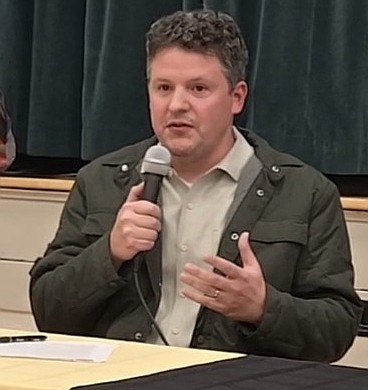
This isn’t simply a question of whether someone can one day legally scarf down a pot brownie on Sherman Avenue.
“It would essentially be the voters of Idaho voting to give away a big piece of their own power,” said Luke Mayville, executive director of Reclaim Idaho, Postdoctoral Fellow at Columbia University and Sandpoint High School graduate.
Mayville, joined by political contemporaries and debaters at the Harding Family Center in Coeur d’Alene on Monday evening, was referring to a November ballot question that asks voters whether state legislators should be given exclusive authority over legalization of marijuana and narcotics.
Called House Joint Resolution 4, the effort would amend Section 26, Article III of the Idaho State Constitution so as to fully invalidate any and all citizen-led ballot initiatives to legalize the cultivation, production, distribution, possessing, prescribing and using of “marijuana, narcotics or other psychoactive substances.”
A “no” vote on this ballot question would leave the state constitution as is.
In addition to Mayville, Monday’s forum panelists included Idaho Sen. Ben Toews, R-Coeur d’Alene, his daughter Sadira Toews and Idaho constitutional guru and commentator David Adler, president of The Alturas Institute and former professor.
The Toews spoke in favor of HJR4, while Mayville and Adler opposed the effort.
“My favorite psychoactive substance that I begin every day with is coffee,” Adler said. “With caffeine, you would be entrusting the legislature to regulate your favorite psychoactive substances, as well. Do you want that?”
Fueled by a Populist wave, Idaho’s initiative and referendum clauses were written into the state constitution in 1912. This means, per Article III, Section 1 of the state constitution, Gem State citizens were given the right to petition for new laws.
The last time Idaho’s initiative and referendum were amended was in 1934, shortly after the Volstead Act was repealed and the federal alcohol prohibition was abolished. This gave the state full authority over intoxicating liquors.
In his support for HJR4, Ben Toews referred to Idaho's original state constitution written in 1889, which states “the first concern of all good government is the virtue and sobriety of the people, and the purity of the home.”
“That foundational principle of sobriety and temperance guides us today as we consider House Joint Resolution 4,” he said.
Ben Toews said, among the 24 states in the Union with legal marijuana status, many were influenced by “special outside interests” and that drug regulations “belong under the deliberative legislative process and not the citizen-led process.”
Ben Toews said the new amendment would be a “limited exception” and that Idaho citizens will “retain full initiative for every other subject.”
“Why this narrow protection?” he said. “Because experience in other states shows that the citizen-led initiatives have been repeatedly used by well-funded outside special interests to legalize medical marijuana as a first step toward a broader recreational legalization.”
Sadira Toews, who has regional and national awards for speech and debate through the national Christian Forensics and Communications Association, noted the negative health impacts of marijuana legalization in other states.
Colorado, one of the first states to legalize recreational marijuana, experienced a 17.8% jump in marijuana-related traffic crashes after the law was put into the books, according to the Journal of Studies on Alcohol and Drugs.
Toews also noted that a study on pediatric cannabis exposure found that marijuana-related emergency and hospital visits for children ages 12 and younger increased from 0% to 2.4% following medical marijuana policy changes.
“The damaging exposure to substances among adolescents is concerning and thus must be scrutinized to ensure that future generations are given the opportunity to thrive,” she said.
But for Mayville and Adler, this isn’t the first time the state of Idaho has tried to restrict citizen-led initiative and referendums.
In 2025, Idaho lawmakers introduced proposals requiring a 60% voter supermajority for any initiative to pass. Restriction efforts were also introduced in 2019, 2021 and 2024.
“The threshold attacks on citizens’ rights have been part of the pattern,” Adler said. “(HJR4) is an accentuation of that pattern and you can expect more.”
In the past, major citizen-led initiatives in Idaho have led to the creation of the Idaho Fish and Game Commission, the Idaho Placer and Dredge Mining Protection Act and Idaho's Sunshine Law, which requires public disclosure of campaign finance contributions, expenditures and lobbyist activities.
HJR4 only needs a simple majority vote to pass, which means it only needs 50% of the vote plus 1.
 Luke Mayville, an executive director of Reclaim Idaho, speaks in Coeur d'Alene on Monday.
ARTICLES BY RAY ERKU

High on authority: Should Idaho citizen-led initiatives over drug laws be kept?
Should Idaho citizen-led initiatives over drug laws be kept?
This isn’t simply a question of whether someone can one day legally scarf down a pot brownie on Sherman Avenue. “It would essentially be the voters of Idaho voting to give away a big piece of their own power,” said Luke Mayville, an executive director of Reclaim Idaho, Postdoctoral Fellow at Columbia University and Sandpoint High School graduate.

In remembrance: City eyes Independence Point for fallen firefighter dedication
City eyes Independence Point for fallen firefighter dedication
On Monday, the city’s parks and recreation commission approved a memorandum of understanding with the Panhandle Parks Foundation to “memorialize the parties' shared commitment to plan, fund, construct, and maintain” the permanent memorial, according to city documents.

Kicking into downtown: The Beacon owner to open ‘Kickers’ country-western venue on Fourth Street
The Beacon owner to open ‘Kickers’ country, Western venue on Fourth Street
Former madam Molly B'Damn had her Murray brothel. Famous lawman Wyatt Earp was a Kootenai County sheriff’s deputy. Now, in the spirit of these iconic frontier heroes, downtown Coeur d’Alene’s getting its own country-western dance floor.