
Glacier National Park documents first bat casualty from deadly fungal disease
HAILEY SMALLEY | Hagadone News Network | UPDATED 3 days, 4 hours AGO
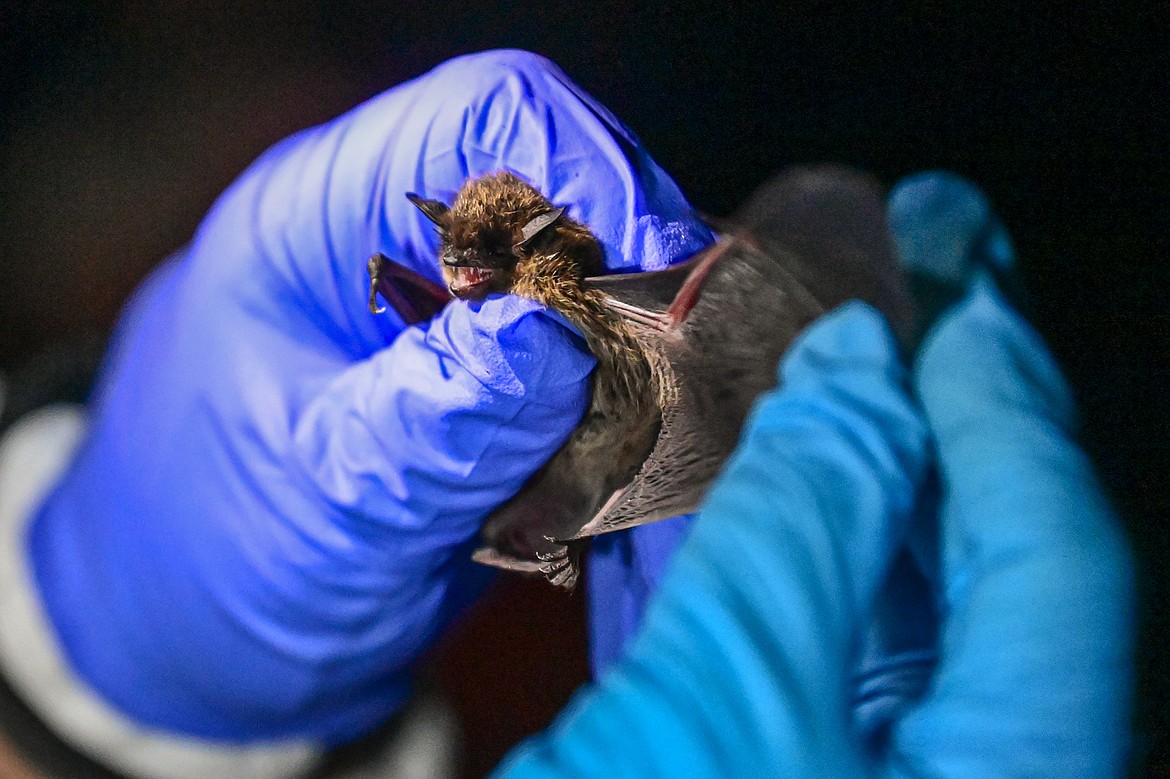
Glacier National Park biologist Lisa Bate checks the wings of a bat as she takes measurements during a "Going Batty" field trip in the park on Thursday, July 9. (Casey Kreider/Daily Inter Lake)
Casey Kreider
A bat found dead in the St. Mary area of Glacier National Park has tested positive for white nose syndrome, marking the first confirmed case of the deadly fungal disease within the park's boundaries.
While harmless to humans and most animals, the fungus that causes white nose syndrome is lethal to hibernating bats. Spores colonize on the bats' skin as they overwinter, gradually eating away the wings, ears, tail and snout. Crucial winter fat reserves quickly thin as the bats attempt to fight off the infection, eventually leading to starvation and death.
Millions of North American bats have died of white nose syndrome since the fungus was first documented in New York in 2006, and infected hibernacula often see population drops of more than 90%.
In 2020, the disease was documented in Azure Cave in eastern Montana, the largest known bat hibernaculum west of the Mississippi River. Within a few years, the 1,700-strong roost dwindled to just 40 little brown bats.
The bats in Glacier National Park have a headstart on the deadly disease, thanks to a long-term monitoring and research project headed by park biologist Lisa Bate. For the past 15 years, Bate has worked to systematically document the park's bat biodiversity and create a baseline of what a healthy population looks like.
In 2024, she collaborated with researchers at the U.S. Geological Survey's National Wildlife Health Center to begin field testing a first-of-its-kind vaccine against white nose syndrome in the park's eastern region.
To date, Bate and her team of wildlife technicians have captured and microchipped 529 little brown bats in St. Mary. Half received a dose of the vaccine, and half received a placebo with no effect on immunological response. The team regularly uses a handheld scanner — what Bate described as "a Darth Vader little reader thing" — to sweep the bat houses on the east side of the park for signals from the microchips.
Over time, the team will be able to track how the vaccine affects the survival rate of bats. Glacier National Park is an especially useful field site, Bate said, as it is one of the few locations in the country where the vaccine was introduced ahead of the fungus.
This summer, state and federal biologists administered the same oral vaccine to about 900 little brown and Yuma myotis bats living in bat houses outside Libby Dam. Routine monitoring by Montana Fish, Wildlife and Parks turned up signs of the fungus that causes white nose syndrome in 2025, though no bats appeared ill at the time.
Along with the deceased bat, several samples that Bate's team collected this summer tested positive for the fungus.
Of the 10 bat species known to inhabit Glacier National Park, four are susceptible to white nose syndrome. Three other local species can carry the fungus, though they are not known to develop symptoms of white nose syndrome.
All bat species in Montana are insectivores; their nightly feasts help keep pesky bugs like mosquitos and gnats in check. Montana Fish, Wildlife and Parks estimated that bats provide $680 million a year to farmers and other Montanans in the form of natural pest control services, and Bate said bats in Glacier National Park also serve as prey for some animals.
Park officials are reminding visitors to help curb the spread of the disease by carefully cleaning and decontaminating all clothing and equipment after visiting a cave where bats are present.
Residents can also assist monitoring efforts by reporting suspicious bat deaths to Montana Fish, Wildlife and Parks. Bats often die outdoors in the warm summer months, but a dead bat found outdoors in winter may be a sign the animal was infected with white nose syndrome. Some bats may also present with a white powdery fungus on their snout, ears, tail or wings, though the infection is not always visible.
While white nose syndrome does not affect humans, officials advise against handling live or dead bats, as they may carry other infectious diseases or parasites.
Reporter Hailey Smalley can be reached at 406-758-4433 or [email protected]. If you value local journalism, pledge your support at dailyinterlake.com/support.
ARTICLES BY HAILEY SMALLEY
Tech highlighted in chamber-sponsored Flathead Valley timber tour
One of Montana's oldest industries has become fertile ground for innovation in recent years.
A snapshot in time: Volunteer pilot helps residents look at a treasured resource from a new angle
A recent flight would take him across the Thompson chain of lakes, a 20-mile stretch of glacially carved tarns between Kalispell and Libby.
Glacier National Park documents first bat casualty from deadly fungal disease
A bat found dead in the St. Mary area of Glacier National Park has tested positive for white nose syndrome, marking the first confirmed case of the deadly fungal disease within the park's boundaries.