
Kalispell City Council considers cracking down on public comment time limit
JACK UNDERHILL | Hagadone News Network | UPDATED 1 hour, 1 minute AGO
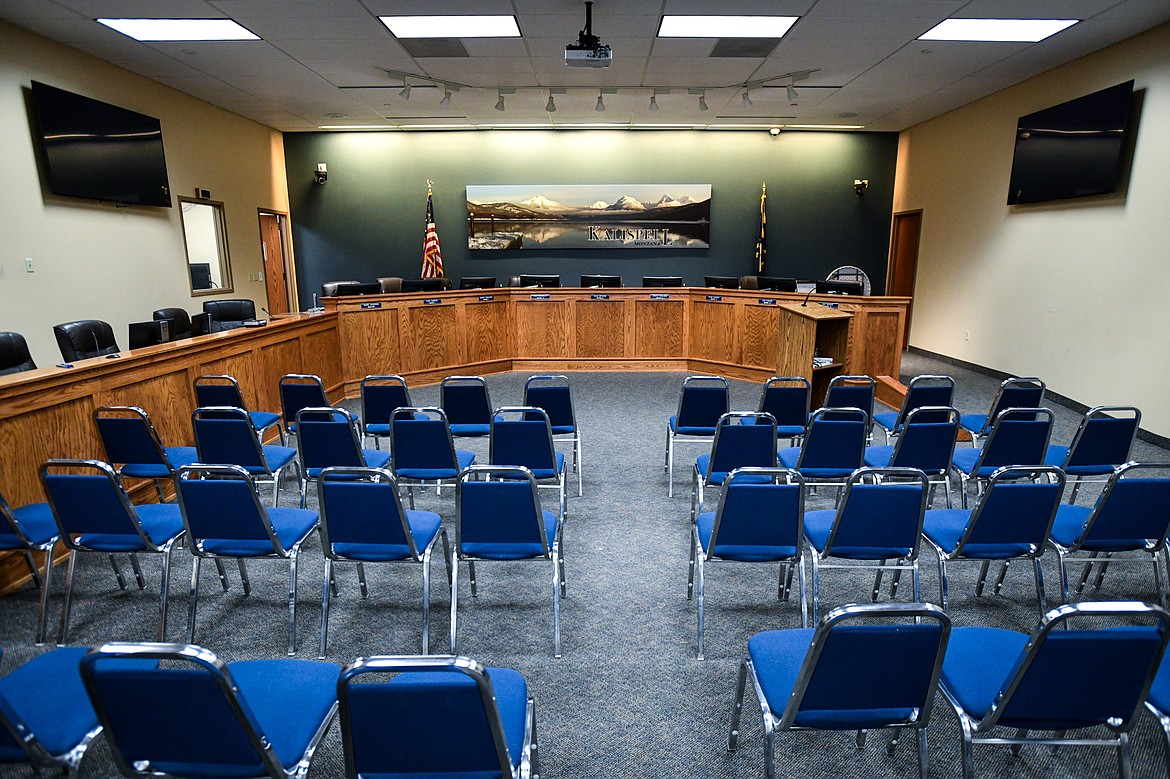
Kalispell City Council chambers in City Hall on Wednesday, April 3. (Casey Kreider/Daily Inter Lake)
Casey Kreider
KALISPELL GOVERNMENT, HOUSING AND TRANSPORTATION REPORTER Jack Underhill covers Kalispell city government, housing and transportation for the Daily Inter Lake. His reporting focuses on how local policy decisions affect residents and the rapidly growing Flathead Valley. Underhill has reported on housing challenges, infrastructure issues and regional service providers across Montana. His work also includes accountability reporting on complex community issues and public institutions. Originally from Massachusetts, Underhill graduated from the University of Massachusetts, Amherst with a degree in Journalism before joining the Inter Lake. In his free time, Underhill enjoys mountain biking around the valley, skiing up on Big Mountain or exploring Glacier National Park. IMPACT: Jack’s work helps residents understand how growth, housing and infrastructure decisions affect the future of their community. | October 28, 2026 12:00 AM
Residents speaking at future Kalispell City Council meetings likely can expect stricter enforcement of time limits.
Council on Monday expressed support for cracking down on the length of public comment at meetings — something it hasn't done in recent memory — while simultaneously extending the allowable time to speak to five minutes.
City code already limits public comment to three minutes, but Mayor Ryan Hunter has typically allowed people to speak much longer, following the lead of his predecessor Mark Johnson.
Most Montana cities enforce their three-minute-limit rule, according to City Manager Jarod Nygren.
Councilor Lisa Blank proposed holding a work session on the topic earlier in the month, citing recent lengthy and sometimes confrontational public remarks.
Councilors appeared willing to impose a uniform time limit on members of the public to ensure everyone has an equal chance to weigh in and avoid having to decide who should receive additional time.
Councilor Sid Daoud expressed skepticism toward enforcement, arguing that any limit on public comment stifles the public process. He argued Council should stick to encouraging people to keep their comments to three minutes and asking people to wrap up if they go well over.
But Nygren warned that picking and choosing who can violate the limit opens the city up to litigation.
"What's wrong with being consistent? I don't understand," Councilor Lisa Blank — who supported stricter enforcement — asked Daoud.
"You guys can try it; it's not going to work," Daoud responded.
Most councilors appeared open to displaying a timer that warns speakers when their time is up.
If Council were to enforce a strict time limit, the body appeared in general agreement that the limit should be extended.
"Three minutes to me is ridiculous. I don't know why it's become the national standard," Hunter said.
He said he's seen viral videos of members of the public being escorted out of council meetings across the country for speaking over three minutes. Hunter argued that five minutes will allow adequate time for people to get their point across.
Councilor Dustin Leftridge suggested allowing experts on topics being discussed to provide lengthier public comment if needed, but Daoud said doing so would be subjective and could turn problematic.
"Who's to say that what I have to say is more expert than someone else? I don't think that is a place we want to get into is judging what people say," Blank added.
Leftridge also argued that councilors should have an opportunity to immediately respond to false information.
"Misinformation breeds, we hear that, and instead of being able to say, 'Actually, what we are discussing tonight is not what you read on Facebook,' We listen to an hour and a half of commentary where that could be alleviated fairly early on in the process," Leftridge said.
Hunter said councilors can't immediately respond because it invites a back-and-forth exchange that disrupts and prolongs the meeting.
"There's a reason why we're kind of limited in our ability to engage with public comment," Hunter said.
No vote was taken on Monday, but Nygren said a proposed ordinance extending the public comment time limit will go before Council at a future meeting.
COUNCIL ALSO pondered putting money toward capital improvements to ensure the city can continue sending its biosolids to the Flathead County Landfill.
Biosolids, also known as sewage sludge, are solid organic byproducts of wastewater treatment. Kalispell once sent up to 70% of its biosolids to Glacier Gold Composting, with the remainder going to the county landfill.
But after Glacier Gold closed its Olney facility in September, the city began sending all its biosolids to the landfill.
Despite upgrades to the city's wastewater treatment center in preparation for the transition, the system still struggles to meet county landfill standards on how wet the material can be.
"A lot of times it takes two years to fine tune operations, and we've had three months," Public Works Director Susie Turner said.
The county landfill requires biosolids to be at least 18% solid, which is in line with federal guidelines aimed at preventing heat-related chemical reactions that have damaged landfills elsewhere in the United States.
To achieve the standard, the city has been mixing sludge with composted leaves and wood chips produced from trees trimmed by the Parks and Recreation Department. The method adds about $35,000 a year in additional costs, primarily due to more material being shipped to the landfill, according to Turner.
Turner expects the method to hit some speed bumps when the winter precipitation hits. A loader mixes the leafy debris and biosolids on a lot outside the wastewater treatment facility and is exposed to the elements.
Councilors appeared willing to invest in a roofed facility and paved lot for mixing to occur.
But because there is no inherent benefit to landfilling biosolids, the county can choose to close its doors to the material whenever it wants, according to city officials.
That's why Turner proposed investing in a drying facility that would rid the biosolids of pathogens, allowing the city to dispose of the biosolids several different ways.
"We could essentially give the produce away. It's the same as composting," Turner said. "It would definitely help us reduce our dependence on the landfill as our sole receiving facility."
However, the upgrades would take time and require a much larger capital investment than continuing to mix the sludge with leaf compost.
Hunter suggested investing in a preliminary engineering report for a potential drying facility while also constructing a covered shed to continue blending the biosolids in the meantime, which other councilors appeared to support.
Citizens for a Better Flathead Executive Director Mayre Flowers urged Council to collaborate with the neighboring communities also grappling with biosolids.
"While I totally understand the proposal to go forward with a drying facility in the interim. I think it behooves us now to start sitting down together," she said.
Reporter Jack Underhill can be reached at 406-758-4407 or [email protected]. If you value local journalism, pledge your support at dailyinterlake.com/support.
ARTICLES BY JACK UNDERHILL

Kalispell City Council considers cracking down on public comment time limit
Residents speaking at future Kalispell City Council meetings likely can expect stricter enforcement of time limits.

Kalispell City Council to review long-term solutions for disposing biosolids
Kalispell has stopped composting its biosolids and is instead sending it to the Flathead County Landfill, but the shift has come with growing pains.
Samaritan House gives tour of reduced-cost apartments under construction
As warm autumn sunlight poured through the ground level windows of Samaritan House's forthcoming apartment building in Kalispell, Marney McCleary gestured upward at the ceiling, where the Gypcrete flooring for the second-story units had already been installed.