
State orders catch-kill-report rule for brown trout in Flathead Drainage
HAILEY SMALLEY | Hagadone News Network | UPDATED 1 day, 11 hours AGO


State fisheries officials are taking the first steps toward controlling the recent infiltration of invasive trout into the Upper Flathead Drainage.
The Montana Fish and Wildlife Commission unanimously approved an emergency catch-kill-report regulation for brown trout in the Flathead Drainage upstream of the SKQ Dam on Oct. 14.
Montana Fish, Wildlife and Parks has received scattered reports over the past two years of the non-native trout in local waterbodies, including two confirmed captures of brown trout in Ashley Lake. Officials were unable to verify several other reports of brown trout in the Flathead River and Church Slough, but they characterized the sightings as "likely legitimate" in a regulation request to the governor-appointed members of the Fish and Wildlife Commission.
"These brown trout are the result of illegal introductions and pose a real threat to sport and native fish throughout the drainage," the document stated.
A prized quarry for fly fishermen, brown trout are stocked in many Montana waterbodies. But fisheries biologists consider the cold-loving salmonids invasive in the upper Flathead Drainage because they prey upon and compete with native fish species, including vulnerable populations of bull trout and westslope cutthroat trout.
"We are known as an intact cutthroat trout fishery, and we're very proud of that. We want to keep that stronghold here, and this [regulation] will help us do that," Flathead Valley fishing outfitter Mark Fuller told the commission during a public comment period.
The Confederated Salish and Kootenai Tribes, Montana Trout Unlimited, Fishing Outfitters Association of Montana and Flathead Wildlife also voiced support for the rule, which will go into effect with the 2027 fishing regulations.
The measure requires anglers to immediately kill and retain any brown trout they catch in waters upstream of the SKQ Dam, including Flathead Lake. The catch must be reported to Montana Fish, Wildlife and Parks within 24 hours, and anglers must either drop the fish off at a regional office or make arrangements to transfer the fish to the state wildlife agency within 10 days of capture.
Fish should be delivered whole, though they may be frozen prior to drop-off. Edible portions of the fish will be returned upon request.
Fisheries biologists will analyze the ear bones of the submitted brown trout carcasses for trace elements, which can then be mapped to specific streams to determine where a fish was born. That information, along with observations on the trout’s reproductive status, will help officials determine whether the local brown trout population has become established enough to reproduce.
"In any situation like this, all biological information is relevant," Fisheries Division Administrator Adam Strainer said.
"I think the most important critical piece here is contacting Montana Fish, Wildlife and Parks," he added.
The Confederated Salish and Kootenai Tribes intend to implement an identical regulation on the portions of Flathead Lake that are tribally managed, according to the regulation request.
Reporter Hailey Smalley can be reached at 406-758-4433 or [email protected]. If you value local journalism, pledge your support at dailyinterlake.com/support.
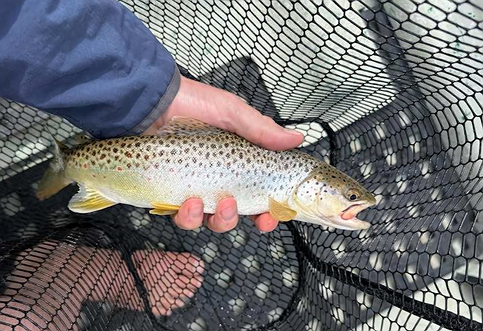 Montana Fish, Wildlife and Parks identified this fish caught in the Flathead River as a nonnative brown trout. (Courtesy photo)
ARTICLES BY HAILEY SMALLEY

Independent Seth Bodnar courts 'politically homeless' voters in Senate race's final stretch
Standing in front of the fireplace at the Montana Taphouse in Whitefish, independent U.S. Senate candidate Seth Bodnar regaled patrons with the story of the first operation he commanded as a lieutenant in the U.S. Army.
White nose syndrome found in Glacier National Park bats
A bat found dead in the St. Mary area of Glacier National Park has tested positive for white nose syndrome, marking the first confirmed case of the deadly fungal disease within the park’s boundaries.
Stocking program brings back native rainbow trout to Kootenai River
Montana’s only native rainbow trout are on the precipice of a comeback, three years after state wildlife officials first began building a regional stocking program.