
PNVA Conference has something for everyone
JOEL MARTIN | Hagadone News Network | UPDATED 6 days AGO
Joel Martin has been with the Columbia Basin Herald for more than 25 years in a variety of roles and is the most-tenured employee in the building. Martin is a married father of eight and enjoys spending time with his children and his wife, Christina. He is passionate about the paper’s mission of informing the people of the Columbia Basin because he knows it is important to record the history of the communities the publication serves. | October 29, 2026 1:00 AM
KENNEWICK — The Pacific Northwest Vegetable Association will hold its annual conference in Kennewick Nov. 18-19.
“I’ve been involved in agriculture all my life,” said PNVA President James Zahrend. “I’ve been involved with a lot of organizations, and all of them try to put on some kind of meeting to meet the needs of their constituents. But the PNVA is unique in that it touches pretty much every segment of the vegetable production business.”
This year’s conference has something for everyone, from biosciences to economics to whiz-bang technology. Farming is more than just popping seeds into the ground and waiting for them to come up, Zahrend said.
“When I grew up, I was a farmer, and I think most people thought of us as a bunch of bumpkins: ‘If you can’t do anything else, you can farm,’” he said. “Well, that’s not the case anymore. As in so many industries, it’s technology, technology, technology … We provide a lot for our members in terms of education.”
Wednesday offers two sessions, one devoted to onions and another to general vegetables and organic production. Thursday will include a session on pest management, and another that was introduced last year: Issues in Vegetable Production. That one brings in experts on small-scale farming, farm labor and environmental concerns to talk about how the grower and supporting businesses interact with the rest of the world. That session encompasses seminars on state and federal issues, water rights, dam breaching and climate change.
“Many of these are very large topics, topics that the whole industry is struggling with,” Zahrend said. “Labor, cost of inputs, commodity prices, government regulation – the list goes on and on.”
“We’ll have Eric Snodgrass with Nutrient Solutions talking about the Super El Niño impacts and what to prepare for in 2027,” said PNVA Executive Director Sheri Nolan. “We’ll have legislative updates from both Washington Friends of Farms and Forests and Oregonians for Food and Shelter.”
While all this is going on, the convention center will be filled with businesses of all kinds – more than 100 of them – making their pitch at the trade show. That aspect is especially important, Zahrend said.
“Gone are the days when you could grow 70 acres of anything and make a living,” he said. “You have to be big, have economies of scale. There are relatively few growers, and there are a lot of people who support them, everywhere from consultants like myself and the companies that provide products for the growers … It’s a huge infrastructure, and that makes up the vast majority of the people who attend the conference.”
Every year, the show brings in 750-800 people, Nolan said. Next year, there will be a lot more space available for them, as the convention center is expanding and PNVA will move over to that larger space. That will include a 60,000-square-foot exhibition hall, 5,000 square feet of additional meeting space and a 162-room convention hotel connected to it, according to the Three Rivers Convention Center website.
The PNVA has more than 500 members, according to its online directory, but like other organizations, it needs people to step up for leadership, Zahrend said. He puts out a call every year at the conference for board members.
“It always seems to be a struggle to get people involved,” he said. “I think we’re very fortunate; other organizations that I’m involved with are struggling to get board members, and these organizations, which I feel are very important, are going to die if people don’t get involved.”
Meet the speakers
Josephine Antwi
Dr. Josephine Antwi is an Assistant Professor and Irrigated Crop Entomology Specialist at Oregon State University’s Hermiston Agricultural Research and Extension Center. She leads research and extension programs focused on arthropod pest management in irrigated cropping systems, including potatoes, cereals, alfalfa, and corn. Her work explores insect-microbial-plant interactions and how environmental factors influence pest dynamics. Dr. Antwi earned her Ph.D. in Entomology from Texas A&M University, her M.S. in Biological Sciences from the University of Louisiana and her B.S. in Natural Resources Management from Nkrumah University of Science and Technology, Kumasi, Ghana.
Aaron Becerra-Alvarez
Dr. Aaron Becerra-Alvarez is an Assistant Professor of Weed Science in Vegetables and Specialty Seed Crops at Oregon State University, based in Corvallis. His research focuses on plant-management-environment interactions to develop integrated weed management strategies, with expertise in herbicide physiology, weed ecology, and sustainable crop production. Dr. Becerra-Alvarez earned his Ph.D. in Weed Science from the University of California, Davis, and a B.S. in Crop Science and Horticulture from California State University, Chico.
Emilie Demard
Dr. Emilie Demard is a Biology Assistant Professor and Entomology Extension Specialist at Utah State University. Originally from France, she earned a master’s in agronomy from AgroSup Dijon in 2016 and a Ph.D. in entomology from the University of Florida in 2022, then completed a postdoctoral appointment at Florida before joining USU. Demard’s research focuses on integrated pest management, including cultural and biological control strategies for insect and mite pests affecting tree fruit and vegetable crops.
Lindsey du Toit
Dr. Lindsey du Toit is the Alfred Christianson Distinguished Professor of Vegetable Seed Pathology and Chair of the Department of Plant Pathology at Washington State University. Based at the Mount Vernon NWREC, she specializes in the epidemiology and management of diseases affecting small-seeded vegetable crops in the Pacific Northwest. Originally from South Africa, du Toit earned her M.S. and Ph.D. in Plant Pathology from the University of Illinois. Since joining WSU in 2000, she has led research and extension programs advancing disease diagnostics, seed health, and sustainable agriculture for regional and global vegetable seed industries.
Allan Felsot
Allan Felsot is a professor and extension specialist at WSU Tri-Cities. He earned a Ph.D. in entomology from Iowa State University, an M.S. from the University of Florida and a B.S. in biology from Tulane University. His research focuses on environmental risk assessment, pesticide toxicology, contaminant characterization, agricultural biotechnology, and pesticide drift mitigation. As an extension specialist, he provides expertise in environmental chemistry, pesticide safety, integrated pest management, and risk communication. Felsot also teaches courses on ecology, biotechnology, pesticides, entomology, and environmental science.
Claire Murphy
Dr. Claire Murphy is an assistant professor and Extension Specialist in the School of Food Science at Washington State University, stationed at the Irrigated Agriculture Research and Extension Center in Prosser. Her work focuses on reducing foodborne pathogen contamination throughout the produce supply chain. Murphy also develops predictive models to enhance food safety in evolving agricultural systems. She earned her B.S. in Food Science from the University of Delaware, her M.S. and Ph.D. in Food Science and Technology from Virginia Tech and her Master’s of Public Health in Infectious Disease and her Ph.D. in Infectious Disease from the Virginia-Maryland College of Veterinary Medicine, Virginia Tech.
Brian Nault
Dr. Brian A. Nault is a professor of entomology and program leader at Cornell University’s AgriTech campus in Geneva, New York. An internationally recognized expert in vegetable entomology, his research focuses on the biology and ecology of insect pests and the viruses they transmit to vegetable crops. He holds degrees in entomology from Ohio State, Georgia and North Carolina State universities.
Lyndon Porter
Dr. Lyndon Porter is a Research Plant Pathologist with the USDA Agricultural Research Service, based in Pullman, Washington. He specializes in legume pathology, focusing on disease resistance in peas and beans. Porter has contributed to the development of genetic markers for resistance to Pea Enation Mosaic Virus and identified genes linked to Fusarium root rot resistance. His work has led to the release of multiple pea lines now used by breeding companies to improve crop resilience. Dr. Porter earned his M.S. in Botany from Brigham Young University and his Ph.D. in Plant Pathology from Washington State University.
Stuart Reitz
Dr. Stuart Reitz is the director of Oregon State University’s Malheur Experiment Station in Ontario, Oregon, where he leads research and Extension programs focused on cropping systems in Malheur County. An internationally recognized entomologist, his work emphasizes integrated pest management, insect ecology and the management of insect vectors that transmit plant diseases. Reitz earned a bachelor’s degree in biology from the University of South Alabama, a master’s degree in zoology and a doctorate in entomology from Clemson University.
Alan Schreiber
Dr. Alan Schreiber is the founder and director of Agriculture Development Group, Inc., established in 1998 to conduct independent field trials and provide consulting services to growers and industry stakeholders. ADG operates a 100-acre research farm near Pasco, where Schreiber oversees studies on insects, weeds, diseases, and crop varieties. He also serves as executive director of the Washington Blueberry Commission and the Washington Asparagus Commission and administrator of the Washington State Commission on Pest Management. Schreiber was recognized in 2025 with the Mid-Columbia Ag Hall of Fame’s Visionary Award.
Eric Snodgrass
Eric Snodgrass is a senior science fellow and principal atmospheric scientist with Nutrien Ag Solutions. An internationally recognized climatologist and meteorologist, he specializes in translating complex weather and climate data into practical decision-making tools for agriculture. Before joining Nutrien Ag, Snodgrass spent 13 years teaching atmospheric sciences at the University of Illinois Urbana-Champaign.
Tim Waters
Dr. Tim Waters is an area extension educator at Washington State University with specialties in pest management in vegetable crops; vegetable variety development; alternative cropping systems; and potato and vegetable production. He holds a bachelor’s degree in Biology, a master’s in Entomology and a doctorate in Entomology, all from WSU.
Carrie Wohleb
Dr. Carrie Wohleb is a regional vegetable crops specialist with Grant/Adams County-WSU Extension in Moses Lake. Wohleb focuses on potato production, regional potato insect pest surveys and pest and disease management in vegetable crops. She received her undergraduate degree from the University of Washington; she earned her master’s degree and Ph.D. from Washington State University. She has been a member of the WSU faculty since 2008.
James Woodhall
Dr. James Woodhall is an Associate Professor and Extension Specialist in Plant Pathology at the University of Idaho, specializing in the detection and characterization of plant pathogens. With over two decades of experience in potato disease diagnostics, his research focuses on improving disease management through molecular techniques, monitoring programs, and integrated strategies.
James Zahand
James Zahand is an agricultural consultant, nationally certified crop adviser, and pesticide applicator with nearly five decades of experience in the agricultural chemical industry. Through James Zahand Consulting, PLLC, he provides training, consulting, and educational programs for growers, crop advisers, and agricultural professionals throughout the Pacific Northwest and beyond. Zahand holds a bachelor of science in microbiology from Ohio State University and a master’s in plant pathology and entomology from Cornell.
This guide was created with the assistance of Copilot for Microsoft 365.
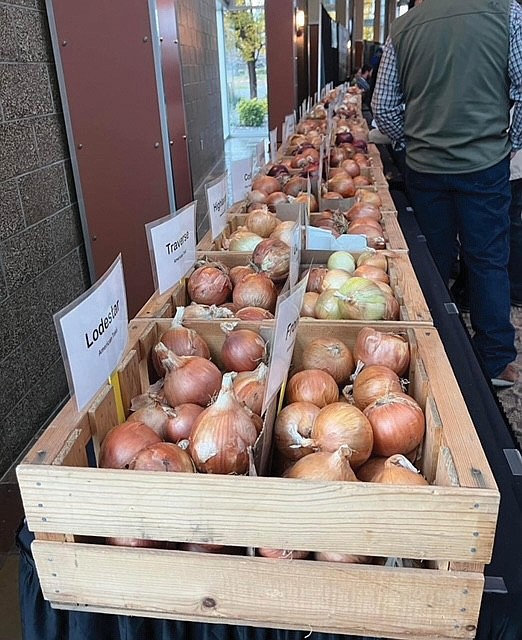
 While the PNVA conference covers all kinds of veggies, special attention is paid to onions.
FILE PHOTO
ARTICLES BY JOEL MARTIN

CBAA Premier Series offers music, ballet and comedy
MOSES LAKE — Columbia Basin Allied Arts 49th Premier Series is a little shorter than past seasons, but that’s because the focus is on quality over quantity, said CBAA Executive Director Shawn Cardwell. “Allied Arts is really trying to step up the prestige level of the shows that we’re bringing,” Cardwell said. That prestige is reflected this month in the first show, by a living legend: Booker T. Jones. Jones is the founder and last living original member of Booker T. & the MG’s, the instrumental jazz/rhythm and blues band of the 1960s that paved the way for the soul and funk sounds of the 1970s. “(His show has) a lot of storytelling,” Cardwell said. “He’ll be armed with his Hammonnd B organ; its sound is really iconic.”

Hidden chimney damage can turn cozy fires dangerous
MOSES LAKE — The weather is getting chillier, which means lots of people are getting ready to build the first fire of the year in their fireplace. Here in the Columbia Basin where electricity is plentiful, few homes are heated with burnable fuel like wood or oil. But even chimneys attached to fireplaces that only get occasional use should be checked regularly, said Joe Ochal, CEO of Chimney Scientists. “Chimneys last about 20-30 years before the interior of them starts to degrade and they have holes where heat can transfer into the wall cavity,” Ochal said. “When we’re going into people’s homes and do a chimney cleaning, we put a camera in the chimney every time to make sure there’s no holes where there’s heat transfer. People will often say to us, ‘Well, it’s been this way for 80 years,' and (they’re) surprised that chimneys require maintenance.”

BASIN EVENTS: November 2026
COLUMBIA BASIN — November is right around the corner, and the Basin is brimming with things to do. Here are a few ways to get out and about.