
State Wildlife Commission rejects no-wake zone proposal on Swan Lake as too specific, advocates for wider approach
HAILEY SMALLEY | Hagadone News Network | UPDATED 4 hours, 7 minutes AGO
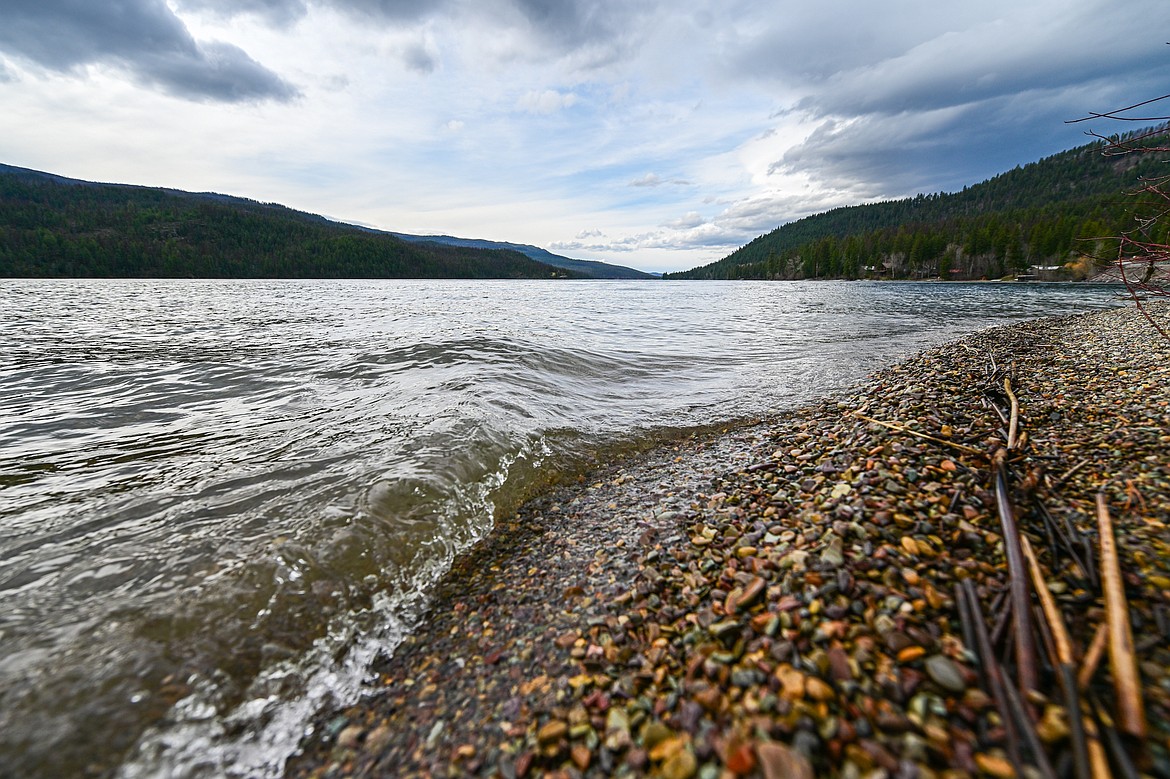
The shoreline of Swan Lake on Saturday, March 21. (Casey Kreider/Daily Inter Lake)
Casey Kreider
A citizen petition to expand the no-wake zone on Swan Lake failed to pass muster during October's meeting of the Montana Fish and Wildlife Commission, but the grassroots effort could still have ripple effects for waterbodies throughout the region as regulators wrangle with new boating technologies.
"We've seen over the years, bigger and bigger boats and bigger and bigger waves," Swan Lake resident Doug Harwood told commissioners during an Oct. 14 meeting. "And now we're into the point where we've got shore erosion issues. We had to replace our dock last year due to dock damage caused by waves."
Harwood was one of 11 property owners to pen a petition asking the commission to extend the no-wake zone on Swan Lake to all areas within 500 feet of the shoreline. Most large lakes in Montana, including Swan Lake, are already subject to a 200-foot wake free zone, but the petitioners argued that a larger buffer was needed to accommodate newer boat models capable of producing larger wakes.
In the hour-long debate that followed the petition's introduction, commissioners vacillated between sympathy for the petitioners' arguments and skepticism about the utility of a site-specific rule.
"The issue is not necessarily the waterbody. The issue is the tool, the wake boat," Region 1 Commissioner Ian Wargo said. "It's a new technology ... I'm not saying I'm opposed to it, but it is something that was not a thing 15, 20 years ago, and it's probably time to have this discussion."
That discussion, Wargo contended, needed to happen on a regionwide scale and might be better suited to the state Legislature than the governor-appointed commission. He successfully carried a motion to deny the petition but said he would "100% support" a future rule-making process that sought to change the no-wake zone on all lakes in western Montana from 200 feet to 300 feet.
Wargo confirmed in email correspondence with the Daily Inter Lake that he has since begun exploring options for the commission to initiate a more wide-reaching proposal that reexamines the current no-wake zone regulations at a statewide level.
"To my knowledge, there has never been a 'commission petition' that has been entertained," he wrote. "So, I am in the process of determining if that is something that the commission could even do."
The commission has fielded a surge of citizen petitions related to boating wakes in recent years, including requests to alter the no-wake zones on Church Slough, Half Moon Slough and Lake Five. Only the Half Moon Slough petition resulted in any rule changes, but commissioners at the Oct. 14 meeting observed a growing sense of deja vu over the issue.
"We've just dropped the ball on taking it up," Region 2 Commissioner Jeff Burrows said. "It comes in on a specific waterbody. We have this same exact discussion. We say, 'Let's look bigger picture,' and then it sits for six months until the next petition comes up."
"I think if there was ever a time for the commission to move forward and let this process move forward, it's probably about now because all of these are new uses," Region 3 Commissioner Susan Kirby Brooke said at another point in the meeting. "We've got a lot of very frustrated people on both sides of the argument, and I think now's the time to put this into the [rule-making] process and see what comes out of it."
THE COMMISSION made more substantial inroads on several other action items, including the approval of the 2027-2028 fishing regulations.
A request from the state wildlife agency to transplant northern leopard frogs from eastern Montana to the Blackfoot and Seeley-Swan valleys encountered little resistance. The amphibians are native throughout Montana, but an outbreak of an aquatic fungus in the 1990s nearly wiped out the entire western population.
A single modification was made to the state's list of potential grizzly bear release sites, omitting a location near Blacktail Mountain that members of the public worried would situate conflict-prone bruins too close to the ski area and nearby neighborhoods. Another 22 sites in Flathead County made it onto the approved list.
The remote release sites represent a non-lethal option for wildlife managers dealing with a problem bear. If a grizzly is sifting through trash or lingering near a hiking trail, wildlife biologists can capture and relocate the animal to preempt further run-ins with humans.
When a grizzly bear ambled into Polson in mid-September, for example, wildlife biologists tranquilized the animal and released it into the Big Creek area.
"Ideally, these are bears that don't have a history of conflict and getting them out of harm's way helps keep that going," Wildlife Division Administrator Ken McDonald said.
State and federal officials relocate an average of 20 grizzly bears per year, but a low huckleberry crop has spurred an increase in bear-human conflicts throughout the state. Montana Fish, Wildlife and Parks has recorded 28 grizzly bear relocations in 2026, all but three of which were originally captured in Northwest Montana.
Even so, McDonald told commissioners that most of the 400-odd relocation sites scattered across the state would never end up being used. Rather, the state wildlife agency was seeking approval of a large range of sites to ensure officials had alternative release locations if bad weather or poor road conditions made some areas inaccessible.
The Fish and Wildlife Commission must approve a list of grizzly bear release sites every five years.
THE COMMISSION also approved a suite of proposed fee increases for fishing access sites and other sites managed by Montana Fish, Wildlife and Parks, which will go into effect no earlier than 2027. Under the new rules, Montana residents will pay $20 for a campsite at fishing access sites while non-residents will be subject to a $40 fee. Commercial use fees for state-managed sites will also increase.
Fees for state-managed lands have not been comprehensively reviewed since 2014, and Parks and Outdoor Recreation Division Administrator Renee Lemon told the commission that revenues have not kept pace with the cost of site operations.
"This is mainly due to the increasing number of people and the pressure at our fishing access sites that is leading to the need to invest in additional infrastructure, such as adding latrines or expanding parking areas," she said.
In just the past four years, the cost of maintaining the state's 338 fishing access sites has nearly tripled, from about $3.2 million in fiscal year 2022 to $8.9 million in fiscal year 2026, Lemon said. Annual revenue from fishing access sites only increased 8% during the same period, from about $930,000 to just over $1 million.
The agency based the fee increases on consumer price index adjustments and the prices that nearby states charge for similar recreational sites. The Parks and Recreation Board will review a similar slate of fee increases for state parks in December.
Reporter Hailey Smalley can be reached at 406-758-4433 or [email protected]. If you value local journalism, pledge your support at dailyinterlake.com/support.
ARTICLES BY HAILEY SMALLEY

Independent Seth Bodnar courts 'politically homeless' voters in Senate race's final stretch
Standing in front of the fireplace at the Montana Taphouse in Whitefish, independent U.S. Senate candidate Seth Bodnar regaled patrons with the story of the first operation he commanded as a lieutenant in the U.S. Army.
White nose syndrome found in Glacier National Park bats
A bat found dead in the St. Mary area of Glacier National Park has tested positive for white nose syndrome, marking the first confirmed case of the deadly fungal disease within the park’s boundaries.
Stocking program brings back native rainbow trout to Kootenai River
Montana’s only native rainbow trout are on the precipice of a comeback, three years after state wildlife officials first began building a regional stocking program.