
Q&A: Martinez, Thompson outline priorities for 13th District
NANCE BESTON | Hagadone News Network | UPDATED 2 days, 21 hours AGO
EPHRATA — As Election Day approaches, voters across Central Washington's sprawling 13th Legislative District will decide who will represent them in Olympia as the next state representative for Position 2.
The district, which stretches across a mix of agricultural communities, small towns and growing population centers, faces ongoing debates over water, housing, energy policy, taxes and the role of state government in local affairs.
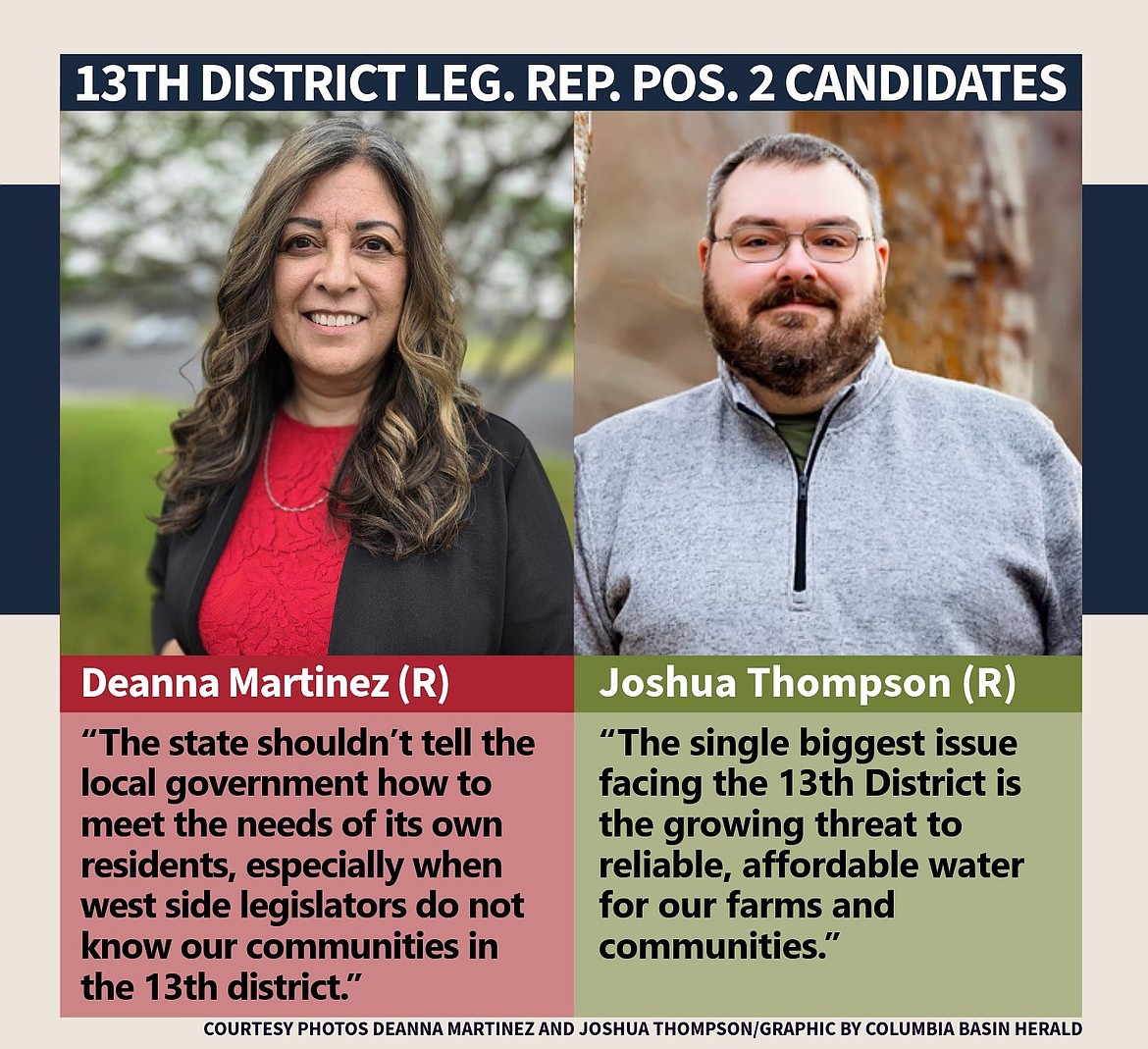
The race features Republicans Deanna Martinez, a former city council member who argues that local communities need a stronger voice against policies coming from Olympia, and Joshua Thompson, an Ellensburg city council member who points to his experience in local government, business and technology consulting as preparation for the role.
The Columbia Basin Herald asked both candidates a series of questions about the issues facing the district, their priorities if elected and how they would approach challenges ranging from water security and economic development to housing affordability and state spending. Their responses are published below and have been edited only for style and clarity.
Ballots must be postmarked or returned to an official ballot drop box by Nov. 3. Voters can verify their registration status and access election information through VoteWA.gov. Grant County voters may also contact the Grant County Elections Office at 509-754-2011 ext. 2704 with election-related questions.
Question: Why are you running for the 13th Legislative District Position 2 seat, and what qualifications or experiences make you the best candidate to represent the district in Olympia?
Martinez: I’ve been involved in state politics for the last several years and as a (former) city council member, I recognize that Olympia has too much say in what we do here in the 13th District. I’ve developed relationships with most of the Republican caucus and believe that will serve me and the district well.
Thompson: I’ve always wanted to serve my community. First, I served through church as a youth group leader and by coaching middle school basketball and Little League baseball. In 2021, a few community members asked me to run for Ellensburg City Council. Since joining the City Council in 2023, I've loved serving my community as a Councilmember. Now my family and I are in a place in our lives where I can serve the 13th District.
In addition to my public service on the city council, I graduated from Eastern Oregon University in 2005 with a degree in Business/Economics. After college, I started as a support engineer at Microsoft. Since then, I've built a 20-year career as a contractor and consultant for dozens of businesses, including years of technical, marketing, and cybersecurity consulting with Microsoft and Amazon. I've jumped into complex projects with multimillion-dollar budgets, using the analytical skills I’ve built over the course of my career. With strong support from District 13 leaders, I am ready to serve.
Question: What do you believe is the single biggest issue facing the 13th District today, and what specific legislation would you support to address it?
Thompson: The single biggest issue facing the 13th District is the growing threat to reliable, affordable water for our farms and communities. Multi-year drought, limited storage, and over-allocated rights in the Yakima and Columbia basins force early shutoffs, fallowing, and economic losses for family farms that drive our economy.
I would support legislation to accelerate completion of the Odessa Groundwater Replacement Project, fund additional storage and conveyance, and protect senior water rights from further curtailment. I would also back bills that support local control in water decisions, expand voluntary conservation incentives without new mandates, and ensure hydropower remains available to support irrigation. These targeted steps secure water for agriculture and growth while rejecting one-size-fits-all Olympia policies that ignore Central Washington’s realities.
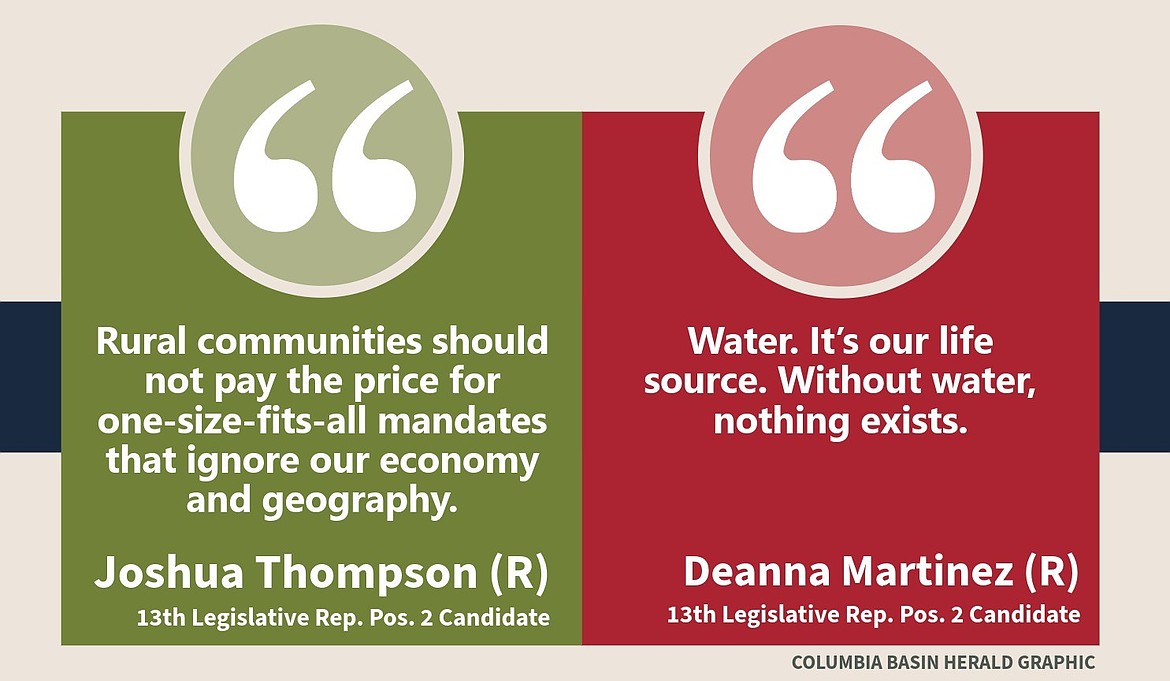
Martinez: Water. It’s our life source. Without water, nothing exists. I’d prioritize working with state and federal agencies to support solutions that work best for each county. I will support continued state budget funding for the Columbia Basin Project/OGWRP.
Question: The 13th District includes agricultural communities, small towns and growing cities. How would you balance the needs of farmers, businesses and residents when those interests conflict?
Martinez: The agricultural community is an economic industry. Supporting ag supports business and residents.
Thompson: First, we need to take better care of our farmers. Washington state is 50th in farm profitability. Farmers face increasing fuel costs and overly burdensome regulations. Regardless of these headwinds, agriculture is the biggest sector of our economy, and in general, we should do what we can to make it easier for farmers to succeed here. Beyond agriculture, our growing manufacturing and tech sector will also compete for water and power. District-wide, we will need over 20,000 new homes in the coming years, with most of them being first-time home buyers.
The biggest risk for conflicts of interest between farmers, businesses, and growing communities is really conflicting, burdensome regulations from Olympia, not local conflicts. Restructure or remove excessive one-size-fits-all regulations and give local governments more control, since they know what their cities and counties need. That alone will go a long way towards preventing conflicts.
Question: Housing affordability remains a concern across Washington. What role should the state play in increasing housing availability while preserving local control over development decisions?
Thompson: The state should first remove cost-driving barriers like Growth Management Act land limits, expensive energy codes, slow permitting, and high fees. Local communities are best situated to assess their own infrastructure, character, and capacity. Statewide density mandates that override local zoning undermine this without reliably improving affordability.
Streamlining approvals, expanding buildable land, and cutting regulatory costs will increase supply more effectively than top-down rules or rent caps, which deter building. Protecting property rights and local decision-making delivers more homes while respecting community self-governance.
Martinez: Allow local decision-making on zoning, land use. The state shouldn’t tell the local government how to meet the needs of its own residents, especially when west side legislators do not know our communities in the 13th District.
Question: Many residents say Olympia passes policies that don't reflect the realities of rural communities. What is one state law or policy you believe should be changed because it negatively impacts Central Washington?
Martinez: Repeal the natural gas ban.
Thompson: One state policy that hurts Central Washington is the Clean Energy Transformation Act. It requires 100 percent non-emitting electricity by 2045 without fully accounting for the realities of our hydro-based system, irrigation needs, and growing power demand from data centers and agriculture.
In practice, CETA drives up costs and creates reliability risks for rural communities that depend on affordable power for pumps, processing plants, and new economic development. It also limits the ability of local utilities to use existing hydro resources efficiently while meeting strict mandates written primarily for the Puget Sound region.
I support legislation to amend CETA to prioritize reliable, affordable power for Central Washington—protecting hydropower as a core resource, giving local utilities more flexibility, and ensuring energy policy does not undermine farms, food processing, or job-creating industries. Rural communities should not pay the price for one-size-fits-all mandates that ignore our economy and geography.
Question: Washington continues to face debates over taxes, spending, and the state budget. Would you prioritize reducing taxes, increasing services, or maintaining current spending levels? Why?
Thompson: Washington has a massive spending problem. Over the last decade, state spending has increased by 114%. The original 2025-2027 operating budget was approximately $78 billion. That increased to $80.2 billion with the April 2026 supplemental bill. The state used over $800 million from the rainy-day fund to “balance” the budget. Adding spending that quickly will create waste, unnecessary duplication, and other inefficiencies.
As a government, our primary fiscal goal should be to be good stewards of the taxpayer’s dollars. We should not raise taxes to fund additional spending without continuously auditing current programs.
Martinez: Reducing taxes which are burdensome on our businesses that create the jobs that people need.
ARTICLES BY NANCE BESTON

MLPD recovers nearly 2 pounds of meth during drug investigation
MOSES LAKE — Detectives with the Moses Lake Police Department's Street Crimes Unit recovered nearly 2 pounds of methamphetamine while serving a search warrant at a residence in the 4800 block of North Stratford Road on Oct. 28. According to the Moses Lake Police Department, the search warrant targeted 52-year-old Eligio Guzman as part of an investigation into methamphetamine distribution. During the search, detectives located the methamphetamine and also seized a ledger containing information on alleged customers.

Assessor candidates discuss fair valuations, transparency and taxpayer service
EPHRATA — With ballots due Nov. 3, Grant County voters will soon decide who will serve as the county's next assessor, an office responsible for valuing property, administering exemptions and ensuring assessments comply with state law. The position plays a key role in determining the property values used to calculate local property taxes for homeowners, farmers, businesses and other property owners throughout the county. The race features Clayton Johnson, a longtime employee of the Grant County Assessor's Office who currently serves as the county's senior sales analyst, and Anson Bartrand, a chief financial officer who says his background in finance, real estate and organizational management would bring a fresh perspective to the office.
Wilson Creek seeks applicants to fill mayoral vacancy
WILSON CREEK — The Town of Wilson Creek is seeking letters of interest from residents interested in serving as mayor following the resignation of Mayor Rob Herron.