
An ancient craft in the modern world: the New Agrarian School charts new path forward with first executive director
ELSA ERICKSEN | Hagadone News Network | UPDATED 1 month, 1 week AGO
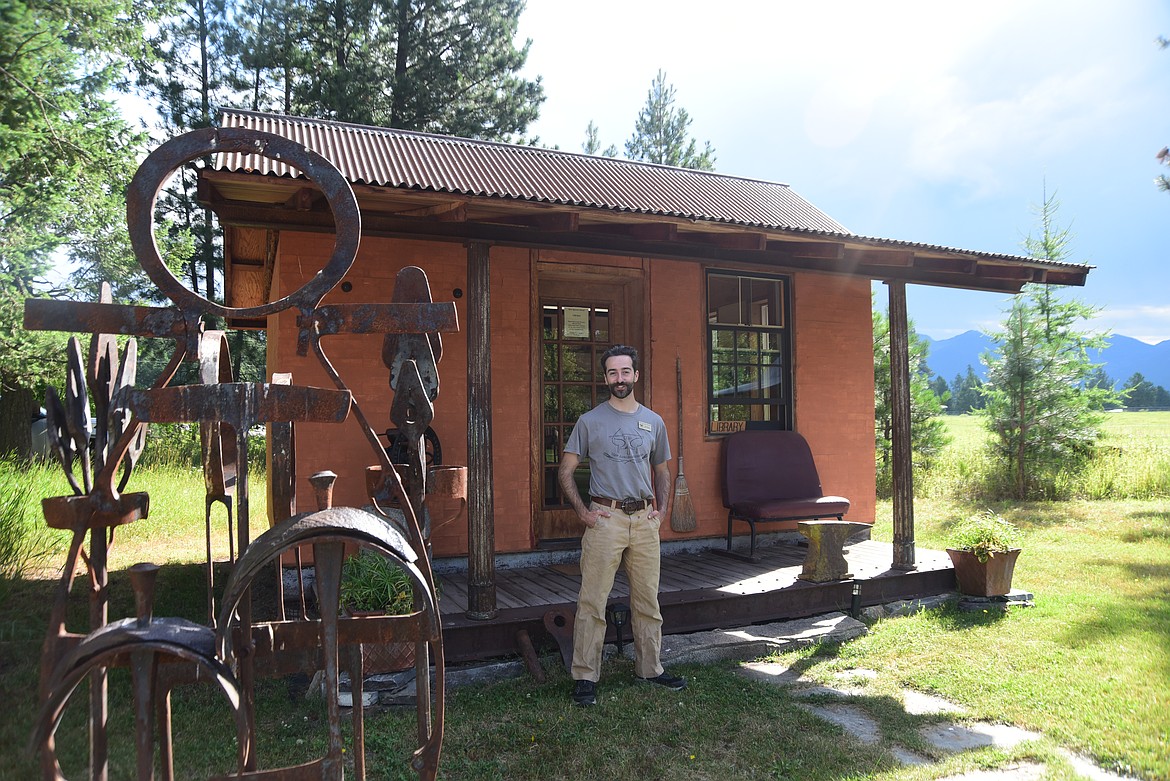
Reed Miller, the first Executive Director of the New Agrarian School, stands outside the school's library on July 17. (Elsa Ericksen/Bigfork Eagle
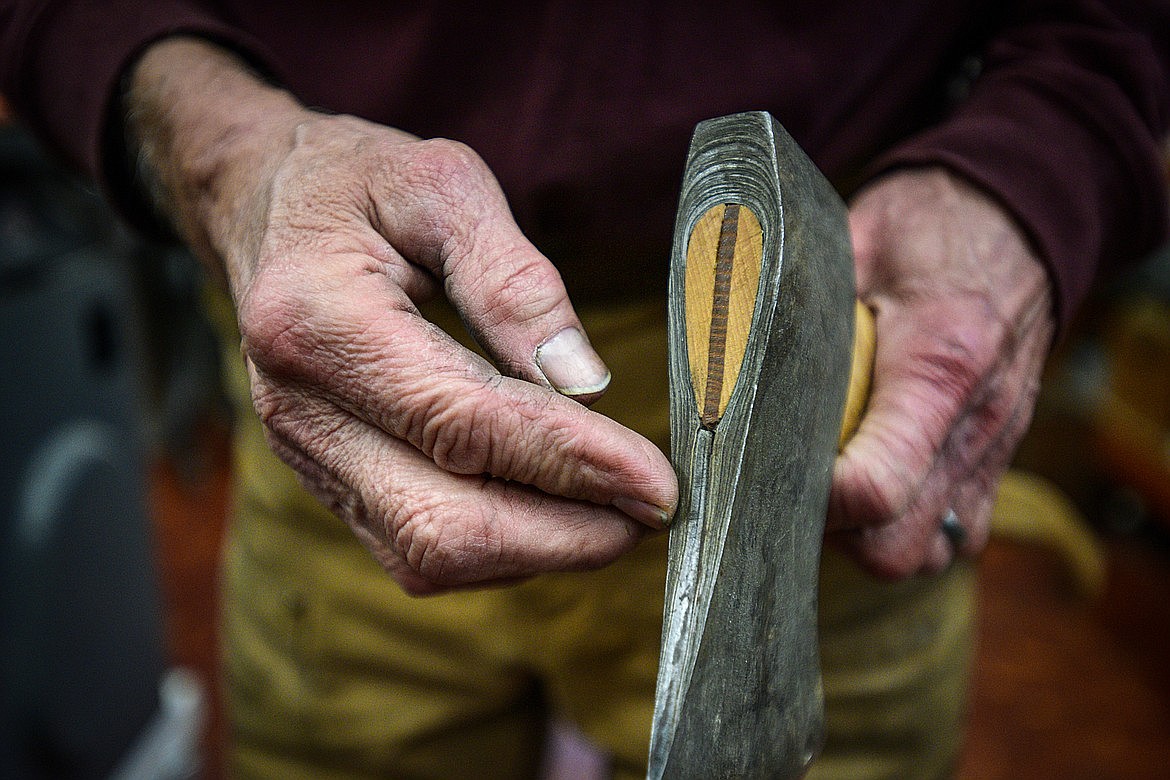
Jeffrey Funk shows a piece of steel repurposed from an automobile leaf spring inside an axe head that was forged from iron salvaged from the Old Steel Bridge in Evergreen. (Casey Kreider/Daily Inter Lake)
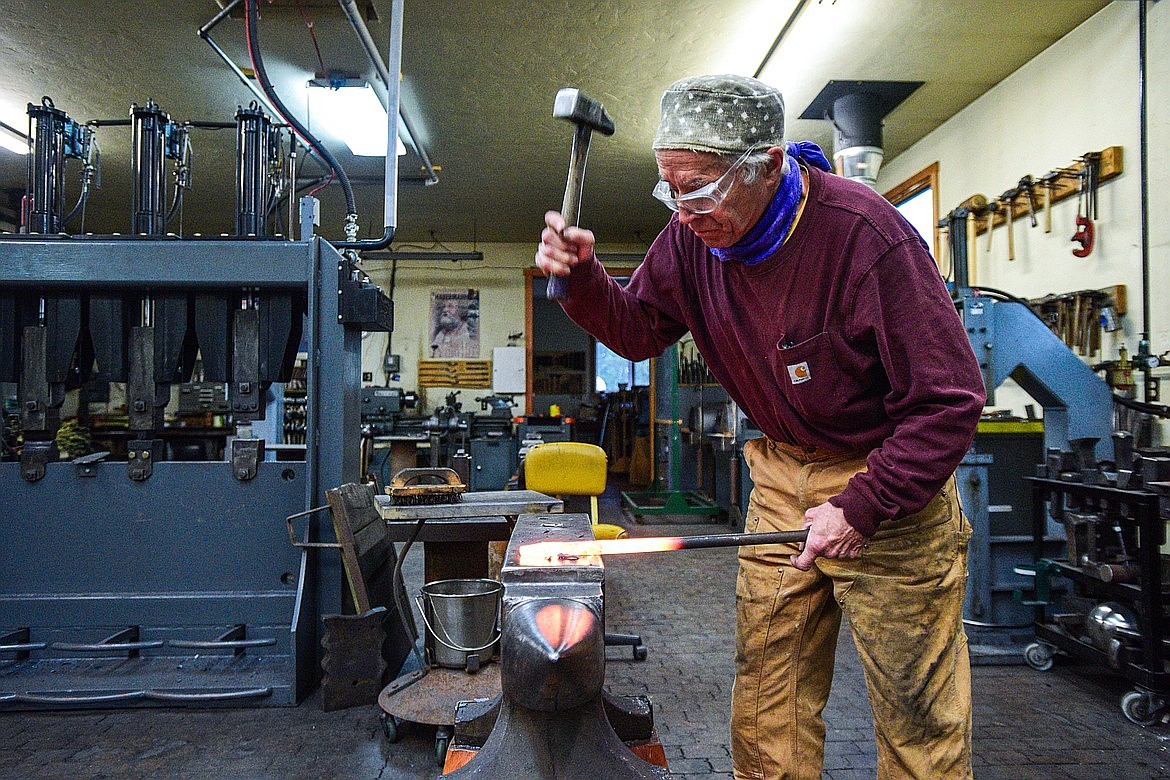
Jeffrey Funk forges a piece of steel atop an anvil inside his workshop at the New Agrarian School in Bigfork on Tuesday, Nov. 12. (Casey Kreider/Daily Inter Lake)
Reed Miller is in an interesting position: he’s been tasked with bridging the gap between the ancient art of blacksmithing and the modern world that has all but caused its extinction. In his role as the first executive director of Bigfork’s New Agrarian School, he will attempt to do just that.
As Miller ambled around the school’s 10 acres near Echo Lake, pointing out the metal bones of old bridges that once spanned the Swan River, Jeffrey Funk, the school’s founder, was teaching a class to six rapt students.
Since Miller joined the New Agrarian School last November, this is the arrangement that suits Miller and Funk: Miller handles the public facing duties while Funk’s time is freed up to do what he is most passionate about, namely passing on his decades of wisdom to the next generation.
“We're not only spanning generations; we're also spanning different skill sets,” Miller said. “Blacksmithing is core to this school, but down the road we want to have a multi-craft school because the cross-pollination between different crafts is intoxicating, and it's very inspiring to see all these different people from different mediums interact and feed off each other.”
With Miller on board, the New Agrarian School now looks to its future and fulfilling Funk’s vision of a remote oasis where students are able to retreat from the modern world for a time to learn a wide variety of craft disciplines that encourage living simply, in close relationship to land and community.
The New Agrarian School was founded by Funk in 2019. Working in a craft that endured for thousands of years but was rendered obsolete by the 1950s, he started to ask himself how one passes on an otherwise secretive tradition. How does one ensure that it doesn’t die?
For Funk, the answer lay in establishing a residential craft school in the model of those on the East Coast, like the Penland School of Craft in North Carolina, where he previously taught blacksmithing classes.
While craft schools such as these are ubiquitous back East, they’re far less common in the West. The nearest comparable school is the North House Folk School in Minnesota, Miller said.
On his 10-acre property, which was at one point an old gravel pit but has since been rewilded, Funk and other guest instructors teach a full slate of week-long classes during the summer to blacksmiths from around the country whose skill levels range from beginner to professional.
There is a demand for the instruction – each of the classes fills with pupils eager to learn from Funk’s decades of wisdom and work in the forges Funk built himself. The class Funk taught as Miller gave his tour is titled “Sketching from Nature,” a course in which students draw inspiration from the flowers grown in Funk’s wife’s garden and then craft lifelike imitations with metal.
Every part of the property has been shaped by Funk’s ethos of working with his hands and living close to nature, and the shop encapsulates his do-it-yourself mentality. Funk has built or salvaged nearly every aspect of the cavernous teaching space, from the meticulously interlocking wooden floors to the forges to the power hammers. The shop’s skeleton is constructed from the dismantled Kearney Rapids Bridge, and the students work with metal from the mechanical axels that once operated at the aluminum plant in Columbia Falls, old voting boxes serving as their workstations.
As a blacksmithing school, the New Agrarian School has succeeded handsomely in its first seven years, but Funk always intended the school to be so much more. And that’s where Miller comes in.
Reed Miller is a Flathead Valley native, a millennial several decades removed from Funk and a woodworker, not a blacksmith. All these make him the ideal person to fill the gaps as the New Agrarian School looks to expand its mission and connect more with the local community.
Miller studied economics and nonprofit administration at the University of Montana, but he always found himself waffling between the desk work required by those professions and the grounding practice of working with wood. He was first exposed to the craft as a trail crew lead in the Bob Marshall Wilderness, where the tenets of wilderness prohibit power tools. Instead, he and his brother used their great-grandfather's ax and crosscut saw to remove trees and clear trails.
“The advantage of doing things by hand is that you're connected with the material more. With wood, when you're working with hand tools, you can hear the sounds that the wood is making, which sounds a little silly in some ways,” Miller said. “It's particularly important with falling trees, is that you can't hear the cracking and the snapping, and there's just so much like sensory input from using a chainsaw that it drowns out everything else. Whereas when you're using hand tools, you're able to be much more responsive to what's right in front of you.”
Inspired by his experience in the Bob Marshall Wilderness, Miller pursued a timber framing education at the North House Folk School, which led him to work in France, Spain and Tanzania. He returned to Montana and became involved with Preserve Montana, completing historic preservation work on log cabins, schoolhouses and even the Archie Bray in Helena.
As someone raised in the digital generation, Miller believes that crafts like blacksmithing and woodworking offer an opportunity to restore human dignity and connect people to the physical world.
“We believe that people are inherently makers. “We have millennia demonstrating that. When you're able to work with craft and sometimes do things a long, slow way, it's far more rewarding,” Miller said.
The New Agrarian School is rooted in ancient practices, but it still operates in the modern world, and Miller sees it as his job to bridge those two eras so that the mission of the school can impact more people in an increasingly busy society.
With his experience in nonprofit management, Miller is taking on the finances of the school and applying for grants, something Funk didn’t have the time to pursue alongside his teaching schedule and professional pursuits. Since coming on board, Miller has already secured the school’s first competitive grant from the Community Foundation for a Better Bigfork.
The school also now accepts digital payment, for the first time since it was founded. Miller also runs the school’s social media pages and digital marketing efforts and manages the students and instructors, a huge job that frees up time for Funk.
Looking to the future, Miller envisions the school will move to purchase the property from Funk, which the nonprofit currently leases. He also wants to expand opportunities for the Bigfork community to experience the forge and the school. A weekend course for youth would be a dream for instructors who want to pass the craft along to the next generation.
For more information about the New Agrarian School, visit newagrarianschool.org.
Reporter Elsa Ericksen can be reached at 406-758-4459 or [email protected]. If you value local journalism, pledge your support at dailyinterlake.com/support.
 Jeffrey Funk shows a piece of steel repurposed from an automobile leaf spring inside an axe head that was forged from iron salvaged from the Old Steel Bridge in Evergreen. (Casey Kreider/Daily Inter Lake)
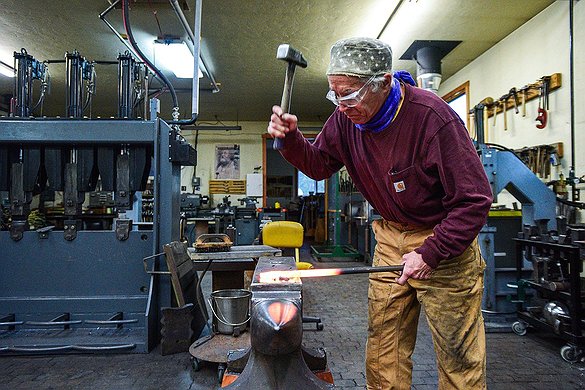 Jeffrey Funk forges a piece of steel atop an anvil inside his workshop at the New Agrarian School in Bigfork on Tuesday, Nov. 12. (Casey Kreider/Daily Inter Lake)
ARTICLES BY ELSA ERICKSEN
The century club: Montana's centenarians reflect on 100 years of life
Completing those hundred laps around the sun is no easy feat. There are an estimated 108,000 centenarians in the United States.
Lakeside residents turn to citizen-initiated zoning to protect neighborhood
For the last three years, Fetveit has spearheaded a neighbor-led effort to create a new zoning district in Lakeside that would protect this area along the lakeshore from overdevelopment.
Effort to rebuild iconic Bigfork cross is underway
When completed, the new cross will stand 100 feet tall with a crossbeam that spans 53 feet. The metal roof trusses that will be used to construct the cross will be 5 feet wide.