
Enjoy huckleberries? Thank a bumblebee
CHRIS PETERSON | Hagadone News Network | UPDATED 1 month, 2 weeks AGO
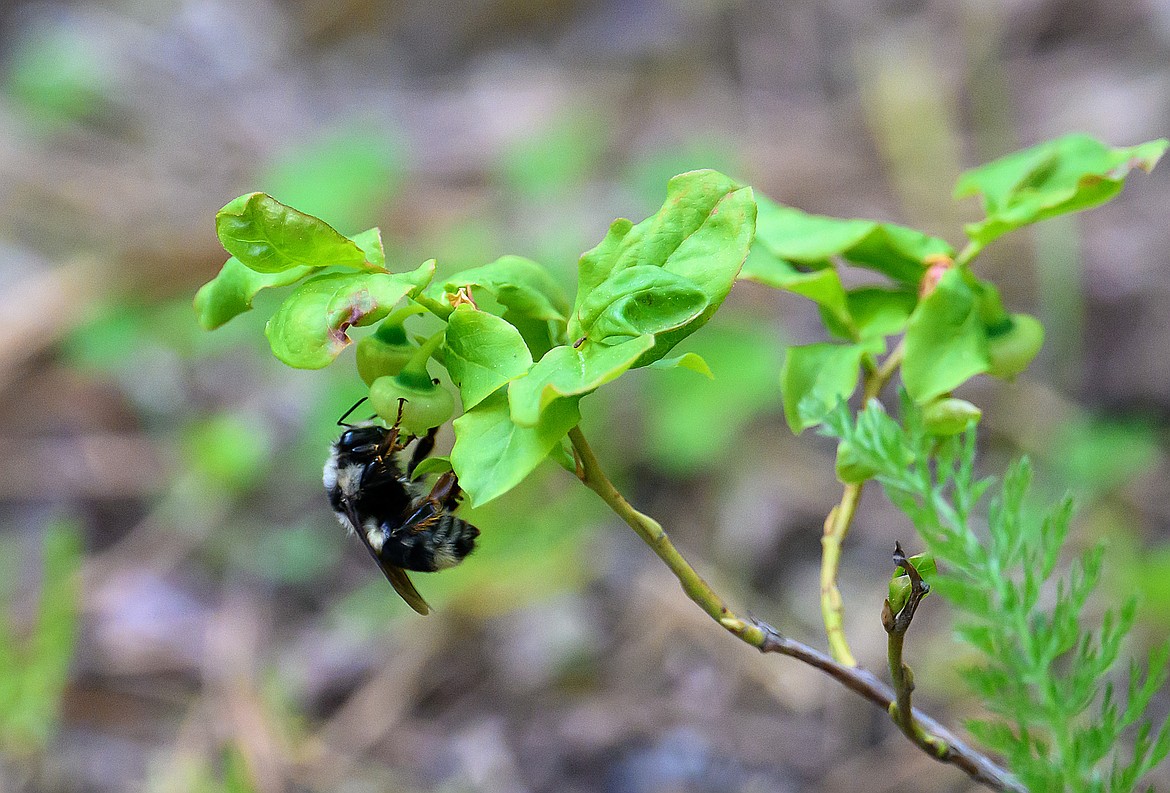
A bumblebee pollinates a huckleberry flower.
Chris Peterson is the editor of the Hungry Horse News. He covers Columbia Falls, the Canyon, Glacier National Park and the Bob Marshall Wilderness. All told, about 4 million acres of the best parts of the planet. He can be reached at [email protected] or 406-892-2151. | September 5, 2026 1:00 AM
If you’ve ever savored a huckleberry, you can probably thank a bumblebee for it. Turns out hucks are one of the favorite plants to pollinate, as they provide an early spring food for bees, according to recent research by the U.S. Geological Survey.
But bumblebees face an uncertain future and some species are already on the Endangered Species List and others are being considered, noted U.S. Geological Survey Scientist Tabitha Graves last week in her talk, “Floral Forensics and Other Bumblebee Findings in Glacier National Park and Beyond.”
Graves and many other researchers have been studying bumblebees now for years and for good reason — three quarters of all human food comes from some sort of pollination. One of the main pollinators is bees and 90% of the insect order Hymenoptera, which includes bees and bumblebees, is considered vulnerable.
One such bee is the Western Bumblebee, which is easily identified by its white rump. The Western Bumblebee was once common, but since 1998 to 2020, it has shown a mean decline of about 57% across the Western U.S.
Reasons are varied but include increasing summer temperatures due to climate change, drought and pesticide use. Studies have found that where Neonicotinoids pesticides are used, bee abundance drops significantly in test plots.
All told, there are about 50 species of bumblebees in North America and 29 documented in Montana. Glacier National Park is an ideal place to study bumblebees because there is no pesticide spraying and the habitat is largely unaltered, save for noxious weeds. Speaking of weeds, there is one weed that proves to be the bumblebee liking, and that’s spotted knapweed of all things. The plant is high in pollen, and in some places, one has to be careful about eradicating the weed, or the bees will have far less to eat, Graves noted.
On the native plant side, the above-mentioned huckleberries are an important food source as is fireweed and sticky geranium. Bees can also be a bit fickle, switching from one plant to another as the day progresses, Graves noted.
In one study done by a colleague, two same-sized plots of huckleberries were tested. In one plot, the hucks were covered and manually pollinated using a pipe cleaner. The other plot was pollinated by bees. The covered plot resulted in about 50 huckleberries. The natural pollinated plot a whopping 550 berries.
Studying bees can take hours in the field, but there are innovative new methods being developed. One involves capturing the bees, cooling them off, photographing them for identification and then releasing them. The other involves leaving the bees alone entirely, but instead collecting flowers and then collecting bee DNA left behind.
It’s quicker, easier and less expensive, Graves noted.
Bumblebees, unlike honeybees, are solitary creatures. They winter underground and once awake in the spring, they feed voraciously (hello huckleberries and other flowering plants) then lay their eggs in wax pots infused with nectar and pollen underground or in litter. The daughters emerge first, and are workers that take care of more queen eggs that, if all goes well, will be males and then new queens. The males leave to mate with queens from other colonies.
The goal of the nest is to produce a new queen to keep the colony going.
A lot of things can go wrong, and the nest can fail if there’s not enough food (flowers) to keep them going or it's dug up or somehow otherwise destroyed.
Graves noted bumblebee physiology is quite complex and more research is needed, but models are already suggested as the West warms and dries further, bees will continue to decline.
People can help in their own backyards and homes, however. One way is to have a “messy” spot in the yard with brush or other material bees can nest in. The other is to provide bees plenty of food.
“The overall recommendation is to plant lots of different flowers that bloom all season long,” she said.
ARTICLES BY CHRIS PETERSON
If Pursuit gets permit to cross BPA power lines, it would be a first for the administration
If Pursuit is successful in securing the permits and building a tram up Columbia Mountain, it might be the only structure of its type that transports humans over Bonneville Power Administration transmission lines, a BPA spokesman noted last week.
Opinion: Past presidents
The phone rang twice.
Groups critical of cuts to Glacier Park maintenance
Conservation groups are claiming parks like Glacier National Park are suffering from maintenance cuts while the Trump Administration siphons off funding for other Park Service projects in and around Washington, D.C.