
New rules for Block Management access
MONTE TURNER | Hagadone News Network | UPDATED 4 weeks AGO
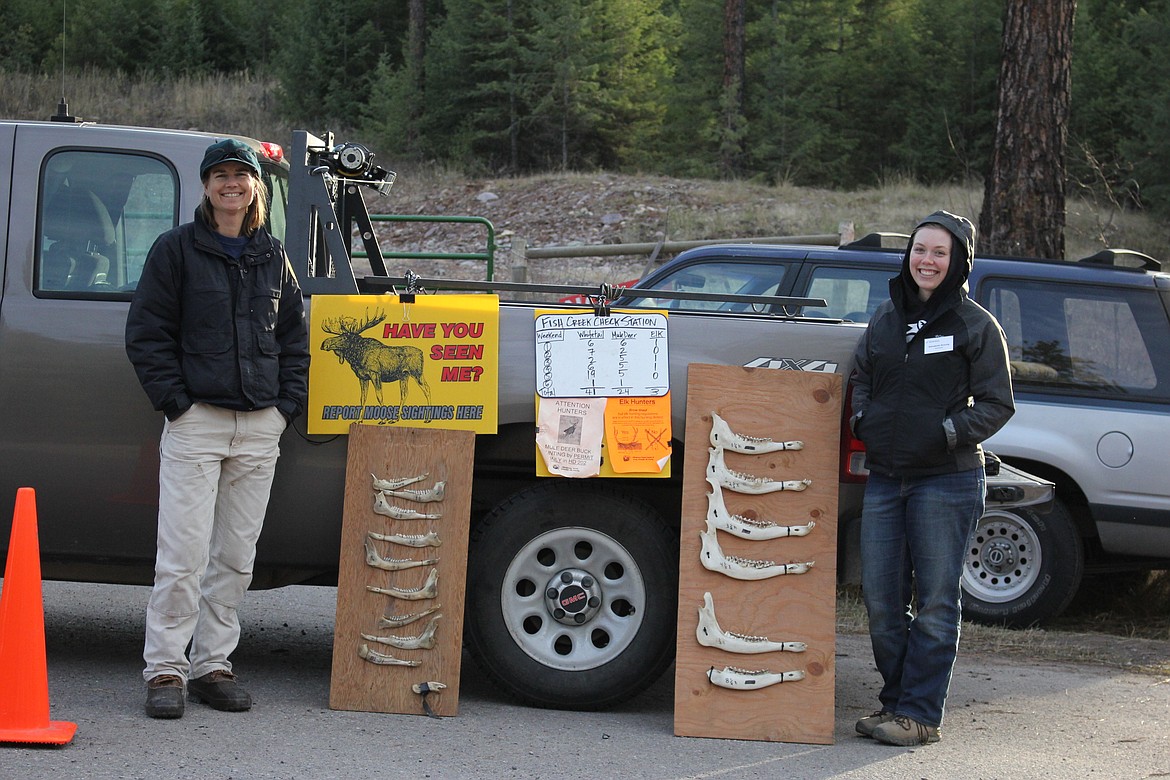
Wildlife biologist, Liz Bradley and UM student Elizabeth Koenig worked weekends at the Fish Creek station during the hunting season to check hunters. (Photo by Kathleen Woodford/Mineral Independent)
For hunters in Mineral County, Block Management Areas have long been an important part of the Montana hunting experience. From the timbered private property around St. Regis and Superior to the ranch and agriculture country stretching toward Alberton, access to private ground can make a big difference.
This year, however, hunters using some of those properties will have another reason to pay close attention to the rules.
A new Montana Fish, Wildlife and Parks program gives landowners who participate in BMAs an additional tool for dealing with hunters who don't follow the rules. And the legislation behind the program has a particularly strong Mineral County connection.
Senate Bill 441, which created the Block Management Enforcement Network, was introduced during the 2025 Legislature by St. Regis Republican Sen. Denley Loge. Loge is not only a St. Regis legislator, but he is also a Block Management landowner, giving him a firsthand understanding of both sides of the access issue. The legislation passed with nearly unanimous support:
Senate Bill 441 creates a new program for block management landowners to opt in to an enforcement network that will prohibit access to the block management properties of network participants to any individual who has been convicted of violating landowner rules or any other fish and game laws. The opt-in is voluntary, and participation can be withdrawn at any time.
Beginning this year, 830 landowners managing 550 Block Management Areas have opted into the new enforcement network. For hunters, the message is straightforward: Block Management access is a privilege and breaking the rules on one property can now affect access to many others. The new system works by connecting participating BMAs
If a hunter violates a rule on a participating BMA and the violation results in a conviction, that hunter can be prohibited from accessing all Block Management properties enrolled in the enforcement network. A first conviction results in the hunter being prohibited from using those properties for the remainder of the current license year. A second conviction can result in losing access for up to three consecutive license years. A third conviction can mean a lifetime prohibition from participating BMAs.
BMAs in Mineral County are The Donally Ranch BMA 14 with 1,180 acres open to hunting. The Warnken Ranch BMA 15 with 615 acres. The Loge Ranch BMA 16 with 596 acres. 5J’s Ranch BMA 17 with 940 acres. And Little Joe Creek BMA 18 with 191 acres. Hunters are urged to know the type of BMA before opening day along with the boundaries and limitations some may have. The 2026 Hunting Access Guide is available online at fwp.gov.
Anyone who has spent time hunting around Mineral County knows that private land access can be a complicated issue and Block Management gives landowners an opportunity to open their property to hunters while establishing specific rules for how that property can be used.
FWP Region 2 Access Manager, Trenton Heisel, helped explain the reason for the new rule.
“Landowners in the enrolled BMA have had incidents where hunters have not been signing in at the registration boxes on the property that are marked with fluorescent green signage. This is a violation of not following the primary BMA rules.”
For a hunter to lose their BMA hunting privileges, the incident must be a written violation and then a conviction before they face the loss of hunting privileges in BMAs. A landowner needs to press charges in these cases which are considered trespassing. After that, the enforcement of hunters losing their privileges to hunt on BMAs is not on the landowners, but FWP enforcement staff.
A landowner who voluntarily opens private property to hunters can quickly become frustrated if hunters ignore the rules, trespass beyond designated boundaries, damage property or otherwise abuse the opportunity. For a small community such as St. Regis, Superior or Alberton, keeping good relationships between landowners and hunters can be especially important.
There are two types of BMAs. Type 1 BMA is an area where the hunters administer their own permission. This includes the BMAs that use the BMA sign-in boxes and BMA’s that do not require hunters to obtain permission. Type 1 BMAs typically do not limit hunter numbers or require reservations, although some may have parking area limits. Type 2 BMA areas are where someone other than the hunter(s) issues permission. This includes BMAs where the landowner or a FWP staff member issues permission, usually in written format. They often require reservations and utilize pasture assignments, hunter number limits, and other hunter management systems.
In the case of requiring hunters to sign in, many are not doing so and just walk into the BMA. This has caused issues for landowners by not knowing who is on their property or who has been in case an incident occurred as there is no tracking system.
This is Heisel’s third season in Region 2 and where he came from in eastern Montana Region 5, he said there they have these and other serious offenses that are fortunately not common this side of the divide.
“There were many cases that walk-in areas were disregarded entirely with people taking gates down and driving the two-track roads on private property. This was not only a violation but in so many cases the roads were damaged with deep ruts after rain from the gumbo which caused ranchers unneeded heartburn during an already stressful season getting cattle ready to market,” he said.
Hunters are still required to follow all state hunting regulations, but they must also follow the individual access requirements established by the landowner and listed for that particular Block Management Area. Wildlife officials say violations aren't necessarily more common on BMAs than they are anywhere else hunters and recreationists use public or private land. The difference is what can happen afterward.
The new enforcement system also comes at a time when Montana's Block Management program is facing a larger challenge. The amount of private land enrolled in the program has steadily declined. In 2002, approximately 8.8 million acres were enrolled in Block Management across Montana. By 2025, that number had fallen to about 6.8 million acres, a decline of nearly 23%.
Meanwhile, demand for those acres has increased dramatically. About 250,000 hunters used Block Management Areas in 1999. By 2024, that number had grown to nearly 700,000.
At the same time, private-land hunting leases and pay-to-access hunting applications have become increasingly common, providing landowners with other opportunities to receive compensation for allowing hunters onto their property.
FWP has been looking for ways to keep landowners involved. In 2023, the Montana Legislature increased payments to Block Management participants. FWP paid approximately $12.3 million to participating landowners last year, compared with about $5.5 million five years earlier.
For Mineral County hunters preparing for the upcoming season, the new enforcement program is one more reason to check the details before heading onto a BMA.
For landowners, the hope is that the additional enforcement will provide some peace of mind. For hunters, it's a reminder that the opportunity to hunt private ground comes with a responsibility to treat that ground, and the person who opened it, with respect.
In Mineral County, where neighbors often know one another and hunting traditions run deep, that may be the most important rule of all.
ARTICLES BY MONTE TURNER

West End Fire to turn up the heat with chili cookoff fundraiser
What better place to enjoy a bowl of full-blown, mega-scorching-hot chili than at a fire station stocked with wildfire equipment, fire extinguishers and a building full of professionally trained firefighters, EMTs and Quick Response personnel?

Senior center cooks up hot dishes with a side social fun
There’s something about a good home-cooked meal that can bring people through the door, and at the Superior Senior Citizens Center, head cook Jessica Williams seems to have figured out the recipe.

Montana-Idaho border reconfigured after survey retraces original state lines
The Bureau of Land Management has completed its official resurvey of the Montana-Idaho boundary near Lookout Pass, going back to the original survey monuments and retracing the line that was established more than 120 years ago.