
Medicaid recipients worry about program’s future amid funding cuts
TAYLOR INMAN | Hagadone News Network | UPDATED 2 weeks, 5 days AGO
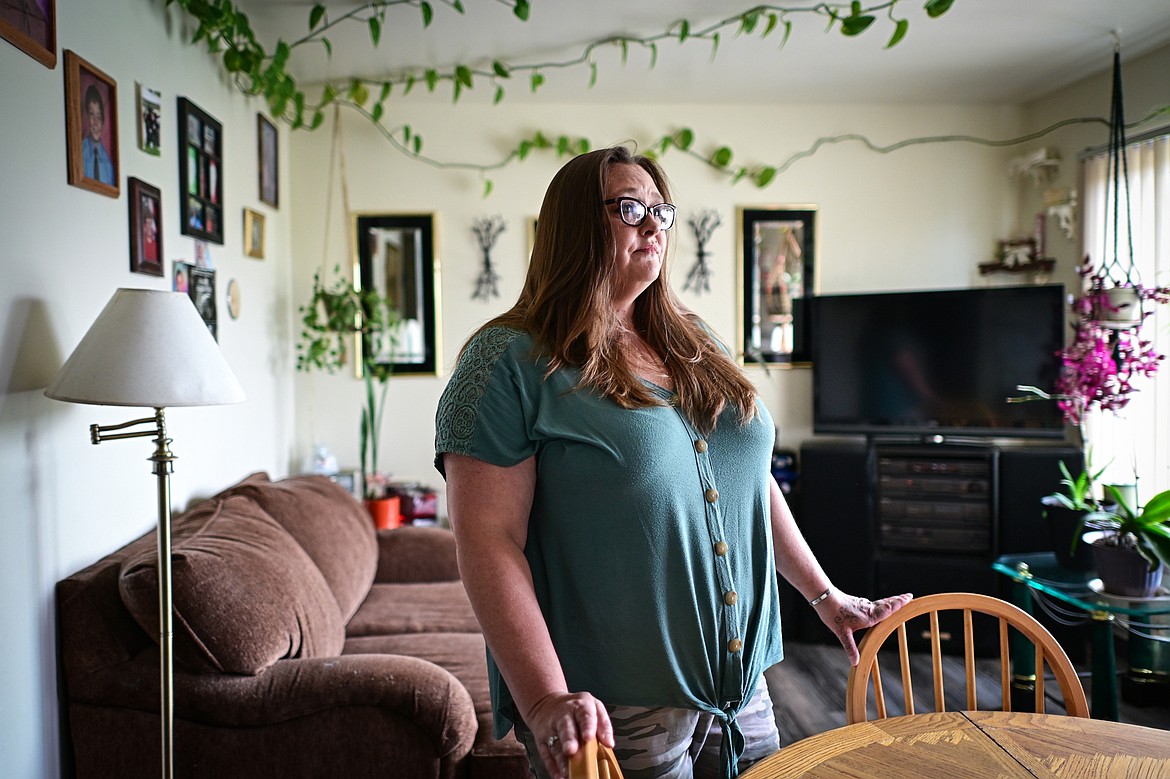
Jazelle Rach in her apartment in Kalispell on Tuesday, Aug. 4. (Casey Kreider/Daily Inter Lake)
Casey Kreider
REPORTER AND PODCAST HOST Taylor Inman covers Bigfork and the north shore of Flathead Lake for the Bigfork Eagle and the Daily Inter Lake. Her reporting focuses on local government, community issues and the people who shape life in Northwest Montana. Inman began her journalism career at Murray State University’s public radio newsroom and later reported for WKMS, where her work aired on National Public Radio. In addition to reporting, she hosts and contributes to Daily Inter Lake podcasts including News Now. Her work connects listeners and readers with the stories shaping communities across the Flathead Valley. IMPACT: Taylor’s work expands local journalism through both traditional reporting and digital storytelling. | September 13, 2026 12:00 AM
Jazelle Rach of Kalispell starts every day by checking on her elderly or disabled neighbors. Living in subsidized housing, there is no shortage of people around her who could use a helping hand.
Along with rides to the grocery store and doctor’s appointments, one of Rach’s biggest tasks is helping her friends and neighbors manage their benefits. Most recently, she’s been assisting her aunt with Medicaid coverage following two strokes last year.
While she helped her track down the right paperwork to take to the Office of Public Assistance, Rach thought about people who don’t have anyone to help with transportation and logistics.
“What would happen if I wasn't there to help her? She's got to have heart surgery right now and doesn't have the medical coverage for it,” Rach said.
With sweeping changes to Medicaid from the federal One Big Beautiful Bill Act, Rach is concerned about upcoming funding cuts to the program and how it will affect healthcare facilities and providers in rural areas.
Spending on Medicaid will be reduced by $665 billion by 2034, according to estimates provided in a recent report from RAND, a nonpartisan research organization. There are also new work requirements for those seeking Medicaid coverage, with various reasons someone can claim an exemption.
Supporters of the federal law say the Medicaid reforms will ultimately lower costs for hospitals and reduce insurance premiums over time, while the new work requirements will encourage those who are able-bodied to get jobs or give back to their community.
All of Montana’s congressional representatives voted to pass the Big Beautiful Bill when it moved through Congress last year.
Rach spoke to attendees of a virtual press conference this summer held by United Today, Stronger Tomorrow — a community organizing project in Alaska, the Midwest and Mountain West. In July, local officials with the organization brought together Medicaid recipients and community members who wanted to speak about their concerns on impending cuts and changes.
Rach has suffered for decades from fibromyalgia, degenerative disc disease and several other chronic conditions related to her thyroid. Though she has never had an issue keeping her Medicaid coverage, she understands it’s easy for others to run into roadblocks with their enrollment or redetermination.
With funding cuts on the horizon, she worries about the impacts on rural health care access.
“Transportation to appointments is already a big obstacle to care, and these cuts mean less providers and more driving, so more people skipping out on preventative care,” Rach said.
Some estimates suggest 7.6 million people will lose Medicaid coverage by 2034 as states figure out how to respond to the changes.
More uninsured people would leave hospitals to shoulder a bigger financial burden, potentially leading to staff reductions and facility closures, particularly for rural healthcare facilities who primarily serve patients on Medicaid, according to the Kaiser Family Foundation. The health research organization projected the policy changes could cause up to 50,000 Montanans to lose health insurance by 2034.
MONTANA WAS one of the first states to implement the new work requirements for Medicaid eligibility. The Montana Department for Public Health and Human Services has been spreading the word about the changes, which took effect July 1.
Though Montana adopted the community engagement requirements this summer, the state agency has given applicants until October to comply.
Montana Senate President Matt Regier, R-Kalispell, said the changes are a move toward more accountability for Medicaid recipients.
As the rollout starts in Montana, Regier told the Daily Inter Lake he is impressed with how well the Department for Public Health and Human Services has communicated what people need to do to be in compliance — going beyond what is required by states in the Big Beautiful Bill.
While some believe the changes are too burdensome for Medicaid recipients, Regier said it’s not too onerous, particularly when he looks at taxpayers who fund the federal program.
“It’s the most compassionate thing for those on Medicaid expansion — if you're able to work and provide — to start down that path of being able to work and get off of the welfare program," Regier said.
"That's better for you as well as the taxpayers of Montana.”
Regier said liberals “judge a welfare program by how many people can be put on it,” while conservatives judge a program by how many people it helps eventually get off government assistance.
“I think it'd be a great society if everybody was self-sufficient and didn't need it. So that's the premise of a lot of things that have happened there in the Big Beautiful Bill, not just healthcare wise, but even tax wise. I think it's moving Montana and America in the right direction,” Regier said.
Anyone between 19 and 64 years old must complete 80 hours of an approved activity, unless they qualify for an exclusion, according to the state health department. Medicaid recipients can work, participate in community service or volunteer for a nonprofit, take part in an approved state or federal workforce training program, or go to school.
Officials with the state health agency said pay stubs, letters and volunteer logs will be used to verify participation. Exclusions include those who are American Indian and Alaskan Native, inmates in public institutions, caretakers for children under 14 and disabled individuals and people with medical conditions or health needs that impact their ability to work, among other circumstances listed by the Department for Public Health and Human Services.
BIGFORK RESIDENT Jessica Fulford already walks a fine line financially to ensure her children don’t lose their current level of Medicaid coverage. She also spoke at the United Today, Stronger Tomorrow virtual press conference, where she said she’s limited on how much money she can earn.
Fulford’s husband is a kindergarten teacher, but she has a limit on how many hours she can work at her part-time job. If she makes too much money, it threatens Medicaid enrollment for her children. She “works just enough to cover the groceries, but not so much that [her] children will lose some of their healthcare access.”
Fulford said she’s struggled with chronic severe pain and illness for over 20 years but has not been able to access the medical care to find a diagnosis.
“Even though we both work, if we have to make a trip to urgent care, then we're either dipping into our savings or one of us is having to work overtime that month,” Fulford said.
Though Medicaid covers the cost of healthcare for their kids, it still has other limitations. When her 9-year-old son Owen began struggling at home and at school, she took him to their primary care provider. She said he is neurodivergent and needs to be seen by a specialist in Missoula to fully understand his condition.
“It will involve the family taking a trip, like getting a hotel and things that all of you are very aware of. But I was actually very excited to call and make those plans because, as a mom, to finally be given the opportunity to understand how my child's brain works would be such a gift,” she said.
When she called, their office told her it would be two years before they could see a new patient on Medicaid.
“I was told that because of lack of Medicaid providers, my son's wait list is two years longer than another child who has private healthcare insurance. And to be honest with you, I just started crying. I didn't understand why my son deserves less care,” Fulford said.
Rach asks similar questions as she helps people around her navigate their health coverage. She said they are currently waiting for financial documents to be mailed to her aunt for her Medicaid enrollment. If it doesn’t get here in time, they may have to reapply and start all over again — a process that can take months.
“Unless you have that type of attitude, you just spin your wheels and get nowhere. And it gets so disappointing ... It's really easy to get to that frustration level of ‘It’s pointless, why even try?’” Rach said.
But for the health of her friends and neighbors, Rach keeps trying anyways.
Along with new work requirements, Medicaid recipients will have more frequent redetermination periods to ensure they are still qualified for coverage.
To learn more about changes coming to Medicaid in Montana, visit dphhs.mt.gov/medicaidchanges.
Reporter Taylor Inman can be reached at 406-758-4440 or [email protected]. If you value local journalism, pledge your support at dailyinterlake.com/support.
ARTICLES BY TAYLOR INMAN

Logan Health nurses union ratifies new contract with major across-the-board raises
Nurses at Logan Health in Kalispell say their newest union contract includes "life changing" pay raises that benefit both tenured and new nurses.
Fall job fair gives employers a chance to connect with job seekers in person
Learning what local companies are offering new hires is just one benefit of the job fair, which is held at the Flathead County Fairgrounds Trade Center in the spring and fall.

Summit Cookhaus offers commercial kitchen space for valley's caterers, home bakers and chefs
Summit Cookhaus owner Jake Kuntz said the rentable kitchen space in Kalispell offers an opportunity for batch bakers, caterers and others who want to work from a larger space than their home kitchens.