
More data centers, then more energy resources, needed
RAY ERKU | Hagadone News Network | UPDATED 1 month AGO
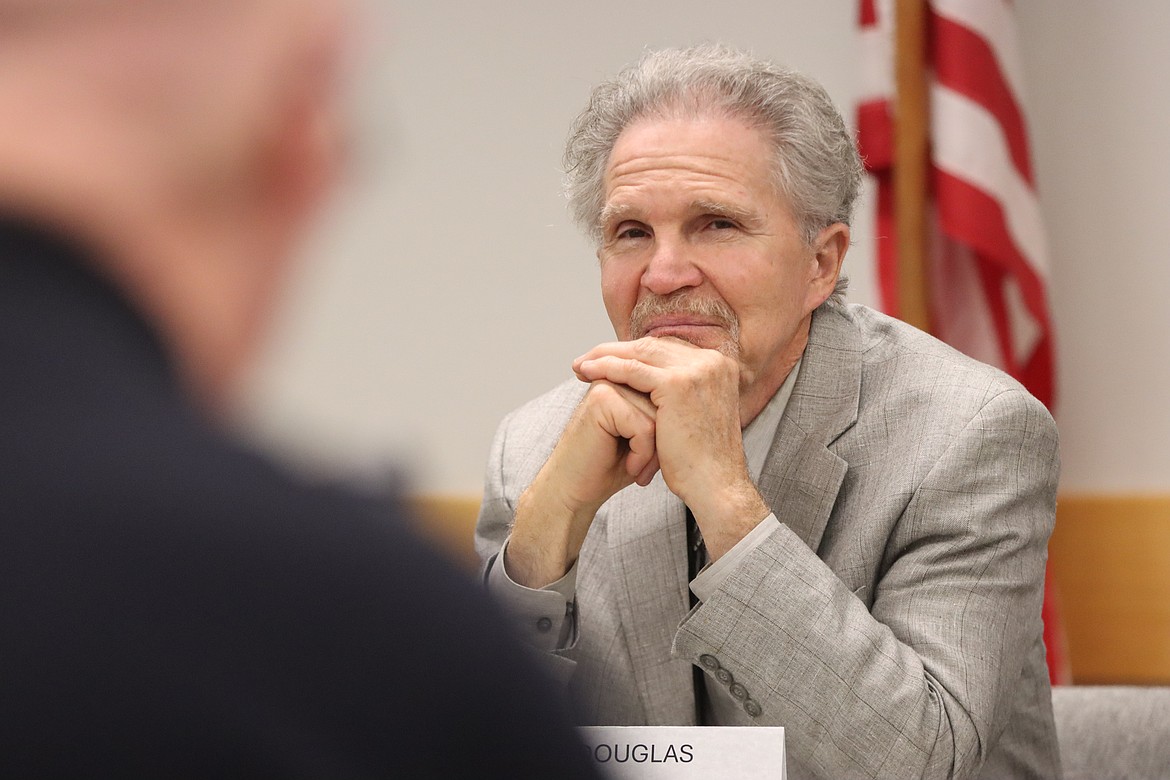
Doug Grob, who represents Montana on the Northwest Power Council and Conservation Council, listens to a public comment given by Jim Robbins in Coeur d'Alene on Monday.
RAY ERKU/Press
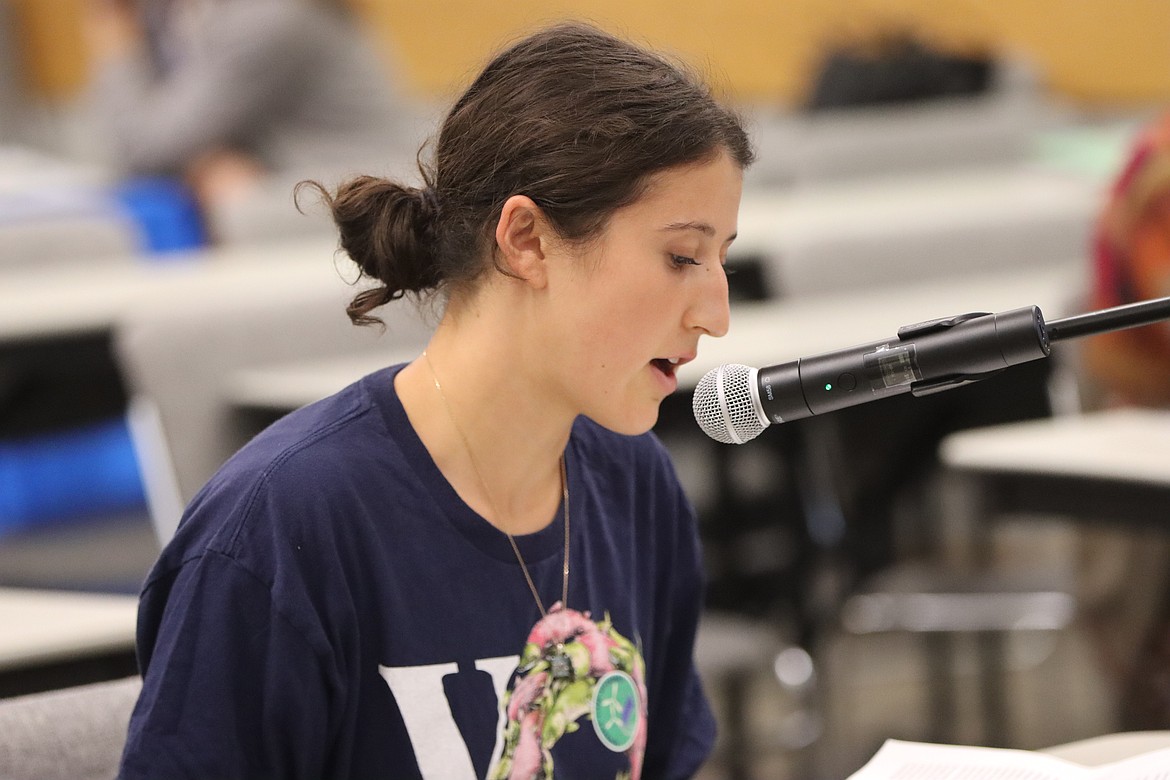
Abby Saks, a Spokane resident and Inland Northwest grassroots organizer for Save Our Wild Salmon, voices environmental concerns regarding a new plan calling for more energy resources in Coeur d'Alene on Monday.
Bracing for a Pacific Northwest influx of data centers and the tech sector over a short-term period, a power planner is calling for more infrastructural needs to meet future electricity demand.
The Northwest Power Council and Conservation Council, a regional organization representing Oregon, Washington, Idaho and Montana, expects its power system to grow 50% to 100% by 2046. This includes long-term impacts and heightened electricity demand caused by electrification of transportation, buildings, and industries as well as population and economic growth.
Current peak demands range from 33,300 megawatts in summer to 35,500 MV in winter. Data from NPCC shows those peaks rising above 60,000 MW in 20 years.
“That’s a lot of load growth,” said Kevin Smit, a NPCC Power Planning Resources manager.
In Coeur d’Alene on Monday, NPCC members, Montana Rep. Doug Grob and Idaho Rep. Ed Schriever, heard public comments over a plan that identifies a regional portfolio to add to the existing power grid between 2027 and 2032, which currently has an estimated capacity of up to 70,000 MW.
The plan, the ninth of its kind since U.S. Congress created the Council in 1980 when it passed the Northwest Power Act, calls for adding 1,060 of average megawatts on top of the 8,247 aMW of total energy efficiency savings added to the regional power system since 1980. This total will be split up – 860 aMW in Oregon and Washington and 200 aMW in Idaho and Montana.
It also looks to add to its power grid 9,000 MW more of renewable energy, which is a balanced mix of solar and solar assets, as well as 5,200 MW more of storage and renewable hybrids and 2,100 MW more of natural gas assets, which includes coal and gas production.
Simply put, the region could see construction of additional wind and solar farms, as well as upping production of coal and gas.
“To meet this moment, the Council sharpened our analysis and evolved our planning methods from our most recent power plan,” Grob said in a prepared statement. “The Council uses innovative modeling techniques and tools that were informed by advisory committees consisting of many of the top experts in the region.”
There were two public comments during Monday’s meeting. They included infrastructural, climate and environmental concerns about the new plan.
Jim Robbins, a Kootenai Electric Cooperative-appointed member of the Idaho Consumer Owned Utilities Association, is a power user who suggested the NPCC to focus more of its plan relying on natural gas resources rather than renewables such as solar and wind generation.
Robbins, who estimated it would take up to 750,000 acres of land to build new wind turbines for the plan, cited various winter cold spells in Washington that have the potential to threaten the power grid. He used a cold spell between 2016-2017 as an example.
“No wind, extreme cold. It was zero degrees in Seattle and -20 on the east side of the Cascades, and I have no idea how cold Montana was,” he said. “And you're proposing 9,000 (MW) of wind for the very thing that doesn’t show up? I find this dangerous.”
He urged the council to use more dispatchable baseload power production “so that we don’t run out of power during critical times.”
He also said Eastern Washington and Oregon as well as Idaho and Montana “will take the brunt of all these wind turbines.”
Abby Saks is a Spokane resident and Inland Northwest grassroots organizer for Save Our Wild Salmon, nonprofit coalition working to protect and restore endangered wild salmon and steelhead populations. She spoke in favor of the plan to use more renewable energy.
“Our region must work together to limit these impacts of climate change and to do so must foster an energy future where electricity is affordable and clean,” she said, adding, “Our region's transmission system is severely outdated, which has limited our ability to bring clean energy projects onto the grid.”
Saks also spoke about the negative impacts of relying on fossil fuels.
“As we see the impacts of the climate crisis worsen,” she said, "our salmon populations also continue near extinction.”
With the public comment window open until Oct. 16, the NPCC will likely approve the plan by the end of 2026 or early 2027.
In September and October, additional hearings will be held in Spokane, The Dalles, Missoula, Idaho Falls, and Seattle, as well an online-only webinar, according to the NPCC.
For more information about future hearings or the ninth plan, visit www.nwcouncil.org/energy/ninthpowerplan/
 Abby Saks, a Spokane resident and Inland Northwest grassroots organizer for Save Our Wild Salmon, voices environmental concerns regarding a new plan calling for more energy resources in Coeur d'Alene on Monday.
ARTICLES BY RAY ERKU

City unpacks ‘ambiguous’ state housing regulation
After Idaho lawmakers ease up on accessory dwelling units, Coeur d’Alene must comply by Feb. 1, 2027
For Idaho state law nowadays, residents can legally create larger guest houses, homeowners don’t need to obtain permits for renting out living spaces, and developers can build entire starter-home neighborhoods on far smaller lots than previous generations. These are just some of the new provisions that are the result of Senate Bills 1352 and 1354, as well as House Bill 583.

State proposal triggers response from local firearm gurus
State proposal triggers response from local firearm gurus
Idaho lawmakers are aiming for an official state firearm. Like the huckleberry being its state fruit, Idaho could have a Winchester Model 1873 level-action rifle as its state gun. What do local Coeur d'Alene gun gurus think about it?

Alarm rises over ‘door kick challenge’
Police investigate cases of people kicking in residential front doors
A popular and dangerous trend suspected among youth and young adults is raising alarms with the Coeur d’Alene Police Department and city officials.