
Guest opinion: Taking the wrong road
Jim Elliott | Daily Inter-Lake | UPDATED 1 month AGO
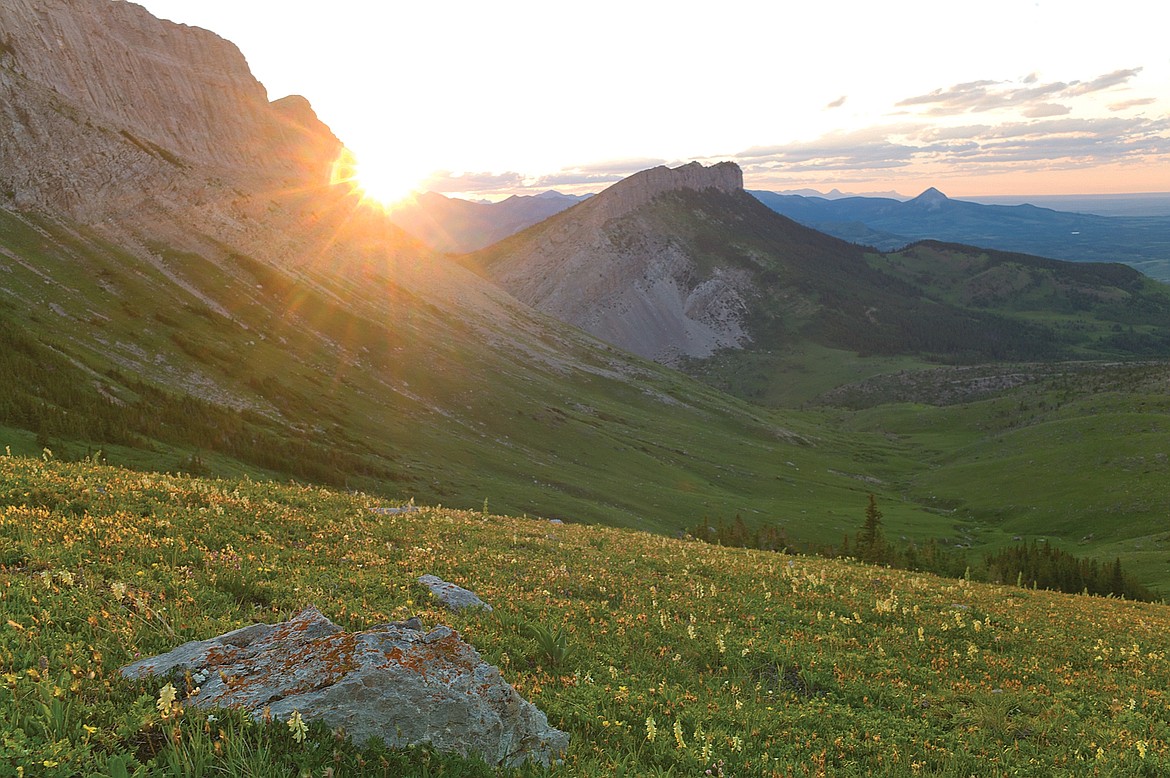
The sun sets along Hurricane Ridge and Walling Reef on the Rocky Mountain Front in the Bob Marshall Wilderness.
Trump’s idea of eliminating the 21-year-old Roadless Rule to allow road building and timber harvesting in the nation’s forests is a lot like his pipe dream of freeing up Venezuela’s vast petroleum resources for development. It’s wishful thinking. More accurately, it is an opportunity to make it look like something is being done. Some would call it a con job.
The Roadless Rule was put in place during the George W. Bush administration. It protects some 50 million acres from development and road building. There are a lot of moral and ethical arguments being raised against repeal of the Roadless Rule. Set them aside. There is scientific evidence that the Roadless Rule is good for wildlife, set that aside.
Think about this, instead: risk, stability and simple economics. Business needs a reasonable guarantee on its return from investments. The oil business needs that and the timber industry needs that. So, what’s in it for the forest products industry with repeal of the Roadless Rule? It looks like not much. The Forest Service estimates that it could increase timber harvest on national forest lands by between 5% and 10% at most. That could generate between $4.6 million and $10.6 million for the timber industry, according to the Forest Service. Compare that with the $10 billion worth of U.S. forest and wood products exported from the U.S. each year, as reported by the Forest Service International Foundation.
Why are there no roads in Roadless Areas?
“Too much cost for too little return,” said my friend Bill Nolen, who has 50 years of experience in road construction and the timber industry. It costs a lot to build a permanent road, up to $140,000 a mile. The Forest Service has often paid for this cost using taxpayer dollars, which means the construction costs are not paid by the logging industry.
The cost of roads is only part of the issue, there remain the issues of transportation costs, lumber mill availability and the availability of skilled and unskilled labor.
Two years ago the highly efficient, well-managed Pyramid Lumber mill in Seeley Lake closed its doors. The reason was its inability to find workers, and that reason was partly due to the cost of rentals in the area. Also to consider is that the more remote the timber sale is from the mill, the higher the transportation costs, cutting down on the profit. To remedy the distance restraints, a new mill could be built nearer the source of timber, but the cost would be prohibitive and still the housing costs would be high. Experienced loggers are retiring and the cost of equipping a new family logging operation with machinery runs to a few million dollars.
Add to all that the uncertainty of supply and the possibility that the Roadless Rule could be revived by the next administration; in short, a lack of certainty for investors.
Fire suppression is a current selling point by the Trump administration. That, too, is a red herring. The vast majority of forest fires are human caused; cigarettes and catalytic converters are a couple of the sources. Human caused fires occur near roads. Building more roads so that vehicles can get crews to fires faster also invites the possibility of more fires along those roads, but, hey, at least they can get the firefighters there faster. But aerial attack using smokejumpers in helicopters can get there the fastest, as they do now.
Yes, there are restrictions on the use of roadless areas, but there are also exceptions that facilitate fire suppression according to Trisha O’Connor, former supervisor of Bridger-Teton National Forest in Wyoming. The Forest Service has carried out fuels reduction on over 2 million acres of land in the roadless areas since 2001. Mining is allowed on registered claims, as well as is access to the mine site
In sum, the hype over the elimination of the roadless rule will change little, like the other proposals; hamburger is still the same price even with the duty-free import of Mexican and South American meat, and Gasoline and diesel are still high even with the vast Venezuelan oil reserves at our disposal.
Stay tuned for more deception.
Jim Elliott served 16 years in the Montana Legislature as a state representative and state senator. He lives on his ranch in Trout Creek.