
Pablo residents raise concern over nearby gravel pit
EMILY HEIMARK | Hagadone News Network | UPDATED 1 month, 1 week AGO
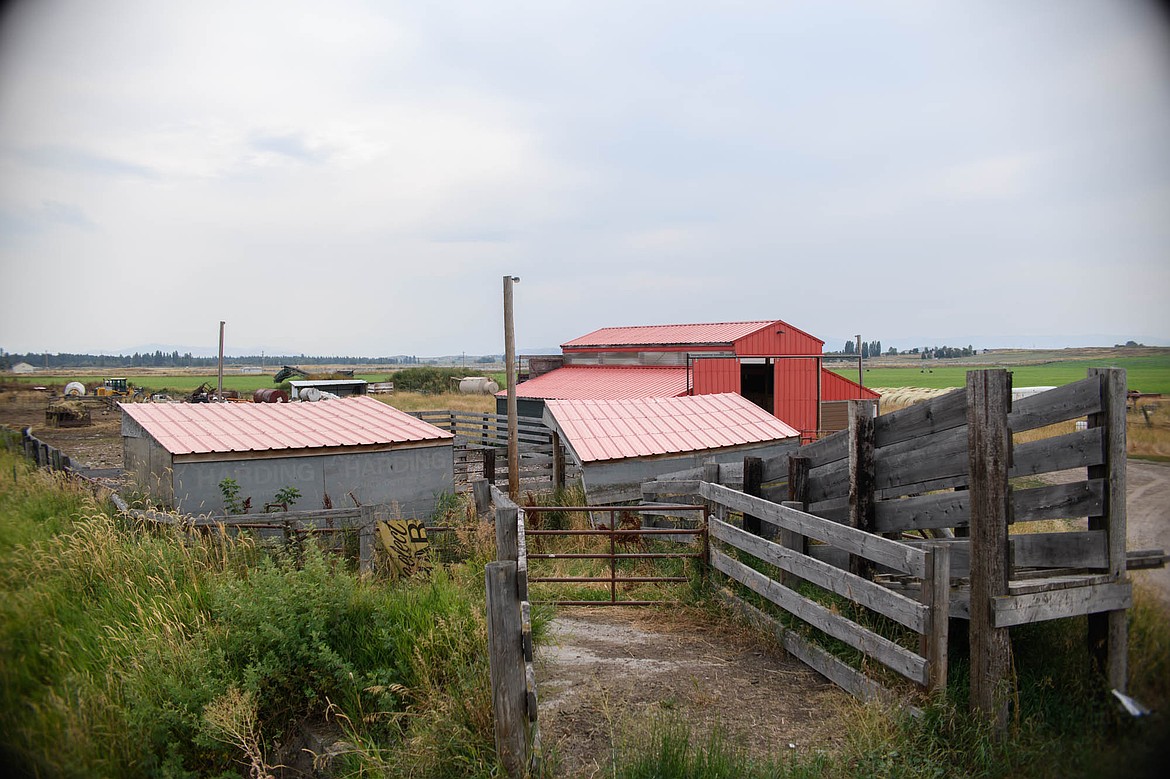
Trenton Harding's old ranch property on the corner of Division Street and Montana Avenue is the proposed location of the gravel pit in Pablo. (Emily Messer/Leader)
Emily Heimark (Messer) joined the Lake County Leader in July of 2025 after earning a B.A. degree in Journalism from the University of Montana. Emily grew up in the rolling hills of southeast Missouri. She's lived in Montana since 2022 and honed her reporting craft through the UM J-School newspaper and internships at the RMEF Bugle Magazine and the Missoulian. At the Leader, she covers government, business, education, agriculture and community news. Contact Emily Heimark at [email protected] or 406.883.4343 | September 17, 2026 12:00 AM
Pablo residents are raising concerns about the many problems a proposed gravel pit in their backyard may cause.
Last month, residents received public notice of the opencut mining permit application for the Harding Pit, filed by Mission Valley Concrete Industries. The proposed location is at the corner of Montana Avenue and Division Street in Pablo, about half a mile east of Highway 93.
The permit area covers 32 acres and, according to the letter residents received, is estimated to remove 750,000 cubic yards of gravel. The pit is estimated to operate for up to 14 years, with reclamation to be completed in the fall of 2040.
Pablo couple Justin and Sam Perkins have been elected by their neighbors to voice local concerns and have raised questions about dust and noise pollution, traffic, safety and water quality impacts, noting that Pablo has no zoning ordinances to prevent this within the townsite. During the public notice stage, the Perkins also voiced concerns that transparency and communication have not been executed well.
“We’re not really opposed to that [the gravel pit]. We’re opposed to the location of it, ” said Sam Perkins, who has friends and family who own property around the proposed location.
“There’s no noise ordinance, no quiet time. If this was a town, this wouldn’t be an issue because that never would have been zoned as commercial,” she added.
Noise is a major concern for these residents because Sam said Treasure State Concrete starts crushing gravel at 2 a.m., a noise that can be heard up to three-quarters of a mile away. Crushing gravel also raises concerns for local residents, as dust could affect those with respiratory issues.
“I’m not against small businesses. I’m not against people trying to make it. But this is not outside of town,” Sam said.
But Treasure State and Glacier Sand and Gravel are outside of town, she said. Another concern is traffic, safety, and the damage heavy trucks could cause to Pablo roads. The Perkins pointed out that Pablo already doesn’t have great roads, and adding this level of commercial traffic could make them worse, leaving them wondering whether the developer will contribute to road repairs.
While the truck traffic is slated to head up Division Street to Highway 93, the Perkins believe it will head in every direction from the pit, and the intended path will pass by a daycare, raising public safety concerns.
Pablo also has a high water table, meaning local ground wells are located at 20-25 feet, with some test wells at eight to 10 feet. This high aquifer also feeds the town’s water supply, leaving residents troubled about commercial equipment digging in the area.
The Perkins said they want to know the protocol if they hit groundwater while digging, because exposed water could become contaminated with bacteria, nitrates and other contaminants that could reach the aquifer.
According to the Perkins, many local residents have invested in the area by cleaning up their properties and upgrading their buildings, which has ultimately increased home values. However, a nearby gravel pit could reduce home values by 20-30%, prompting the Perkins to ask whether the developer will refund property owners for the depreciation.
The Tribes oppose proposed gravel pit
The Confederated Salish and Kootenai Tribes sent a press release on Friday, Sept. 4, to the Leader, stating that the Tribes opposed the opencut mining permit for this gravel pit, citing “concerns about potential impacts to groundwater, surface water, nearby homes, public water and sewer infrastructure and educational facilities.”
According to the press release, the Tribes recently received formal notification from WGM Group, acting on behalf of Mission Valley Concrete Industries. The site is about one-half mile from CSKT Tribal Headquarters and near Salish Kootenai College.
The release stated that after reviewing the permit, the CSKT Natural Resource Department identified “several concerns” regarding the location and its potential effects on water resources. The statement added that the application neither identifies nor addresses the shallow groundwater conditions in this area or potential impacts to water resources.
The press release further stated that the proposed pit overlies the shallow unconfined Mud Creek aquifer, which historic water quality information indicates has experienced elevated nutrient levels associated with surface activities. The Mud Creek aquifer also provides water that supports Stinger Creek, “an important water resource” that is associated with a rare wetland type extending across several hundred acres.
According to the press release, Stinger Creek is already identified as impaired, raising concerns about potential increased degradation.
“CSKT Natural Resources also identified concerns about the proposed pit’s proximity to the Pablo sewer retention ponds,” the press release stated.
The press release noted that, according to the application, groundwater levels are 11 to 18 feet deep. Depending on the excavation depth and groundwater conditions, “excavation could potentially alter localized groundwater flow between the retention ponds and the proposed pit.”
“The application identifies more than 138 affected landowners and entities in the surrounding area, including CSKT members and nonmembers, the tribal government, Lake County, Pablo Water and Sewer District, Ronan School District and Salish Kootenai College,” the press release stated.
In the statement, CSKT stated it is requesting a government-to-government consultation with the state regarding the project and that the CSKT Legal Department is also preparing formal correspondence from the Tribal Council outlining the Tribes' concerns.
The statement added that the tribes will continue to review the proposed project and to participate in the state permitting process to protect tribal resources and the interests of the surrounding community.
A public meeting
With various concerns about Pablo circulating, the Perkins said that, most importantly, they want community involvement and believe residents deserve to voice their concerns at a public meeting.
According to the notice letter from WGM Group on behalf of Mission Valley Concrete Industries, residents can request a public meeting through the Montana Department of Environmental Quality regarding this gravel pit. However, House Bill 599, passed in 2021, requires either 51% of homeowners in occupied dwelling units or 10 real property owners within a half-mile radius to file a request.
So far, the Perkins have confirmed they have requested a public meeting. All requests for that meeting must be filed by Sept. 26 and meet the 51% or 10 real property owners requirement for the public meeting to occur.
“We want to get that 51%. Obviously, that’s our goal so that we can sit down and have a conversation about it,” Sam said.
County Commissioner Gale Decker confirmed that the county had also received notice from the Department of Environmental Quality. He explained that the county has similar questions to those of the residents that weren’t addressed in the notification, which they are hoping can be addressed in a meeting.
“Gravel pits aren’t very popular among the general population; people have a lot of questions about them,” Decker said. “There’s probably a way to mitigate most of the impacts people are worried about.”
Decker noted that even if residents don’t reach the required percentage of homeowners requesting the DEQ public meeting, they still feel a public hearing is needed so the developer can address those concerns. This could possibly be a county-hosted meeting, but Decker said he is unsure how that process would play out.
Decker explained that the county has no authority to approve the proposed project because the state approves this type of operation.
Decker confirmed that there are no zoning districts in unincorporated towns that protect citizens from these types of development. He added that the county has about 14 districts surrounding Flathead Lake that prohibit gravel pit development.
Creating a zoning district for Pablo would be a citizen-led initiative, and the county would help facilitate it, he said.
Intention and operation
However, the developer, Trenton Harding, has much different operational plans that mitigate many of the concerns.
Harding inherited Mission Valley Concrete Industries from his father, who operated a similar business in the same Pablo area. Harding currently operates under that company name and does excavation work.
“I grew up in the sand and gravel ready mix world, and it was cool being able to see stuff like that as a kid,” Harding said.
The proposed site was previously a farm and ranch he operated with his father. Ranching has always been a hobby of his, and he has now sold off most of the cattle. He now produces 1,600 to 1,800 tons of hay from this land each year.
Harding explained that the idea for this gravel pit came after a recent cancer diagnosis. Although he is currently in remission, he is trying to provide for his family in case something happens to him. Although he has received offers for the ranch land, he doesn’t want to leave his wife having to sell the property.
He explained how his dad’s operation handled high truck traffic and said that what he is trying to do with this gravel pit is “substantially safer than that.” Harding said the operation will simply be a bucket in the ground, digging out gravel and loading it into a truck.
The operation will just be pit runs with no crushing, screening or washing of the gravel. This is largely due to the fact that equipment needed to crush gravel “costs a million and a half bucks.”
“You’d also need a million dollars in good loaders,” he said. “It's not washed. It's just gravel. It is the lowest impact that there is.”
Harding explained that he understands residents' concerns about the shallow aquifer in the area, but he completed test holes with his engineering firm, WGM Group, confirming that gravel is located from 16 to 18 feet, and he does not intend to go past that.
He said it is clay beneath that, and the gravel there is too compacted in the clay for him to use. Harding said they will not hit groundwater, and his permit says that he cannot dig into groundwater. He added that if they hit groundwater, he is required to cover it back up.
While this type of work still isn’t the quietest operation, Harding explained that berms around the property will reduce dust and noise, and that they will never excavate gravel at 2 a.m.
Harding said he is currently working with DEQ to address the truck traffic direction. As to public safety concerns, Harding said he has kids who go to school in the area, and he wouldn't do this if he thought traffic would put his children in jeopardy.
While he understands that 750,000 cubic yards sounds scary on paper, the pit is “insanely small” compared with other local pits owned by larger companies. He explained that he has no interest in competing with them and that a pit this small would not interest a company like Knife River.
“There’s simply no dollars in it,” he said.
He added that the required offsets also reduce the pit's size.
Harding added that he’s not interested in “poisoning any groundwater” because his crops depend on it. He intends to reclaim the pit as an alfalfa field to continue haying.
While it was not advised, Harding explained that he spent a lot of money on a reclamation bond because he wants to be a good neighbor and chose to take that burden on himself. He added that DEQ has many regulations he must follow, and the bond amount is set by DEQ.
Ultimately, Harding said he hopes this pit will create good-paying jobs for the community “that is in desperate need of good-paying jobs.”
“I want people who are employed by Mission Valley Concrete to be able to go take their family out to the Tailgate or Cheers for a burger after work,” he said. “This job is going to be able to provide that.”
He’s also hoping that a local source of gravel will help reduce construction costs, easing the burden of high housing costs.
Harding added that he’s a community member here who cares about the community. He’s donated gravel to the Boys and Girls Club in Ronan and is donating gravel to the new Pioneer Days rodeo grounds.
ARTICLES BY EMILY HEIMARK
Proposed changes to City of Polson government to appear on ballot
The Polson Local Government Review Study Commission completed its report earlier this year, and the proposed changes to the city charter and supplementary report of action to be taken will appear on the November ballot.

Native cowboy from Mission Valley travels to Kyrgyzstan for Nomad World Games
Reaching down from the back of his horse, he grabs the goat carcass, a total of 80 pounds of dead weight, as dust strikes him in the face; the adrenaline rush is never-ending, and the physical demands on his body are unreal.
Rollins Fire completes community-funded addition and remodel
After outgrowing its space, the Rollins Volunteer Fire Department sought support from the community and raised $2.2 million to fund necessary upgrades and a station addition.