
Guest Opinion: Fish and Wildlife Commission silences Montana voices
Josh Schott | Daily Inter-Lake | UPDATED 3 weeks AGO
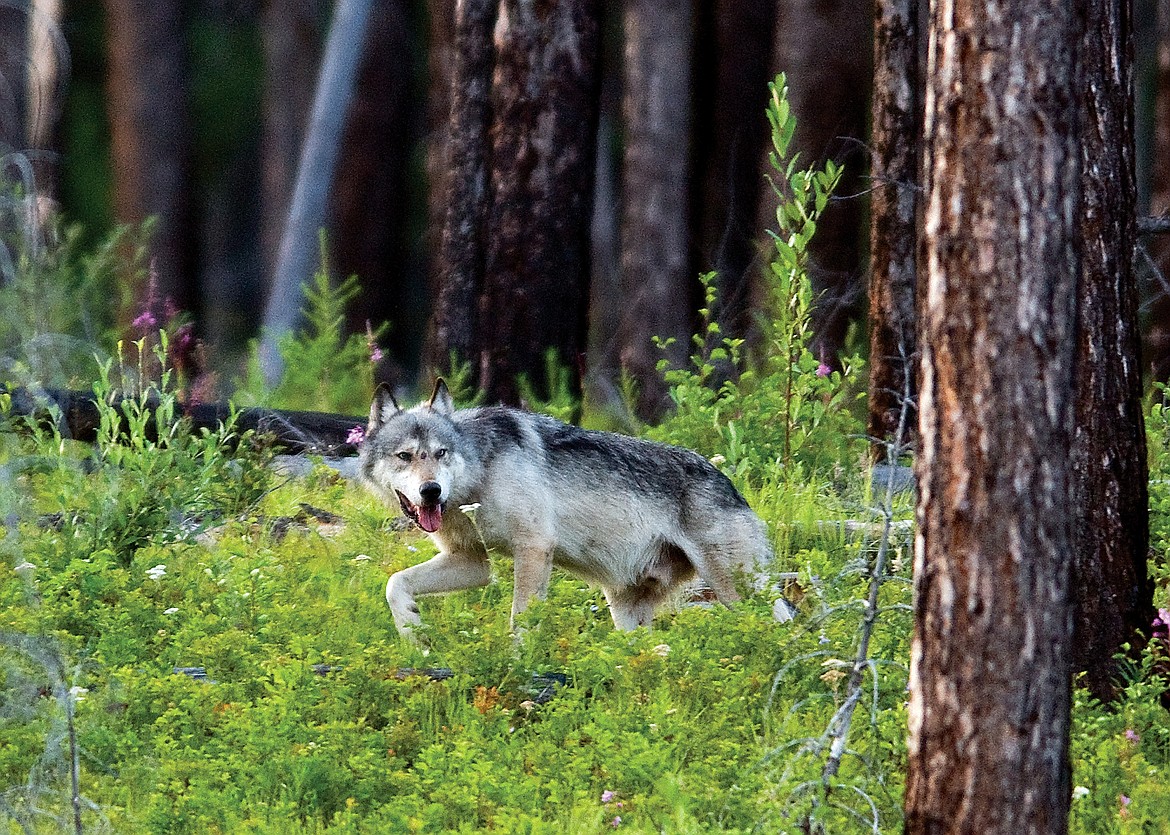
A gray wolf walks through the woods in Glacier National Park up the North Fork in this file photo. A new pack of wolves has been discovered on Apgar Mountain and may be the culprit in pet deaths across the river.
The Montana Fish and Wildlife Commission’s decision to allow the killing of 300 wolves — 50 more than Montana Fish, Wildlife and Parks recommended quota of 250 — does not represent the 74% of Montanans who believe wolves belong on our landscape.
The commission passed this much higher quota, despite 92% of written and spoken comments (2,019 people out of 2,203) speaking out against killing this many wolves, such as calling for a hunting/trapping moratorium or a significant reduction from the state's quota of 250.
The aggressive killing quota follows Fish, Wildlife and Parks admitting that the state’s model for estimating the wolf population — called Integrated Patch Occupancy Model — has vastly overestimated the number of wolves in the state for years. The state updated the same model to Integrated Patch Occupancy Model 2.0 and produced a new estimate of 725, which is 369 fewer wolves than Fish, Wildlife and Parks told the public last year.
Integrated Patch Occupancy Model 2.0 is not peer-reviewed and independent scientists still dispute the validity and accuracy of the model and the population estimate. Some of these scientists state that the population is closer to 400 wolves in Montana.
As a response to the public outcry, the commission actually increased the total quota by 50 through a last-minute amendment that was submitted after the comment period expired. Commissioner Ian Wargo, who proposed the last-minute amendment, said at the end of the meeting that “nothing that was said in comments would change anything.”
Wargo’s statement says everything about what he and the commission think about Montanans whose values, heritage and identity are deeply connected to the land, wildlife and our right to have a voice in how our wildlife is managed. We don’t matter and our voices won’t be heard.
When 92% of people voice their opposition to a proposal that the commission passes anyway, the state reveals that the “public participation process” is merely a performative sham meant to conceal the fact that a few well-connected fringe special interests set wildlife management policy behind closed doors. Year after year, the commission ignores the will of the people and silences Montanans at the cost of our most vulnerable wildlife.
The same study that showed 74% of Montanans believe wolves belong on our landscape and that only 36% tolerate wolf trapping also noted that the “minority of Montanans who have exceedingly negative attitudes towards wolves represent… an influential segment of the population.”
There are only 304 active wolf trappers in Montana, and fewer than 60 trappers were responsible for 41% (102) of the wolves killed last season. A practice two-thirds of Montanans reject accounts for nearly half of all wolves killed to satisfy the recreational pursuits of roughly 300 people. Therein lies the problem: A small, influential special interest group that is not representative of the larger population steamrolls the rest of Montanan voices.
I participated in the Aug. 19 commission meeting in Helena and witnessed how the entire framing, discussion and point of reference for making decisions solely centered the interests of wolf hunters and trappers. Non-consumptive economic considerations and broader conservation and recreational interests were not remotely included. They only fixated on how to kill the maximum number of wolves and how to make it easier for wolf hunters and trappers to do so.
The commission is tasked with maintaining healthy, resilient, connected, sustainable wolf populations capable of fulfilling their ecological role across Montana landscapes. Yet, their goal in practice has been to drive wolves to the brink of collapse.
This comes as no surprise based on the structure of the commission and wildlife management in Montana. The seven governor-appointed commissioners represent specific industries connected to the governor, such as livestock ranching, outfitting and hunting. None of the current commission members has a background in wildlife science or management, or represents broader conservation and recreational interests.
The commission and wildlife management decisions are supposed to represent all Montanans, but they actually only represent a few fringe special interest groups at the expense of everyone else. Montanans deserve better, the land deserves better and the wildlife deserves better. We have no choice but to overhaul the commission.
Montanans pride themselves on respecting and honoring the land and the wildlife that live on it. Hunters take that responsibility seriously and it shapes what it means to be a hunter in this state. Stewardship is not a partisan value here. It is the inheritance every Montanan shares.
The commission doesn’t uphold that inheritance. It reflects the influence of a handful of well-connected special interests who have captured this process, advanced over the objection of the overwhelming majority of Montanans. This is not hunters against wolf advocates. It is Montanans against a political machine that doesn’t answer to them.
Josh Schott is the Rocky Mountain coordinator for Team Wolf and is from Flathead County.