
Mid-century Moses Lake: A Decade of Transformation
Dollie Boyd/Contributed Report | Columbia Basin Herald | UPDATED 3 weeks, 2 days AGO
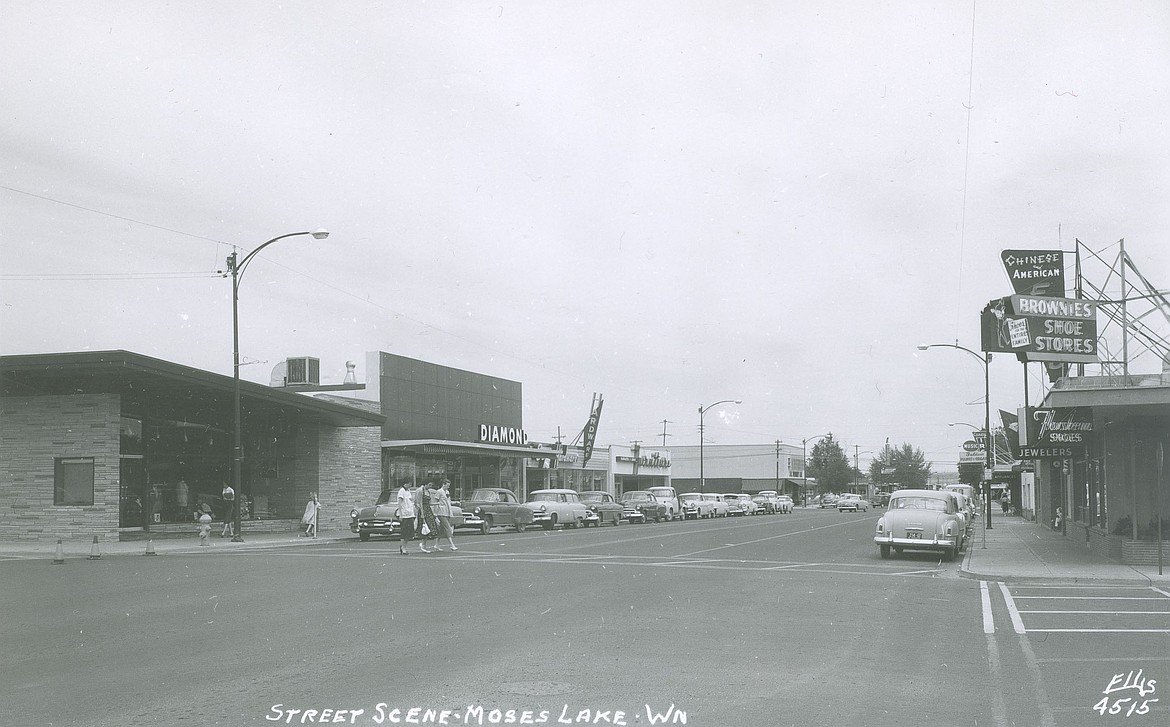
A mid-century shot of Third Avenue in downtown Moses Lake, taken by photographer J. Boyd Ellis. You can see the sign for Elmer’s Chinese American restaurant on the right side of the image.
COURTESY PHOTO/MOSES LAKE MUSEUM & ART CENTER
Moses Lake has a certain look. A short trip through our downtown business district and older, established neighborhoods reveals a great deal about the history of this place; the history is in the landscape, and mid-century architecture helps to tell our story.
Between 1950 and 1960, the population of Moses Lake grew 322 percent. To call those years a boom time is an understatement. The reason for such massive, explosive growth was the Columbia Basin Project, perhaps the most audacious public works project ever attempted. Water from the Project activated the rich soil in our region and changed Moses Lake forever.
The Project, put on hold during World War II, resumed full speed after the Allied victory. Test farms, new neighborhoods, and opportunities sprouted alongside potatoes and sugar beets. A May 1947 ad in the Herald proudly announced the completion of the first of 25 new homes in Knolls Vista. The ad invited the public to an open house to inspect the “homey, two-bedroom residence with garage attached and a full basement,” and announced the imminent completion of 24 other houses and the sale of 82 lots. Knolls Vista developers could see the future on the horizon.
The downtown corridor was developing too. Restaurants, drug stores, clothing and shoe stores, a photography studio, and more began to spring up on Broadway and Third Avenue. Finally, residents could purchase more goods and services in town instead of waiting for mail order or driving hours to another town. Longtime Moses Lakers have fond memories of fancy meals at Elmer’s Chinese American Restaurant, shopping at Dietzen’s Thriftway, and getting their picture taken at Hilderbrand’s Photography Studio.
Other neighborhoods sprouted from the shrub steppe. One of my favorite walks around town is through the Montlake neighborhood. Many of the houses there feature outstanding examples of mid-century modern design. Angular forms, dramatic roof lines, natural materials, and sparse ornamentation create clean lines warm organic feel indicative of the style. After decades of Depression, war, and deprivation, Americans were eager to look to an optimistic future. Adopting modern design for our homes and businesses telegraphed that upward momentum.
No discussion of the mid-century infrastructure of Moses Lake would be complete without mentioning the Moses Lake Public Library building. Its unique roofline, basalt-clad exterior and design touches inside and out make it an outstanding example of mid-century architecture. Since its opening in 1965 it has been a landmark on the downtown threshold and a prominent reminder of the importance of a literate, educated community.
Moses Lake in the mid-1950s was an American Dream town. The town played a crucial role in World War II, and returning veterans were drawn to the opportunities opened by the Columbia Basin Project. One article about the changes in the region stated that, “During the 1948 -1957 decade 770 new industrial establishments” were created in the Columbia Basin. Everything was on the rise in and around Moses Lake.
Not only was the look of Moses Lake changing during those years, but the population was changing too. New agricultural businesses meant more agricultural workers. Some of those workers had worked in the area previously under the World War II-era guest worker arrangement with Mexico commonly known as the Bracero Program. After the war, some braceros returned to put down roots, bringing friends and family with them. As early as 1945 Spanish lessons for businesspeople were being offered in Moses Lake.
Moses Lake’s mid‑century decade was more than a period of rapid expansion; it was the moment that defined our identity. The landscape, the architecture, and the people who arrived and put down roots all contributed to a legacy of resilience and reinvention. Today, when we admire our mid‑century homes, stroll through historic neighborhoods, or step inside the iconic library, we’re experiencing echoes of the optimism and ambition that shaped Moses Lake in the last century. I invite you to look at our town with fresh eyes, to remember this transformative era, and to appreciate not only how far we’ve come, but also how the spirit of possibility continues to guide our community forward.
Back in the Day appears bi-weekly and looks at the rich and sometimes little-known history of the Columbia Basin.