Montana grizzlies still making news
SCOTT SHINDLEDECKER | Hagadone News Network | UPDATED 3 weeks AGO
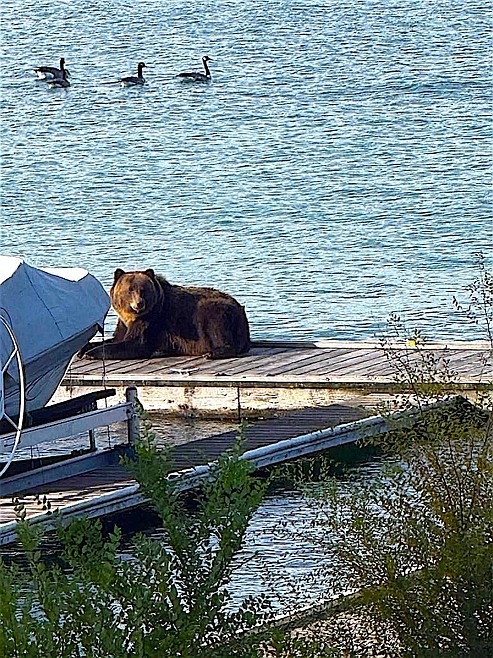
A grizzly bear rests on a dock in Polson Bay. (Photo courtesy CSKT)
Montana’s grizzly bears continue to make headlines as encounters and sightings occur across the state.
It appears that the grizzly bear recently seen near Libby in the Parmenter Creek Road area may still be in the neighborhood. A Libby resident who lives in the general area told The Western News a bear was seen on her brother's game camera at 11:13 p.m. Saturday, Sept. 19. She said her brother uses game cameras to monitor his cows and chickens.
She wasn't sure if it was the same bear, but it appeared to be a grizzly.
"It doesn't seem interested in the cows or chickens, but it still seems to be around," she said.
A recent sighting in Polson along with an attack and cattle depredation near Augusta sent social media users into an uproar.
While the Mission Valley and its nearby mountain range has been home to grizzlies for centuries, two grizzlies were seen swimming in Polson Bay and lounging on a dock near the Polson Bay Golf Course residential area.
The Confederated Salish and Kootenai Tribe Division of Fish, Wildlife, Recreation & Conservation shared photos Sept. 19 on its Facebook page of the bears.
According to tribal officials CSKT game wardens and wildlife biologists, along with a Montana Fish, Wildlife and Parks biologist and the Polson Police Department, responded and trapped one of the bears. That bear was relocated and officials said the second bear appeared to have left the area.
Meanwhile, a griz attacked a bowhunter Sept. 14 on state trust land along Elk Creek near Haystack Butte, southwest of Augusta.
The hunter sustained significant but not life-threatening injuries.
Bear hair on the victim and tracks at the scene allowed investigators to determine the animal was a grizzly. They also located the carcass of a domestic cow they suspect was killed by a bear about 150 yards from where the attack occurred.
One day later, a female grizzly bear was euthanized Tuesday evening southwest of Augusta due to livestock depredation. The bear, which didn’t have any cubs, was feeding on a dead cow on state land about three miles from where the archery hunter was attacked. A total of three cattle carcasses were found in the area and all were determined to have been killed by a grizzly bear.
The decision by the U.S. Fish & Wildlife Service to euthanize the bear at the site was in agreement with the United States Department of Agriculture – Wildlife Services and FWP.
It is unknown if the euthanized bear is the same bear involved in the human attack, but due to the surprise and defensive nature of the encounter, no further action will be taken to locate the bear.
Access to the state-owned land from the Elk Creek Road remains closed for the time being due to the cow carcasses remaining in the area.
Last month in Idaho, a grizzly bear was reported getting into chicken coops and killing chickens in the North Bench area of Boundary County.
In a Facebook post Aug. 13, Boundary County Sheriff Travis Stolley said the bear was reported near Juneberry and Holmes roads, just over nine miles north of Bonners Ferry.
Grizzly bears in Montana and Idaho are federally protected under the Endangered Species Act, so any management action is done in consultation with the U.S. Fish and Wildlife Service.
State officials offer the following tips:
- Pack meat out as soon as possible.
- Avoid cutting up carcass at dusk or night. If you kill an animal at dusk, be prepared to cut up the carcass in the dark by carrying strong headlamps. Be extra vigilant and watch for bears.
- Properly hang meat until you can retrieve your downed game.
- If you must leave your animal, return to the site carefully. Leave it in an area that is easily observable from a distance.
- Drag gut piles into open areas, if possible, and at least 100 yards from your carcass as soon as possible.
- If a bear has claimed your animal, do not attempt to haze or frighten the bear away. Report any lost game to FWP.
- Bird hunters should be extra careful while walking in and along areas of brush, especially along waterways. Grizzly bears use thick cover for day beds. Walk with the wind, carry bear spray, and keep a close eye on hunting dogs. If there is abundant fresh sign of grizzly bears in the area, consider bird hunting somewhere else.
For issues in a neighborhood, officials suggest the following:
- Storing and removing attractants, such as grain spills, food waste and scented products, reduces the likelihood that bears will learn to associate buildings, silos and humans with food sources.
- Do not leave out pet food or livestock feed, such as grain, sweet feed, or supplements.
- Secure chemicals such as pesticides, herbicides, biodiesel and other products.
- Many attractants can be secured in a hard-sided building. Locks can easily be added to any door with a hasp, padlock or carabineer. Screws or nails protruding out from the door can deter a bear. An unwelcome mat (piece of wood with nails facing up) can also deter a bear.
- Install electric fence (PDF) around vulnerable animals and non-removable attractants such as birthing grounds, sheep-bedding areas, bee aviaries, compost piles, gardens, fruit trees, berry bushes and corn fields.
- Creep feeders, molasses and mineral blocks should be placed in open areas where livestock can easily view the area before entering. Placement away from brush decreases the chance of livestock loss and reduces the chance of a bear using these products.
- Don’t let grizzly bears linger in your yard because this can lead to habituation.
- Notify your neighbors if you do observe a grizzly bear in the area to help make others aware.
ARTICLES BY SCOTT SHINDLEDECKER

Second Amendment on display at Libby gun show

Jury says Stryker man guilty of child abuse