
U.S. government files CFAC consent decree, governor visits
By CHRIS PETERSON and HAILEY SMALLEY Hungry Horse News | Hungry Horse News | UPDATED 2 weeks, 5 days AGO
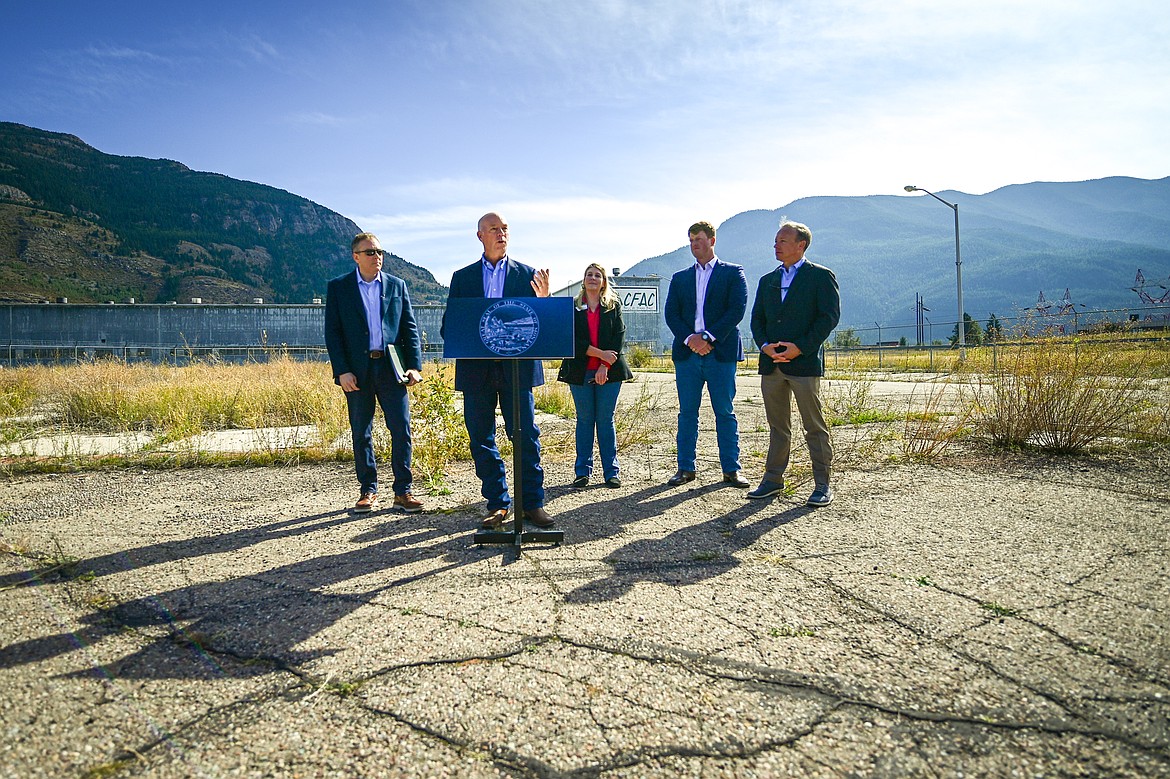
Gov. Greg Gianforte speaks at a press conference held after touring the Columbia Falls Aluminum Company superfund site with Environmental Protection Agency Administrator Lee Zeldin, left, in Columbia Falls on Thursday, Sept. 17. (Casey Kreider/Daily Inter Lake)
Casey Kreider
The U.S. government on Aug. 31 filed an unopposed motion in federal court in Missoula to enter a consent decree for the cleanup of the former Columbia Falls Aluminum Co. site.
Meanwhile, Gov. Greg Gianforte visited the site last week.
The decree is one of the last steps in the Superfund process and will be examined and ultimately approved by District Court Judge William Mercer.
It marks the final legal step in approving the cleanup plan for the site, which includes building a “slurry wall” underground around the west landfill and wet scrubber sludge pond to contain cyanide and fluoride that have been leaking into the groundwater for more than 30 years.
If the wall, which will be about three feet thick and more than 100 feet deep does not work, the company will be required to build a facility that will pump and treat the groundwater on site.
In addition, about 57,500 cubic yards of contaminated soil at the site will be moved to the West Landfill, as will about 35,000 cubic yards of soil from the percolation ponds.
The site includes seven closed lands, one open landfill leachate ponds, percolation ponds, and several buildings.
CFAC has agreed to pay the Environmental Protection Agency $1.8 million in past costs associated with the site analysis and will pay $57.634 million for the actual cleanup, though the Atlantic Richfield Co., under a previous court settlement, will pay 35% of that cost.
If the EPA has to take over the cleanup, CFAC additionally agrees to pay a penalty of $750,000.
The company has also agreed to reimburse the state of Montana for expenses related to the Superfund process as well.
The plant was placed on the National Priorities List on Sept. 9, 2016. It’s been 10 years and several studies later to get to this point. The plant was originally built by the Anaconda Aluminum Co. In 1955 and was added on in 1966. It was a major employer and was once the largest building in Montana.
The main plant was torn down in 2016 and ceased operation in 2009, though didn’t shut down officially until 2015. The entire site is about 1,350 acres, though the landfills and actual cleanup area are much smaller, about 200 acres.
CFAC owned more than just the cleanup site and sold 2,300 acres to developer Mick Ruis, who has already started work on a housing subdivision east of the plant. The EPA signed off the subdivision, saying tests show that the 76 acres that the housing is being built on are not contaminated.
Company officials endorsed the consent decree in public comments. In exchange for paying for the cleanup costs, the U.S. government agrees not to sue the company under Superfund law.
The only other public comment came from a local group of citizens called Coalition for a Clean CFAC. While they said in a Aug. 3 letter they looked forward to the conclusion of the consent decree, they also had concerns about specifics about long-term monitoring and maintenance, long-term financial assurances and discovery of any new hazards.
It isn’t known how long it will take Mercer to sign off on the agreement.
“While I’ve had the chance to visit a lot of Superfund sites, I have to tell you that some are facing what will likely be decades of work and, really, never-ending work,” Environmental Protection Agency Administrator Lee Zeldin said at the conclusion of a Sept. 17 tour of the CFAC site. “Fortunately, we are at a very important milestone moment here in Columbia Falls, where there is just so much incredible progress imminently ahead on this project.”
Gianforte accompanied Zeldin on the tour, along with about a dozen employees from the federal and state environmental agencies and proxies from the offices of Rep. Ryan Zinke and U.S. Sens. Steve Daines and Tim Sheehy.
The first leg of the cleanup, excavating an estimated 67,500 cubic yards of soil contaminated by arsenic and other potentially harmful materials, will likely be completed this month, EPA Remedial Project Manager Allie Archer said.
“You’re going to see some of that cleanup in action,” she told tour participants. “There are areas of the site where the top two feet of soil were identified to have elevated contaminants. We are currently in the process of cleaning up that contamination and disposing of it on-site in the landfill.”
Several pre-existing landfills are expected to receive improved caps and soil covers by the end of October 2026, which will prevent potentially toxic refuse from leaching into the nearby environment and minimize the potential for human or animal exposure.
The slurry wall barrier will likely be completed by 2029, marking the conclusion of the cleanup effort. Long-term monitoring, including regular groundwater sampling, will continue to ensure all the landfill caps and the slurry wall remain effective.
Columbia Falls Aluminum Company will retain ownership of 200 acres of remediated land, including the former landfills and sludge pond, into perpetuity. The sheer amount of spent potliner in that area means the land and underlying groundwater will likely never be considered safe for other uses, Archer said.
“There is unlimited amounts of [cyanide and fluoride contamination] right now because of how prolific this operation was,” Archer said. “So that [contamination] will remain there, but it will no longer be picked up through groundwater and move. It’ll just stay owned by Columbia Falls Aluminum Co. forever in that spot.”
“During our visit, it was great to hear about the future plans to redevelop this site, initially for residential and other uses later on, and I look forward to seeing this continued progress,” Gianforte said in his remarks following the site tour. “Montana Department of Environmental Quality couldn’t do this alone. With the help of our federal partners at the Environmental Protection Agency, we are taking clear and decisive action to return this site to productive use.”