
Local CEO uses her values to empower young Native students
EMILY HEIMARK | Hagadone News Network | UPDATED 1 month AGO
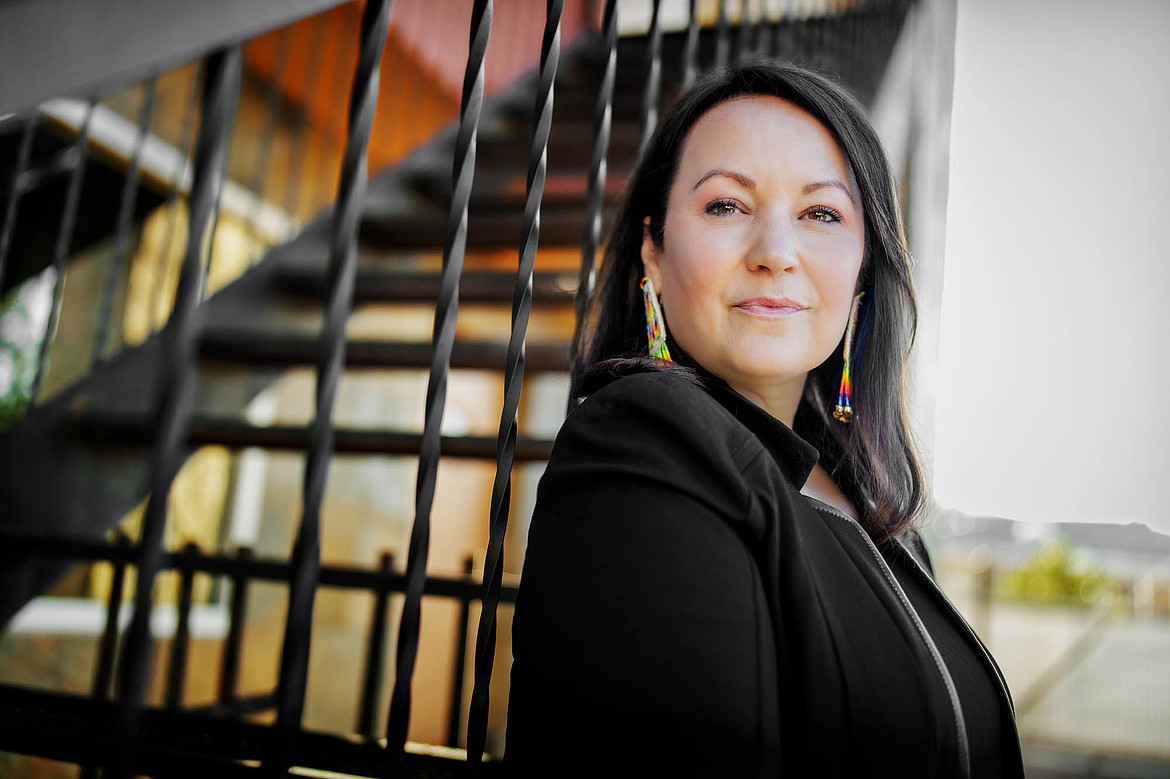
Angelique Albert has pushed Native Forward to new milestones, empowering Native students nationwide. (Photo courtesy of Native Forward Scholars Fund)
Emily Heimark (Messer) joined the Lake County Leader in July of 2025 after earning a B.A. degree in Journalism from the University of Montana. Emily grew up in the rolling hills of southeast Missouri. She's lived in Montana since 2022 and honed her reporting craft through the UM J-School newspaper and internships at the RMEF Bugle Magazine and the Missoulian. At the Leader, she covers government, business, education, agriculture and community news. Contact Emily Heimark at [email protected] or 406.883.4343 | September 24, 2026 12:00 AM
Native Forward Scholars Fund CEO Angelique Albert was recently named on the Forbes' 2026 50 Over 50 list, but Albert explained that she did not receive her education to succeed as an individual; rather, she did it to serve her community and tribal communities on a broader scale.
“It’s an honor to be recognized at that level,” Albert said. “More importantly, what it means to me — it means visibility. It means representation.”
Albert explained that anytime Native people gain visibility, it’s important because that’s something missing in the world.
“Native people are often misrepresented, and it’s important that we come out and show our success,” she said.
She said this isn’t just about representation for herself but about the success and impact of Native Forward, which speaks for itself.
Native Forward is a nonprofit organization that awards scholarships to tribal citizens pursuing undergraduate, graduate and professional degrees. Albert has served as CEO for the past nine years and, during her tenure, has tripled the number of students it serves annually, with Native Forward has awarded $400 million in scholarships to more than 20,000 students from 500 tribes across the United States.
Albert said the organization recently reached a milestone, pulling in $252 million in revenue since she started, more than the $209 million it brought in over the past 47 years.
A foundation in community
Albert was born and raised on the Flathead Reservation and is a member of the Confederated Salish and Kootenai Tribes. Although Albert has lived elsewhere, she is proud to call Pablo her home base.
Albert attended the Ronan and Polson School Districts before enrolling at Salish Kootenai College. She earned two associate degrees and a bachelor's degree from SKC, then completed her master’s at Gonzaga University. She also earned two executive certificates from Dartmouth, a certificate from Boston College, and an honorary doctorate from Gonzaga.
She explained that she knew education was important from a young age, but so were the values she was taught — a commitment to serve her community.
When asked how growing up in this community shaped her as a leader, Albert said that being part of a Native community is the most important thing to her.
“I am a product of this community, and it is one of the most important things to me,” she added. “I am a product of the public school system.”
When thinking of community, she also thinks of family. She explained that her father is French and Norwegian and the most loving person “you could ever meet.” Her mother is Salish and Kootenai and is a strong, resilient woman, and a product of systems and structures that worked against her.
“I feel such a sense of pride and connection to this community because it is a number one value system for us as Native people that we function in community with one another,” she said.
From a young age, she also witnessed leadership, seeing women lead politically on the tribal council and strong men lead at the federal level.
“I went to council as a young nobody; they showed me such kindness and support,” she said. There's a sense of pride in my tribal leadership and gratitude for having such strong role models.”
She added that she's proud of the strong CSKT that has continued to invest in the environment, education and business, and that she’s grateful to have raised her children here on the reservation.
“I'm a product of this community because that's the way I was raised,” she said. “I am who I am because of this community, and I live my life every day in service.”
SKC gave her the skills to put her values into action and serve others. Albert said she’s thankful for the culturally congruent education SKC provided.
She added that SKC gave her what boarding school took away from her grandfather: access to brilliant teachers and instruction in her Native language and hymns, along with the reservation's history.
She explained that it’s not just education; SKC also serves as a community center.
“Having that feeling of connection to the people here in my community is important to me, and I wouldn't be where I am without their support,” she said.
Before her time at Native Forward, Albert returned to SKC and served as the executive director of the Salish Kootenai College Foundation for five years. She noted that returning to a space where she received so much felt good, and she was glad to contribute in that capacity.
She added that with Native Forward, she gets to continue serving the SKC community.
Native Forward impact
Albert joined Native Forward when the organization thought it was struggling to find funding streams and might close its doors. Now achieving milestones under her leadership, Albert attributes that to “having strong, educated Native people who are mission-driven and committed to providing access to higher education to Native students across the country.”
“It’s not just my leadership, but this is what happens when you put authentic education into the hands of Native people,” she said.
Albert added that there were also pivotal moments when partners and people believed in and invested in the organization, including a $20 million gift in 2020 and a $50 million gift last year from MacKenzie Scott.
“Whenever you have large investments like that, you can really work on building infrastructure and stronger stability for the organization,” she said. “For us, we built a very strong strategy with that first funding.”
That allowed them to take the full amount of Scott’s second gift to fund scholarships, which will fund 1,000 additional students each year.
Native Forward’s main funding stream comes from one federal grant and budgeted federal funds, which are a part of treaty obligations to educate Native people. But most of its funding comes from donations from individuals, foundations and corporate partners. Without those partners, their work wouldn’t be possible, Albert said.
Albert explained that their average scholarship is $10,000, which doesn’t cover the full cost of education, and it’s been critical for the organization to really understand what a current Native student’s college experience looks like to help fill the gaps.
She said these students still face barriers, largely related to affordability. That's why Native Forward has recently created wraparound services for students they fund, including an emergency fund and staff who check in on students and help them navigate tutors and financial aid.
Albert added that they have 22,000 alumni across the communities they serve, and they can connect with students through these alumni or through relationships they have built with tribal colleges and mainstream universities.
The organization has also created 50 different scholarship funds, compared to the eight or 10 they had when she started.
However, Albert notes there is still more work to do, as they can only provide scholarships to 2,300 students who applied last year, which means 11,000 denials.
Albert explained that there is still a disparity in the number of Native people who can get an education, and currently in the country there is a 45% decline in Native people attending college in the past 13 years.
“That is astronomical,” she said.
“It's not all sunshine and rainbows. We can pat ourselves on the back and be proud of the work we've done, and of our collaborative partners who have helped us do that work,” she said. “But there's still so much work to be done because I don't like sending out 11,000 denial letters to deserving students.”
Montana is typically within the top seven states where students receive funding from Native Forward, meaning millions of dollars pour into the “Montana economy through education,” according to Albert.
She added that 30% of that goes to CSKT members and 20% goes to SKC students. Albert said Native Forward’s goal is not just to fund undergrad degrees, but to fund students seeking master's degrees and PhDs. At SKC, the organization has funded an entire cohort of language educators.
While college enrollment has declined, Albert said she encourages anyone considering higher education to pursue it because “it has transformed my life.”
“With every degree, more doors have opened,” she said. “And it allows us as Native people to not only be in spaces where we can have influence, but to create spaces that are aligned to us as Native people.”
Albert explained that 75% of applicants deserve the scholarship, but she strongly suggests strong letters of recommendation because they help applicants score better on the rubric and can be the differentiating factor. To learn more and apply, visit www.nativeforward.org.
ARTICLES BY EMILY HEIMARK
Proposed changes to City of Polson government to appear on ballot
The Polson Local Government Review Study Commission completed its report earlier this year, and the proposed changes to the city charter and supplementary report of action to be taken will appear on the November ballot.

Native cowboy from Mission Valley travels to Kyrgyzstan for Nomad World Games
Reaching down from the back of his horse, he grabs the goat carcass, a total of 80 pounds of dead weight, as dust strikes him in the face; the adrenaline rush is never-ending, and the physical demands on his body are unreal.
Rollins Fire completes community-funded addition and remodel
After outgrowing its space, the Rollins Volunteer Fire Department sought support from the community and raised $2.2 million to fund necessary upgrades and a station addition.